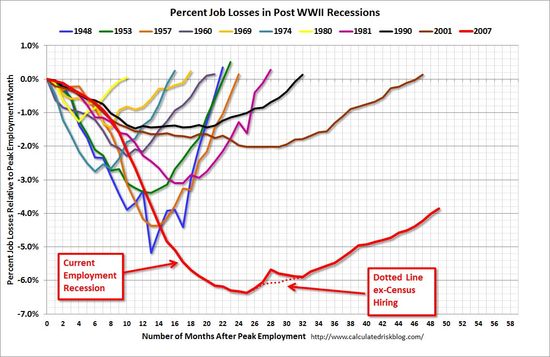
Felix Salmon begins to relax:
At this point, if we have a weak month between now and the election, it’s going to be the bad figure which looks like an aberration: only a sequence of two or three consecutive weak payrolls reports will really convince economists and the market that the recovery is going off the rails. It’s taken far too long to get here, but we’re finally moving in exactly the right direction, at an eminently healthy clip. Or, to put it another way: you can start breathing easier again, come the first Friday of the month. All those good job numbers were real, after all.
Jared Bernstein is more cautious:
So has the GDP expansion that began in mid-2009 finally reached the job market? Have we achieved lift-off, escape velocity–is a self-sustaining virtuous cycle underway? Unfortunately, those are questions that are tough to reliably answer in real time. I will assert that while existing threats–Europe, oil/gas, fading stimulus–could all knock some growth out of the economy in coming months, they’re unlikely to do more than that. The economic bicycle has enough momentum not to keel over, even if it hits a bump. But it’s still plodding more than speeding and it will still take many months–years even–to make up lost ground.
Yglesias focuses on the revisions:
Today's new jobs news is not as good as I'd hoped, but the addition of 227,000 new jobs is still a sign of an economy that's on track for growth. An interesting tidbit is that there was very good news in the revisions which added 20,000 December jobs and 37,000 January jobs. I note that this means that the total level of employment is basically where it would have been had we done no revisions but my 285,000 jobs forecast for February had come true.
Peter Boockvar takes a longer view:
Bottom line, the job gains were good not great with the 12 month average now at 168k.
Brad Plumer explains why good isn't good enough:
The U.S. economy still has a ways to go. Right now, we’re adding around 250,000 jobs per month. If that trend keep up, it’s enough to get us to 8 percent unemployment by election day. That would bode well for President Obama’s reelection chances. But 8 percent unemployment is still unnervingly high. As the Hamilton Project has found, at the current pace we won’t bring back all the jobs lost from the recent recession until sometime around 2020 or so. A separate analysis from the Economic Policy Institute, which used different assumptions about labor force growth, argued that it would be closer to 2018. Either way, a long time.
Chait considers the political implications:
This remains a divided country, and the floor beneath both parties is high enough that a Johnson 1964 type blowout remains almost inconceivable. The divided nature of the electorate means that the race is always going to be within the range that a major event could flip the standings. And there’s enough time until the election that any number of events could come along to change it. But as boring as it can be to defend conventional wisdom, the conventional wisdom has changed because the facts have changed. Obama was positioned to lose his reelection last summer fall. At the moment, he isn’t.
(Chart from Calculated Risk)
 The Dish
