The rise of factory baking:
Buying pre-wrapped bread, consumers were forced to evaluate a product under sensory deprivation—it’s next to impossible to effectively see, touch and smell bread through a wrapper. "Softness," [Aaron Bobrow-Strain, author of White Bread: A Social History of the Store-Bought Loaf] writes, "had become customers’ proxy for freshness, and savvy bakery scientists turned their minds to engineering even more squeezable loaves. As a result of the drive toward softer bread, industry observers noted that modern loaves had become almost impossible to slice neatly at home." The solution had to be mechanical slicing.
Elsewhere, Bobrow-Strain assesses the role of enriched white bread during World War II:
The secret of Germany's "husky soldiers" was its "excellent dark loaf"; the great resilience of Russia was its stubborn rye bread. France, on the other hand, a nation of puffy-white-bread eaters, had folded. What would become of the United States, where people simply would not eat whole wheat? Despite hopeful slogans like "America's Bread Front Has Never Failed," war planners were worried. Something had to be done, but what?
By 1943, this question had been decisively answered. The country would repair its broken staff with synthetic enrichment, the universally mandated addition of thiamin, niacin, iron, and, later, riboflavin to flour and bread. For war planners, synthetic enrichment was the only "realistic" way to improve the nation's health in a hurry.
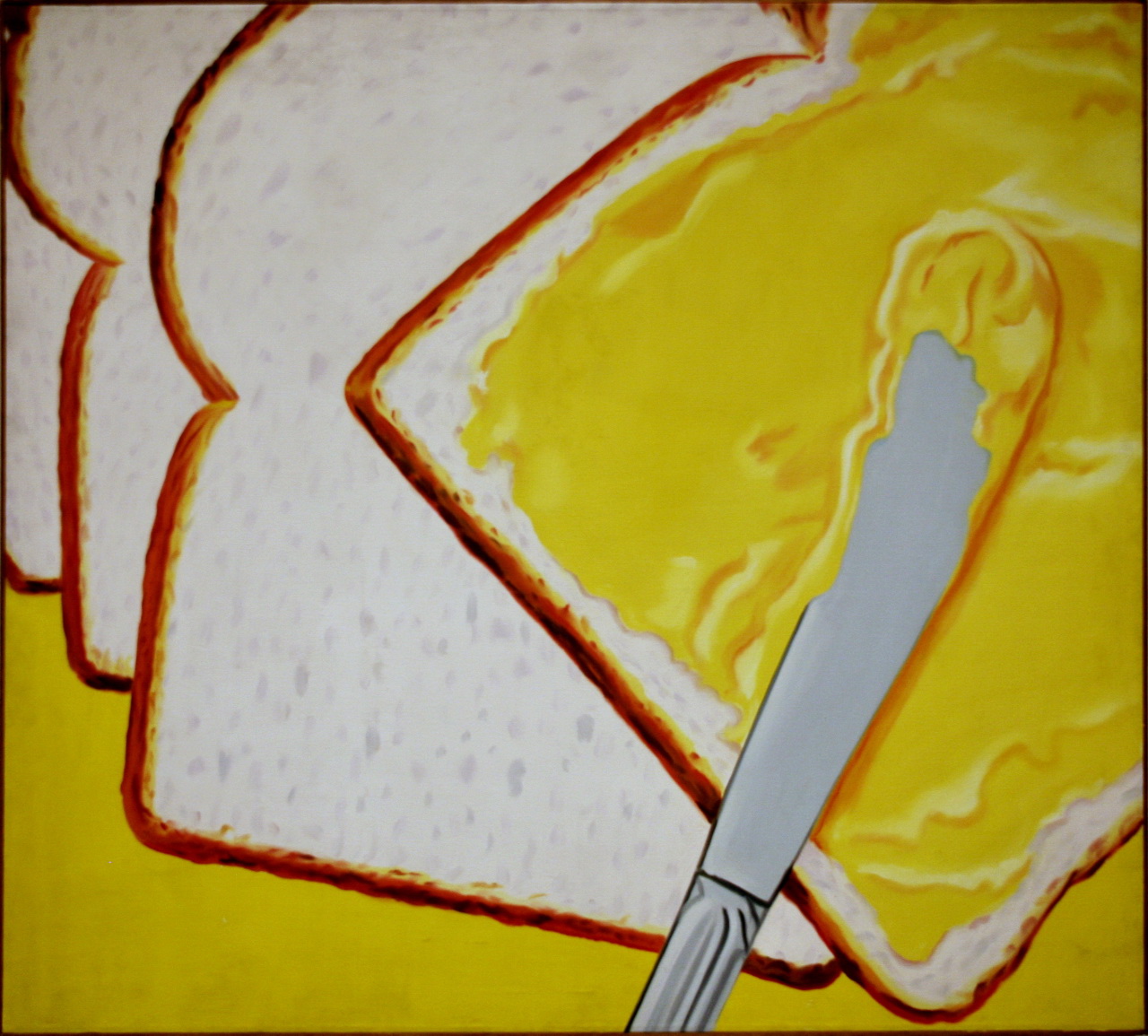
("White Bread," 1964, oil on canvas by James Rosenquist)
 The Dish