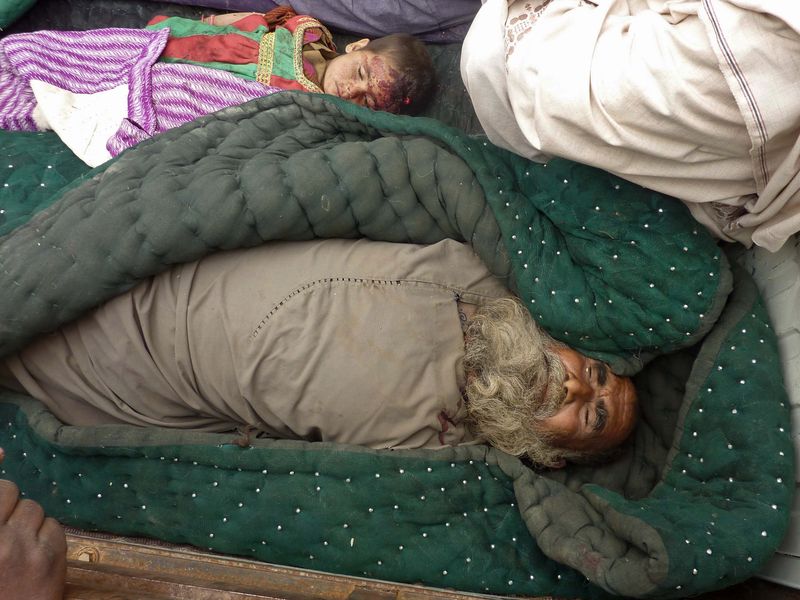
Jennifer Rowland has a good roundup of reporting on the slaughter of Afghan civilians by a deranged American soldier in Panjwai province. A depressed Jeff Emanuel decries the murder:
The effective but controversial tactic of night raids was already a very touchy subject both among the Afghan population and in negotiations between the U.S. and Afghanistan over the post-2014 coalition presence. This one-man ‘night raid’ that left sixteen civilians dead not only adds to that issue, but also takes away significantly from Afghans’ ability to trust coalition troops with their lives and their security. Absent any clear larger goals in Afghanistan, it has to be fair game to ask what ISAF’s purpose in that country is if its ability to secure and protect the general population has been irrevocably compromised.
Carl Prine fears rioting:
We likely shall see the Taliban and other anti-government forces escalate the demonstrations because they’re a handy tool used to discredit the Karzai regime and the US-led coalition. There likely will be spontaneous protests in many parts of the nation, including the Kandahar we’ve screwed down by massing troops there, but those won’t be the interesting ones. I’ll pay more attention to those that appear to be orchestrated by the cadre of the various Taliban networks in the rest of the country, including Kabul. I suspect that these likely will be led by the one militia with a uniquely honed ability to wield violence and protest theatrically to psychologically addle the government elites and the urban masses. Which is to say, the Haqqanis.
Ed Morissey nods:
[T]his will make the Koran burnings look like an Occupy protest.
David Axe thinks "the fallout from the Sunday killings could be greatest in the villages that are most vital to NATO’s endgame strategy:"
The Army, the Pentagon, the NATO International Security Assistance Force and U.S. President Barack Obama all denounced Sunday’s killings and vowing to investigate. But the official apologies may be too late to save the decade-long NATO-Afghanistan alliance, already damaged by the Koran burnings, the 2010 “sport hunting” of Afghan civilians by rogue U.S. troops (reportedly from the same base as the alleged Panjwai killer), errant NATO air strikes that have killed thousands of innocent Afghans over the years plus countless minor acts of cultural cluelessness that have slowly poisoned relations between Afghans and their supposed foreign allies.
David Dayen differs somewhat:
I actually disagree with the idea that this attack represents a turning point. Maybe historians will read it that way after the US withdraws. But the truth is that the policy reality dictated a withdrawal a long time ago. We have no strategic value in continuing to occupy Afghanistan, in support of a corrupt government that has no legitimacy in the countryside. And the American public actually knows this.
Steve Hynd worries about justice for the dead:
Given the way in which casual killing of and pissing on the dead bodies of Afghans has been lightly treated by US military courts in the past, I won't hold my breath that this murderer will be treated any differently. The US and its allies have become like a husband who says its all for her own good, while poor wife Afghanistan has all the bruises.
David Sanger focuses on negotiations with the Taliban:
[B]oth in Washington and Kabul, some American military and civilian officials acknowledged that the events would embolden the hard-liners within the Taliban, who oppose negotiations with a force that is leaving the country anyway and who want to use the next two years to appeal to the understandable national allergy to foreign occupation.
Bruce Riedel also watches the peace talks:
Iran and Pakistan will stoke anti-Americanism. Pressure will build in Europe and America to withdraw faster from the Afghan war. With the anti-war socialists likely to win the French elections, we can anticipate at least one major NATO ally pulling out this year. But there are also significant indicators that the Afghan Taliban and their Pakistani patrons are more interested in a negotiating process than ever before. The Taliban has agreed to open an office in Qatar to facilitate talks and to allow five Taliban prisoners in Guantánamo to be transferred to Qatari control. It did not renounce the negotiations over the Quran crisis. If it does the same now—denouncing the killings but not renouncing talks—it will be a sign they are determined to pursue negotiations.
Jon Lee Anderson recalls a conversation he had with Mullah Zaeef, "a former senior Taliban envoy and post-9/11 Guantámano inmate":
[ Zaeef] smiled tartly, and said that the only possible thing that the Taliban might be willing to talk about with the Americans and their allies were the terms of their complete withdrawal from the country. Such an agreement could determine whether they were able to leave Afghanistan with some semblance of dignity, or not, he said.
Paul Pillar steps back:
The only appropriate policy response to these developments is to press ahead with military disengagement from Afghanistan. The Western mission already has become very hard to perform, and there are bound to be more incidents that will make it even harder.
My reactions from yesterday here and here.
(Photo: The bodies of an elderly Afghan man and a child are pictured in Alkozai village of Panjwayi district, Kandahar province on March 11, 2012. An AFP reporter counted 16 bodies — including women and children — in three Afghan houses after a rogue US soldier walked out of his base and began shooting civilians early Sunday. NATO's International Security Assistance Force said it had arrested a soldier 'in connection to an incident that resulted in Afghan casualties in Kandahar province', without giving a figure for the dead or wounded. By Mamoon Durrani/AFP/Getty Images.)
 The Dish