Amrit Dhillion disses the idea that India is going to be the world's next great power:
While the rich consume luxury goods and the middle class buys fancy cars and gadgets and holidays in Bangkok, they blind themselves to the reality for 700 million or so immiserated Indians. In their vainglorious dinner-table talk about ''superpower'' status, they forget that a country that cannot meet a poor person's most basic needs – enough food, clean drinking water, and electricity – has no business aspiring to superpower status.
Shashi Tharoor counters:
India expresses itself in many ways. Its strength is that it has preserved an idea of itself as one land embracing many – a country that endures differences of caste, creed, color, culture, conviction, costume, and custom, yet still rallies around a democratic consensus.
That consensus is the simple principle that, in a democracy, it is not necessary to agree – except in terms of how to disagree. The reason that India, despite predictions of its imminent disintegration, has survived the stresses that have beset it during more than six decades of independence, is that it has maintained a consensus on how to manage without consensus. This is the India that Mahatma Gandhi fought to free, and its turbulent politics is well worth celebrating.
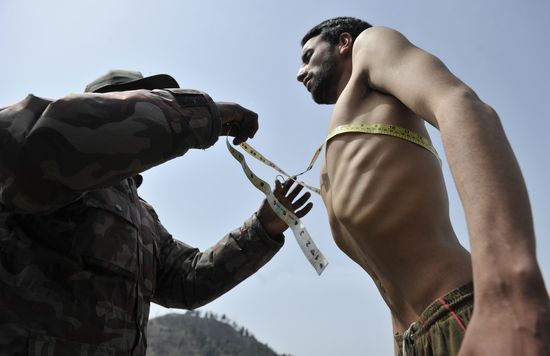
(Photo: An Indian army officer measures the chest of a Kashmiri youth during a recruitment rally in Anantnag, some 65kms south of Srinagar, on March 16, 2012. A separatist insurgency against Indian rule in the Himalayan state that began in 1989 has claimed more than 47,000 lives, according to official figures. Seperatists put the toll twice as high. By Tauseef Mustafa/AFP/Getty Images.)
 The Dish