Sebastian Seung explains why research on mapping out the way different neurons in the brain connect to each other has the potential to revolutionize medicine:
In brain diseases like Alzheimer's and Parkinson's, neurons degenerate and die. Autopsy reveals that something is visibly wrong with the brain. Yet for many mental disorders, such as autism and schizophrenia, a clear and consistent pathology of the brain has not been found. Why?
Researchers have conjectured that the individual neurons are healthy, but they are connected with each other in an abnormal pattern. Unfortunately, such "miswirings" or "connectopathies" have remained merely hypothetical, because our technologies for mapping neural connections have been too primitive. Imagine what it was like to study infectious diseases before the microscope was invented. You could observe symptoms, but not the microbes that caused disease. Similarly, most mental disorders are still defined only by their symptoms. We need to uncover their causes in the brain, and the new field of connectomics will be important for that.
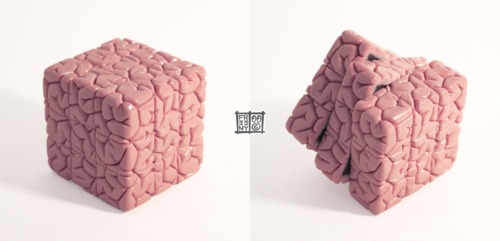
(Image via tumblr fuckyeahnervoussystem. Brain Rubix cube designed by Jason Freeny.)
 The Dish
