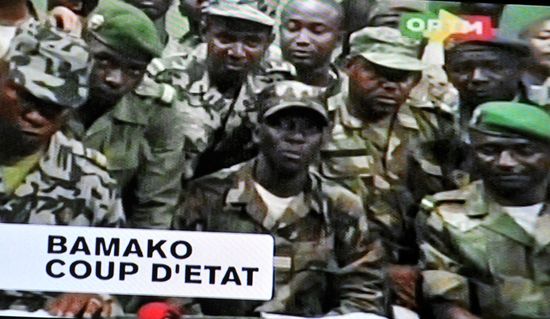
Soldiers in Mali, a reasonably democratic West African country, have taken over [NYT] the presidential palace in an attempted coup. Joshua Keating flags some evidence that the war in Libya was the cause. Larison agrees that ousting Qaddafi has destabilized surrounding countries:
[T]he Libyan war's worst impact may have occurred outside of Libya. The neighboring country of Mali, which also happens to support U.S. counter-terrorist efforts in western Africa, has been roiled by a new Tuareg insurgency fueled by the influx of men and weapons after Gadhafi's defeat, providing the Tuareg rebels with much more sophisticated weaponry than they had before. This new upheaval benefits al Qaeda in the Maghreb (AQIM), and the Tuareg uprising threatens the territorial integrity of Mali. The rebellion has also displaced nearly 200,000 civilians in a region that is already at risk of famine, and refugees from Mali are beginning to strain local resources in Niger, where most of them have fled. "Success" in Libya is creating a political and humanitarian disaster in Mali and Niger.
Ken Opalo casts some doubt on that interpretation:
The proximate cause of the mutiny and eventual (attempted) coup in Mali might have been a confluence of weak state coercive capacity and the resurgence of the Tuareg rebellion in the north of the country (fueled by weapons from Libya); but one cannot rule out the significance of the enabling structural conditions.
(Photo: A TV screen taken on March 22, 2012 shows a group of soldiers announcing a curfew in Bamako starting from March 22 following a military coup. The putschists, calling themselves the National Committee for the Establishment of Democracy, said they had acted due to government's 'inability' to put down a Tuareg-led insurrection in the north and tackle terrorism. By Issouf Sanogo/AFP/Getty Images.)
 The Dish