Dimitar Bechev tracks a growing pro-American bent in Turkey's foreign policy:
Before the Arab spring of 2011, Turkey had confidently pursued what it called a "zero-problems" regional approach (its own version of Brussels's "European neighbourhood policy" that promotes functional integration with states on the European Union's periphery). But the violent upheavals in Libya and Syria effectively derailed the "zero-problems" principle.
Instead, the region's new turmoil reinforced Ankara's bonds with Washington as they forged a common front on the Syrian crisis (while agreeing to disagree on Israel). Turkey shifted towards projecting the notion of a "Turkish model" as something the awakened Arabs could emulate – whose traces of a "freedom agenda" had resemblances to the outlook of neocons in the George W Bush administration. Hillary Clinton, the US secretary of state, has even spoken of a "golden era" in US-Turkish relations.
Soner Cagaptay nods.
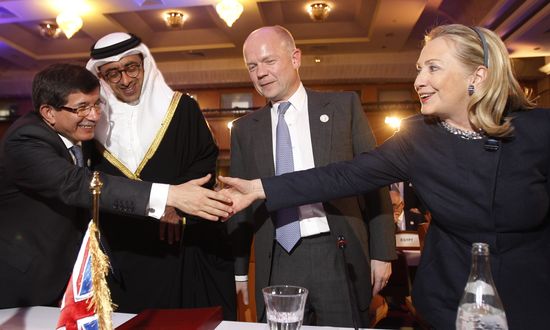
(Photo: Secretary of State Hillary Clinton greets Turkey's Foreign Minister Ahmet Davutoglu (L), United Arab Emirates' Foreign Minister Sheikh Abdullah bin Zayed al-Nahyan (2nd L) and British Foreign Minister William Hague (2nd R), in Tunis on February 24, 2012, during the 'Friends of Syria' conference at which representatives from over 60 countries will discuss the crisis in Syria, with a focus on aid and a political resolution of the violent conflict which has killed over 7000 people since the beginning of pro-democracy demonstrations a year ago. By Jason Reed/AFP/Getty Images)
 The Dish