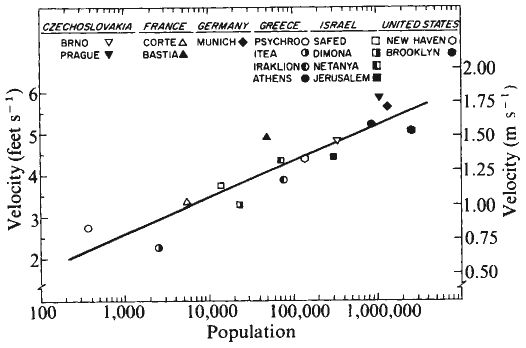
Eric Jaffe revisits several studies on the relationship between population and perambulating:
Stanley Milgram, for instance, believed that the sensory overload of the city prompted a social withdrawal response — in this case, a rapid motor action — to limit a person's environmental stimulation. In 1989 the geographers D. Jim Walmsley and Gareth Lewis pointed out some flaws in the "cognitive overload" theory. For starters, some people obviously thrive on an active, stimulating environment. Besides that, a very slow pace of life no doubt creates cognitive and behavioral changes of its own. …
In line with the previous work, the researchers found that the bigger the city, the faster the walkers — though the effect was not quite as profound as it had been in the Bornstein study. As one possible explanation for the relationship between city size and foot speed, the researchers suggested that economic factors might play a key role. When a city grows larger, they wrote, wage rate and cost of living increase, and with that the value of a resident's time. As a result, "economizing on time becomes more urgent and life becomes more hurried and harried," Walmsley and Lewis suggest.
 The Dish