The Economist and Ezra Klein have useful primers on the Supreme Court case. Lyle Denniston believes that "the final ruling has the potential to be the most important declaration on how the Constitution divides up power between national and state governments since the New Deal days some three quarters of a century ago":
Without exaggeration, it could be the most important pronouncement on the federal "safety net" since the Social Security Act was upheld by the Court in 1937. Without exaggeration, a decision to strike down all or part of the new health law could be the most severe rebuff of Congress’s power over the national economy since the Sick Chicken Case in 1935. And, without exaggeration, a nullification of the Act in whole or in part could be the most devastating blow to presidential power and prestige since the Steel Seizure Case in 1952.
Richard A. Epstein urges the justices to strike down the law:
[T]he Supreme Court should take this opportunity to reconsider the foundations of its commerce clause jurisprudence. The "wide latitude" given Congress is all too often used for enacting laws that support agricultural cartels and monopoly unions. These actions reduce social output, increase the federal footprint and stoke needless political controversy. Leaving production quotas and unionization exclusively to the states, restores to these markets a measure of competitive discipline that they desperately need, while allowing Congress to fulfill its main purpose of regulating cross-border business transactions, and interstate travel, transportation and communication.
Trevor Morrison's counter-point:
[M]any of those now arguing that upholding the ACA’s individual mandate entails abandoning the notion of any limits on Congress’s power are repeat offenders. They are rehashing their same old, long-since rejected, mantra. Ultimately, these folks are manifestly not concerned with helping the Court but are instead interested in using alarmist rhetoric to advance a very different project: returning Congress’s regulatory power to its pre-New Deal, and perhaps even pre-McCulloch v. Maryland, state. They are free to make those arguments, of course. But let’s recognize them for what they are.
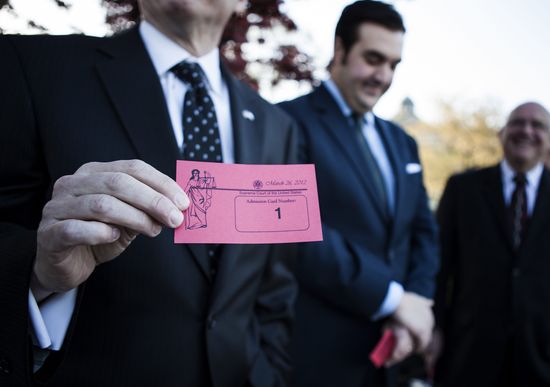
(Photo: Rev. Rob Schenk holds up the first ticket to view heath care arguments outside the US Supreme Court on March 26, 2012 in Washington, DC. The Supreme Court will hear arguments today challenging the Constitutionality of the Obama Administration's health care reforms during the first of three days of arguments . By Brendan Smialowski/AFP/Getty Images)
 The Dish