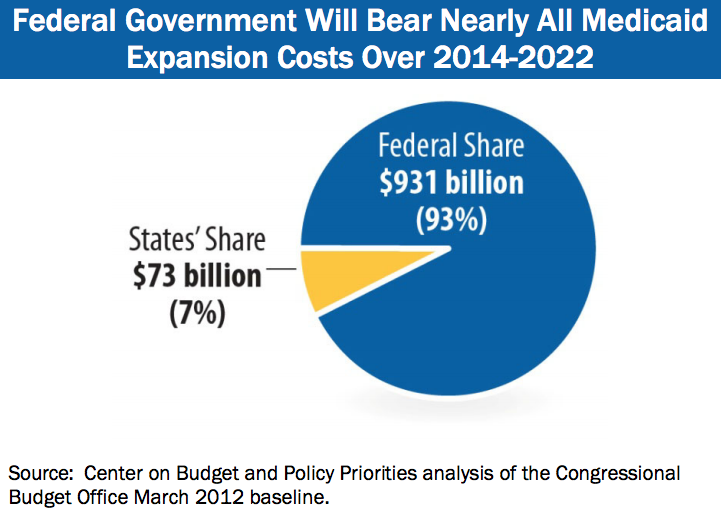
Yesterday, Justice Kagan pointed out that money for Obamacare's Medicaid expansion comes overwhelmingly from the federal government:
"It's just a boatload of federal money to take and spend on poor people's healthcare," Kagan said. "It doesn't sound very coercive to me."
Justice Kennedy sounded skeptical of this point and suggested that giving states massive amounts of money to pay on Medicaid is "coercive." Marty Lederman can hardly believe his ears. He explains the debate:
At issue here is an offer by Congress to give the states hundreds of billions of dollars–Justice Kagan wasn't exaggerating when she referred to a "boatload" of money (indeed, it's a shipload)–on the condition that the states spend the money, as they have since Medicaid's inception, on the categories of needy persons identified by Congress, for the medical services the legislature prescribes. This is a much larger boatload of money than Congress has offered in the past–approximately $443 billion dollars more. And Congress determined that those additional hundreds of billions are to be spent on a new category of beneficiaries, not previously covered by Medicaid–namely, individuals under age 65, not receiving Medicare, with incomes up to 133% of the poverty level. The objecting States don't think federal dollars should be spent on this new population of Medicaid recipients.
The Economist notes that the lower courts dismissed the coercion argument:
States charge that the Medicaid expansion is unduly coercive. Technically states could refuse to expand Medicaid and refuse Washington’s money, they say. But the federal government is so generous as to make this impractical. Every lower court that heard this argument found it to be absurd. Many were surprised that the Supreme Court even agreed to consider it. Yet the court not only tolerated the states’ argument, but seemed amenable to it. … If the court throws out the Medicaid expansion, states will be emboldened to challenge other big programmes.
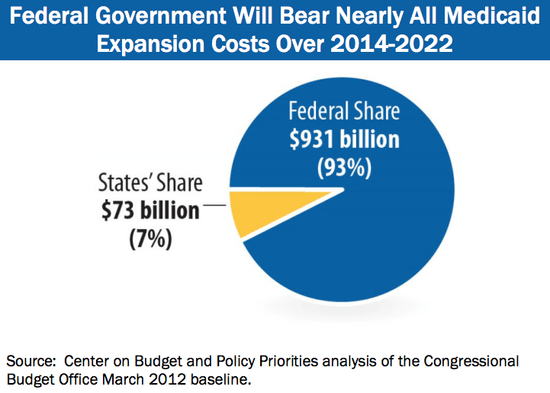
(Chart from CPBB)
 The Dish