"Mr. Boehner comes out and says, Rush's language was inappropriate. Using a salad fork for your entree, that's inappropriate. Not this stuff. I mean, and Rick Santorum says well, what he says was absurd, but an entertainer is allowed to be absurd. No. It is the responsibility of conservatives to police the right in its excesses, just as the liberals unfailingly fail to police the excesses in their own side. And it was depressing, because what it indicates is that the Republican leaders are afraid of Rush Limbaugh. They want to bomb Iran, but they're afraid of Rush Limbaugh," – George F Will.
Month: March 2012
A City Of Strays
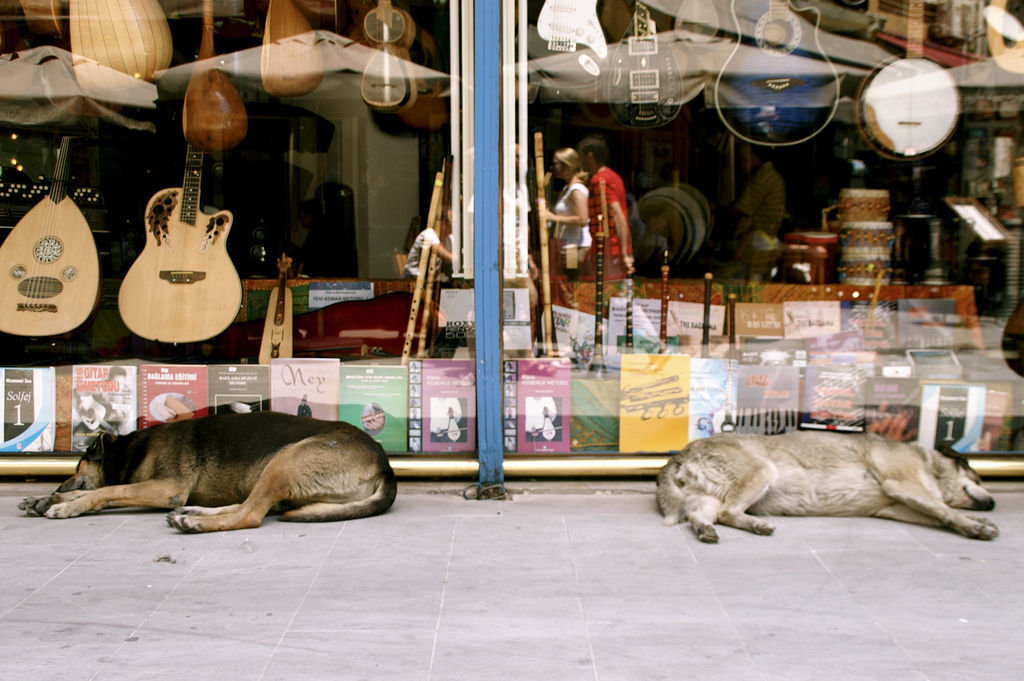
Bernd Brunner examines Istanbul's 100,000 street dogs:
Although there is no clear basis for this belief in the Koran, strict Muslims consider dogs — especially their drool — to be unclean. People don’t let the animals into their homes because they could dirty the prayer rug and because, even today, little tradition exists of keeping dogs as pets. Furthermore, a common belief holds that köpekler, as dogs are called, prevent angels from visiting. … Although dogs formed part of a romantic cityscape, caricatures from the Ottoman period depict them as threats to be stopped, along with cholera, crime, and women in European clothing.
Again and again, attempts were made to catch them and remove them from the city. In the late 19th century, Sultan Abdülaziz decreed that the dogs should be rounded up and deported to Hayirsiz, an island of barren, steep cliffs in the Marmara Sea. Sivriada, a tiny island to which Byzantine rulers once banned criminals, made headlines in 1911 when the governor of Istanbul released tens of thousands of dogs there. A yellowed postcard shows hundreds of dogs on the beach; their voices could be heard even at great distances. However, an earthquake that occurred shortly thereafter was taken as a sign of God’s displeasure, and the dogs were brought back.
(Photo by Joelle McNichol)
Malkin Award Nominee
"Who is speaking up for the mothers who, under HHS mandate, have been falsely coerced into feeling that to be a woman means to have 'control' of their own bodies?" – Pastor Joshua Genig.
Do Dolphins And Whales Deserve Rights?

Nick Sibilla wonders:
Depending on the level of rationality, intelligence, and pain sensitivity an animal has, the more rights it should have. Under this ethical framework, a whale or a dolphin would more or less be the moral equivalent of a young child, the mentally handicapped, and possibly a fetus, depending on the latter's stage of development. Cetacean rights and fetal personhood advocates could become unlikely allies in the years ahead.
(Photo by Flickr user makelessnoise)
Buried Treasures Should Stay Buried
[James Delgado, director of the Maritime Heritage Program at the National Oceanic and Atmospheric Administration (NOAA)], who has excavated wrecks for archaeology institutions throughout his career, says the litany of unknowns is part of the explanation for why wreck hunting is so expensive. "The street value of shipwrecks is minimal. Generally it's a losing proposition, except in a few cases, because it costs more to find them, work them, and deal with what you find. An average mission in deep water can run into the millions, and that's just to find it. For every dollar you spend looking and finding, you'll spend about $10 excavating and treating what you've found [to offset] chemical changes that happen underwater."
And then there's the question of whether you can keep what you find. Governments, insurance companies, and anyone with a chance at a legal claim will set their sights on recovered treasure.
The Neuroscience Of Magic Tricks
Teller reveals the tricks of perception that magicians have mastered. Among them:
[In 1907 David P. Abbott] used to make a golden ball float around his parlor. After the show, Abbott would absent-mindedly leave the ball on a bookshelf while he went to the kitchen for refreshments. Guests would sneak over, heft the ball and find it was much heavier than a thread could support. So they were mystified. But the ball the audience had seen floating weighed only five ounces. The one on the bookshelf was a heavy duplicate, left out to entice the curious. When a magician lets you notice something on your own, his lie becomes impenetrable.
(Card trick via The Next Web and the revealed "magic" here.)
The Greatest Christian Book
The former bishop of Oxford Richard Harries nominates The Cloud of Unknowing, an anonymous 14th century text, among others:
According to Christian theology there are two ways to know God. There is what’s called the positive way, where you try to say things about God, and then there is the negative way, where you have to unsay everything you have said about God and go into a kind of unknown. This is because everything we say about God can be somewhat misleading because we talk in metaphors all the time. And metaphors are always as untrue as they are true. They have to be broken and then remade and broken and remade. And therefore to know God as he truly is, instead of purely our projection, we need to go beyond all our metaphors into what he referred to as “the cloud of unknowing”, where you simply reach out to God himself, whom you can’t characterise or describe at all.
My thoughts about the best writers on God here.
Face Of The Day
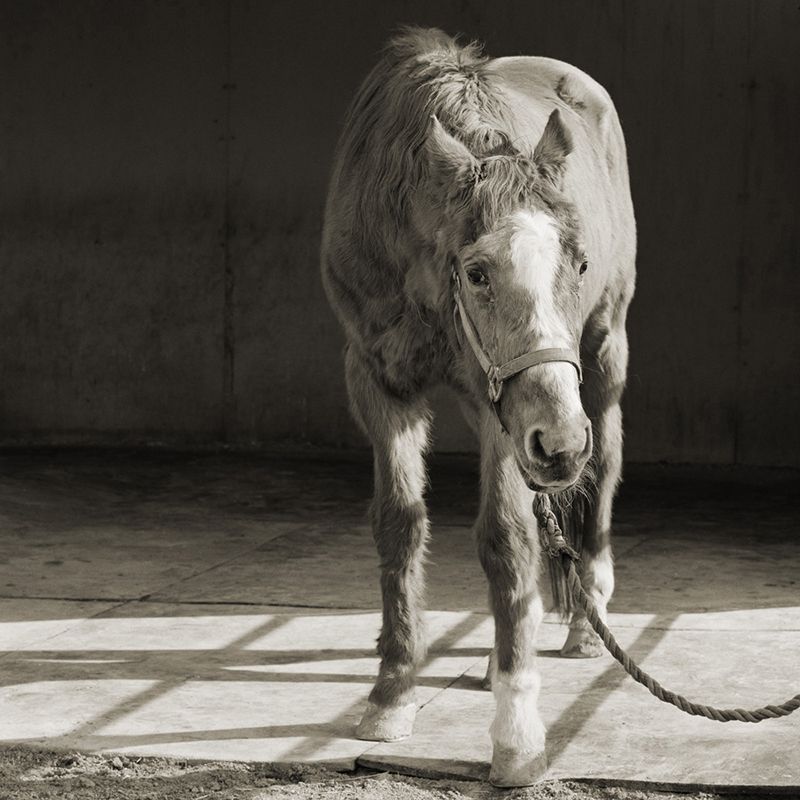
Anahad O'Connor recently praised Isa Leshko's project on elderly animals:
Ms. Leshko was inspired to carry out her project after spending a year caring for her mother, who has Alzheimer’s disease and is now in a nursing home. She considered documenting the experience through pictures but soon decided against it. “A number of fine-art photographers have gone that route and produced really powerful work,” she said. “It just didn’t feel like the appropriate response for me. I didn’t think my mother could provide consent, and I wanted to be present as her daughter and caregiver.”
Later, Ms. Leshko found her outlet while visiting a relative in New Jersey, where she came across a blind 35-year-old horse named Petey. “I was just completely mesmerized by this animal,” she said. “I spent the afternoon photographing him. When I reviewed my film I began to realize that I had a means of exploring my feelings around aging and my mother’s illness.”
More on the animals she finds here. Watch a moving short film about Leshko's project here.
(Photo: Handsome One, Thoroughbred Horse, Age 33, by Isa Leshko, courtesy of the artist)
How To Get Someone To Confess
Ron Rosenbaum reveals documentarian Errol Morris' trick, which he picked up while working with a private eye:
It wasn’t a blackjack-, brass knuckles-type thing. “It went like this,” Morris explained. “He’d knock on a door, sometimes of someone not even connected to the case they were investigating. He’d flip open his wallet, show his badge and say, ‘I guess we don’t have to tell you why we’re here.’ “And more often than not the guy starts bawling like an infant, ‘How did you find out?’” And then disgorges some shameful criminal secret no one would ever have known about otherwise.
The View From Your Window

Milwaukee, Wisconsin, 5 pm
 The Dish