The Global 1%

169

Charles Kenny situates most Americans in it:

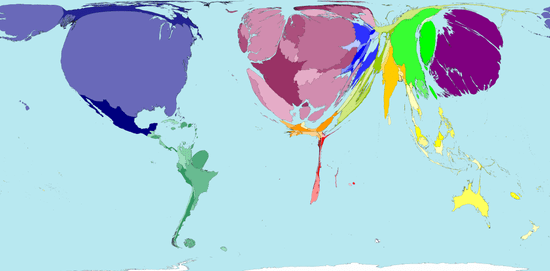
[B]y global standards, America's middle class is also really, really rich. To make it into the richest 1 percent globally, all you need is an income of around $34,000, according to World Bank economist Branko Milanovic. The average family in the United States has more than three times the income of those living in poverty in America, and nearly 50 times that of the world's poorest. Many of America's 99 percenters, and the West's, are really 1 percenters on a global level.

Matt Collin believes this sort of argument won't persuade people to support more foreign aid:

Kenny gives the welfare of people within and outside of the US equal weight. … I think that most people just don’t feel the same way: average levels of altruism for foreigners are certain to be lower than for other citizens, so we should be wary of making arguments which are too dependent on non-discrimination. People still see citizenship as part of a social contract – we’re all in this boat together, even if we were randomly assigned to it. Those that ended up in leaky boats are not our immediate concern ([though that's] not the way I feel).

(Map of countries resized to level of wealth in 2002 by WorldMapper)

Malkin Award Nominee

"Before accepting food stamps, people [should] have to carefully consider whether they want to face the loss of voting privileges, the humiliation of shopping at government stores and using government food, the inability to smoke or do drugs and the added inconvenience of having to make two or three stops for their groceries should they choose to buy snacks with their own money. … There should be humiliation and pain in government assistance. Every time someone accepts food stamps, they are spitting on the principles of independence, and they, not the taxpayers who fund the program, should be reminded of that fact," – Brion McClanahan, The Daily Caller.

Where Anyone Can Be A Cabbie, Ctd

A reader writes:

Schumpeter has obviously never been to Tehran if he's praising their taxi system. I visited the city in 2002, and unless major changes has occurred, it's still one of the world's most polluted capitals, with virtually no functioning public transport, and the most anarchistic traffic you'll ever experience – cars opening up new lanes whenever needed, sometimes in the lanes going the opposite direction – and the streets are constantly clogged by traffic. The dire economic conditions at the time (probably worse now) was well illustrated by the fact that two out of three of my (unlicensed) taxi drivers had university degrees. That makes no sense whatsoever.

Crossing the street in Tehran (like in Algiers, where I am now, with a similar situation of government fuel subsidies and underdeveloped public transport) is putting your life at risk. It's an urban nightmare, and the "free taxi" stuff is making it worse. Market economy is great, but this example is really a poor one.

Update from a reader:

I think the reader response [above] is pretty far off. The lack of public transit and traffic are not because Tehran's taxi system is too dependent on the free market, but because the government has failed to invest in public transportation that would reduce the traffic problems your reader discusses. The Schumpeter post contrasts London, which has a tightly regulated system with Tehran where there is no said regulation. London is a city with from what I have heard a very good public transit system, plus it has congestion pricing – reducing regulations on its cabbies would open more employment opportunities and provide more cabs at lower prices for consumers. Tehran is not congested because there are too many taxis. It is congested because of a lack of alternatives.

Update from another:

I’m Iranian on my dad’s side and we went to live in Tehran when I was 10 years old, leaving shortly before the Revolution. The traffic was just as harrowing back then! There were NO defined lanes. You just inched your car into whatever space you can find. One-way signs were merely suggestions; nobody obeyed them. It was not uncommon to have a camel or goat cross the street (on the side streets) and the honking of horns was constant.

Dad told me that when he learned to drive, his father put him on his lap and said, "Son, you see that white line? Line that up in the middle of your car." I think that about sums up the problem.

Update from yet another:

In a former life, I was training to be a historian.  My nascent area of expertise was 19th and 20th century Iran.  While a graduate student, I had a summer fellowship (funded in part by the US government in a pilot program that has since been abandoned) that took me to Iran.  I spent the summer of 2000 there, much of it in Tehran.

Your reader who was in Tehran in 2002 accurately describes the chaos of automobile traffic in Tehran.  But I must say that with certain caveats that I do think it is a system worthy of praise.  You can get where you are going very inexpensively.  In those days it was never more than "one Khomeini" (10,000 rials / 1,000 toman — then about USD 1.25; Khomeini was on the note) to get anywhere in town.  

I met lots of ordinary Iranians by riding around in Tehrani cabs – first and foremost the cabbies themselves, but it was pretty typical for a cab to pick up and drop off passengers along the way.  A highlight of my trip was the conversations that I had while in cabs in Tehran.  I imagine that it helped that my Persian was pretty clean in those days.  But it's hard to imagine not having in general very pleasant and interesting conversations even in broken English in Tehrani cabs.

The caveats are about safety.  I never bothered with a seat belt because it was painfully obvious that in the event of any accident of any serious magnitude, the crappy Iranian-assembled, British-manufactured and ubiquitous Paykans would turn to dust, instantly (hopefully) killing all occupants.  It was on occasion a hair raising experience being in those cars in that traffic.  Some quasi-Zen practice – turning oneself over to the driver and fate – was requried to avoid developing ulcers whilst riding those cabs.

But I loved the cabs in Tehran.  And I loved my time in Iran.  Wish I could go back.  Beautiful country and a beautiful people and culture.

How Does War Affect The Planet?

Brian Palmer notes an important development: 

Armies used to defeat each other by killing huge numbers of enemies in direct battle. Today, military strategists try to undermine the enemy’s war machine with less bloodshed. That usually means occupying huge swaths of land and destroying the industrial infrastructure. In other words, as war becomes safer for humans, it may be increasingly dangerous for the planet.

Why The Russian Vote Matters

Putin_Poster

Joshua Tucker explains:

Whether Putin survives the whole six years [of his next term] is likely going to depend on whether the nascent protest movements in Moscow eventually make it impossible for Putin to stay in office, or, more likely, lead other elites to conclude that it more trouble than it is worth for Putin to continue as president. Thus, to the extent that a weakened Putin encourages more protest, the results of the election do "matter", perhaps especially so in Moscow.

(Photo: A poster with a picture of Russian Prime Minister and presidential candidate Vladimir Putin, reading 'Another 12 years? No, thank you!' is seen after an unsanctioned opposition rally in front of the Russian Central Election Commission headquarters in Moscow, on February 28, 2012. By Kirill Kudryavtsev/AFP/Getty Images)

Why Does Everyone Hate Jury Duty? Ctd

A reader writes:

As a trial judge, it's painfully obvious to me why so many people hate jury duty. It can be interesting, educational, exciting – a great experience in interactive democracy if done right. You get to make a difference in your community and in the lives of real people; you learn something about the law; you see real justice being done right before your eyes, and you're the one doing it.

Unfortunately, that's not the experience a lot of people come away with. Instead, lawyers and judges often treat jurors like second-class citizens. They give them lip service about how important they are, but then they patently hide information from them, don't explain legal concepts, keep them in the dark about what's happening during the trial, and make it clear that they're not trusted. Worse, their time is wasted, their privacy is invaded, and they're not given the tools to do the job properly – they're usually not allowed to ask questions, instructions may be given just once, orally, and in some jurisdictions, the jurors aren't even allowed to take notes!

All these problems are compounded in those cases dealing with subject matter that is either emotionally wrenching (hearing the gory details of some innocent person's life-altering injuries, especially a child's) or frightening (a vicious crime – and the alleged perpetrator knows your name and is sitting right there looking at you).

I start every jury session by personally thanking the jurors for their service, and explaining to them that we're there to do justice together. I explain to them that the Founders of our country were wise enough to provide that we'd elect representatives to make the laws and carry them out, but when it came to doing justice in the given case, that was too important to elect representatives – we have to come together, as the voice of the community, to do justice, case by case.

I could go on, but you get the point. When I stress that they're there to do something important – to do justice – attitudes change. I take care to explain legal concepts as they arise during trial. I, and many judges, provide written copies of instructions. And when that happens, to my experience, they rise to the occasion and earnestly try to do justice.

It all comes down to job satisfaction. When treated like the job they're doing is important, and when empowered to do it, I find that most jurors enjoy the experience. When patronized, they don't. Which is a shame.

Another reader:

In my experience as a public defender in Oregon, most people really don’t hate jury duty. I feel bad for jurors – they are only paid $10 a day for their service in Oregon courts, plus 20 cents a mile. But I’ve found that jurors take their public service quite seriously. In the last month, I’ve had two trials. Both lasted three days, but in each instance, the 12-person jury took more than five hours to reach a final verdict, because they clearly cared about the process and wanted to reach the conclusion supported by the evidence.

The common saying is that a jury is made up of 12 people too stupid to find a way to get off jury duty. But in my experience, the 12 people who are chosen are the ones who can make the commitment to do it right.
Ad War Update: Cranking Up The Fear

A paranoid and sinister spot from the Romney campaign:

Sam Stein captions:

The clip insinuates that Obama's reelection campaign put large sums of money behind anti-Romney efforts. (While affiliated groups did, the Obama campaign was not involved.) It also plays up the now infamous line from an anonymous "Democratic strategist aligned with the White House" that they'd have to pursue a "kill Romney" strategy unless the economy improved. … There's no mention of former Sen. Rick Santorum, Romney's chief Republican rival, in the spot.

The second [reason the ad is telling] is the overt plea for cash. In both the text below the video on the Romney campaign's landing page and in ads that pop up while it plays, the campaign solicits donations. Having asked supporters to visit his website and help the campaign in any capacity during his victory speech last night, it's becoming more and more evident that Romney is strapped for cash.

Shifting tones dramatically, Romney ridicules the "Democrats for Santorum!" phenomenon in Michigan: 

Ron Paul has reissued the following ad from January, perhaps in an effort to quiet speculation that he's cut some sort of deal with the Romney camp:

Previous Ad War Updates: Feb 28Feb 27Feb 23Feb 22Feb 21, Feb 17, Feb 16, Feb 15, Feb 14, Feb 13, Feb 9, Feb 8, Feb 7, Feb 6, Feb 3, Feb 2, Feb 1, Jan 30, Jan 29, Jan 27, Jan 26, Jan 25, Jan 24, Jan 22, Jan 20, Jan 19, Jan 18, Jan 17, Jan 16 and Jan 12.