The Terror Of Catcalling, Ctd

A reader writes:

You struck a nerve with this one, as I was just discussing this very thing a few weeks ago with a group of high-school freshmen in my English class. We were discussing homosexuality because of an allusion to it in the book we were reading, and several boys made comments such as, "That's disgusting." We got into the debate and eventually a boy admitted that he was terrified/disgusted when he was once sharing a taxi and the other male passenger made a pass at him.

The lightbulb went off. "Oh," I said. "I get it. See, you are afraid, because for the first time in your life you have found yourself a victim of unwanted sexual advances by someone who has the physical ability to use force against you." The boy nodded and shuddered visibly.

"But," I continued. "As a woman, you learn to live with that from the time you are fourteen, and it never stops. We live with that fear every day of our lives. Every man walking through the parking garage the same time you are is either just a harmless stranger or a potential rapist. Every time."

The girls in the room nodded, agreeing. The boys seemed genuinely shocked. 

"So think about that the next time you hit on a girl. Maybe, like you in the taxi, she doesn't actually want you to."

Another writes:

I find any discussion of catcalling fascinating. I'm a 25-year-old male who has lived in Washington D.C. for three years. I constantly walk around the city at night with my female friends, often in less-than-great areas where catcalling is supposed to take place. Except for one memorable encounter with a homeless man, I've never observed any of my female friends being victimized by a catcall. At the same time, they all insist that it happens to them on a daily basis.

I've always assumed that the reason for this strange discrepancy is that catcalling doesn't happen as frequently when I am around. I'm a pretty tall, strong looking man, and I'm guessing my presence quiets some would-be cat-callers. For this reason, I don't know if I can even begin to understand what young women are going through. It is pretty common for me to hear about a friend of mine getting cat-called and think to myself, "Man, I'd love for a women to comment on my ass while walking down the street", but I know that the reality for them must be much different.

Another:

Since I'm a man, until recently, the experience of women and catcalling was alien to me. Last summer, I was walking down State Street in Madison when a guy called out to me, "Hey, nice shirt!" It totally threw me off, because the shirt I was wearing was a basic, business-casual straight guy shirt.

Me: "Huh? I bought it at Target."  
Catcaller: "Well, what have you got planned?"
Me: "Ummm, looking for something to eat."
Catcaller: "Oh yeah, I know this great pl…"
Me: "I think I'll eat here" – and I practically dove into the Qdoba that happened to be where I was, even though I didn't want to eat Qdoba.

I wasn't angry at the guy, but as I ate my burrito, it was a long meditation on "what the hell"? I mentioned it to my wife later and she just kind of sighed.

Is Big Football The Next Big Tobacco?

One begins to wonder. And when I say one, I mean a friend of mine who bent my ear on this somewhat taboo topic the other night. A story today details a mass-tort lawsuit involving 126 former NFL players because of the long-term impact of repeated concussions and head injuries.

The lawsuit alleges that the NFL was aware of the risks of repetitive traumatic brain injury but hid the information and misled players, resulting in permanent brain damage or neurological disorders. “It’s scary the extent to which these guys have been hurt,” said Gene Locks, the plaintiffs’ lead attorney. “When we played football, broken bones, busted noses, tears of tissue were kind of expected. Nobody said you’d get a head injury. These injuries are insidious, they are latent, degenerative, and it gets worse and worse as you get older in certain players.”

According to the lawsuit, [former Redskins QB, Mark] Rypien “suffers from various neurological conditions and symptoms related to the multiple head traumas.” The same language is used for each of the 125 other plaintiffs.

So a lucrative industry knowingly destroys the health of the people it makes money off – and keeps the evidence hidden from them. Sound familiar? But the above video suggests what might be the real crisis for football. If it can be demonstrated that playing high school and college football will cause serious and permanent brain damage, wouldn't parents prefer their kids to be playing baseball or basketball? 

At some point, I suspect, this will become a major scandal, as more brain-damaged adults emerge and more evidence comes out that the NFL may have long known about the health effects of their sport as it is currently played. I may be missing something, of course, given my total absence of any cultural capital on the subject of sports, so I'd be interested in readers' thoughts about this. But I have a few questions in my head I can't answer.

Is it conceivable that football may disappear in America if its impact on the brain is absorbed? Or have to be re-imagined? Is this worse now than it used to be – because the sheer size and weight of some players has increased vastly over previous generations? Do steroids play a part? And doesn't knowing that you're watching a bunch of guys turning their brains into swiss cheese take a little something out of the experience?

The Mandate Lives!

That's the latest missive from the roller-coaster at the Supreme Court:

The Supreme Court spent 91 minutes Wednesday operating on the assumption that it would strike down the key feature of the new health care law, but may have convinced itself in the end not to do that because of just how hard it would be to decide what to do after that.  A common reaction, across the bench, was that the Justices themselves did not want the onerous task of going through the remainder of the entire 2,700 pages of the law and deciding what to keep and what to throw out, and most seemed to think that should be left to Congress.  They could not come together, however, on just what task they would send across the street for the lawmakers to perform.  The net effect may well have shored up support for the individual insurance mandate itself.

More reax to come.

Could Killing The Mandate Help Obama?

Douthat wonders:

If the Supreme Court invalidates the mandate, the justices’ traditional “presumption in favor of severability” will probably ensure that the rest of the legislation remains intact – which might reassure moderate voters that the health care bill wouldn’t actually trample their liberties, because the courts are on the case. Stripping away the law’s most unpopular component might make the rest of it marginally more popular. And setting a clear limit on liberalism’s ability to micromanage Americans’ private decisions might make voters feel more comfortable voting to re-elect their micromanager-in-chief.

Ross's argument rests on the idea that there are workarounds to keep the rest of the bill in place without mandates. They don't sound that plausible to me. And if your gut objection to the mandate is, like mine, an unease with being told by government you have to buy something, then I don't see why that feeling changes if it's a state doing it, rather than the feds.

But Ross may be onto something in a different way.

If the healthcare law is struck down entirely, people will immediately become more aware of what they will lose: for tens of millions, the option of health insurance at all; for many more, the ability to buy health insurance with a pre-existing condition; for millions of under 26-year-olds coverage under their parents' insurance, etc. It may be that the law's eradication by the court would educate the public about the aspects of the bill they like, and make the case for the law the president has signally and pathetically failed to do.

May be. I'm not comfortable predicting anything on this.

The Profound Weakness Of Romney

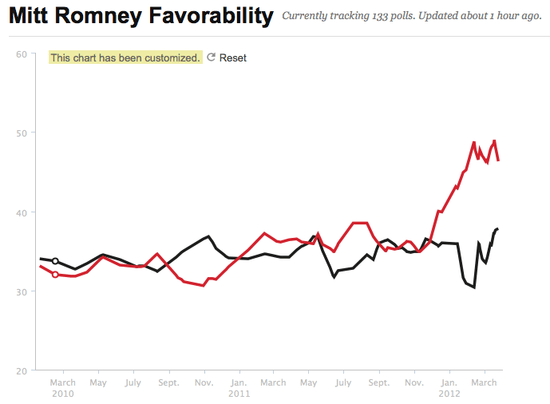
Screen shot 2012-03-28 at 12.12.09 PM

He's now at 50 percent unfavorables in a new poll – a record for him – and not faring much better in the poll of polls above, where black is favorable and red is unfavorable. Since the campaign began in earnest, his negatives have soared. Worse:

Thirty-four percent hold a favorable opinion of Romney, the lowest for any leading presidential candidate in ABC/Post polls in primary seasons since 1984.

The Etch-A-Sketch quote will no doubt have sunk in. And this number comes at a time when the Democrats haven't even really begun to define him in ads – although this one is a good start – and after he has massively outspent his rivals in every primary state. Still, there's been a recent uptick in favorables as the GOP rallies around its likeliest nominee. Obama, meanwhile, has a net positive favorable rating in the same new poll of 10 percent and a five percent fav/unfav in the poll of polls.

Support For Afghanistan War Plummets

69 percent are tired of fighting:

The new low represents the crossing of a certain psychological and cultural threshold. It means the Afghanistan war is now at least as unpopular as the Iraq war was at the height of public ire. In fact, by some measures, the war to beat the Taliban — the guys who gave safe harbor to the 9/11 terrorists — is now more unpopular than the one to get rid of Saddam and his alleged stockpiles of WMDs.

It's a farce we are still asking young men and women to die for. When the troops we are training are actually killing our own soldiers, and when we may well merely be training them to fight a civil war more lethally, we should get out now. Republicans get this, even if their leadership doesn't:

A plurality of Republicans, 41 percent, say that the U.S. should withdraw sooner than the planned withdrawal date in 2014, compared with only 28 who prefer the existing timetable and 29 percent who believe American troops should stay as long as it takes.

In all likelihood, a face-saving period of training the Afghan government forces will continue until at least the election. Then: who knows? The impact of the war on Pakistan has been to intensify what is becoming hysterical anti-Americanism – a factor that will hurt us in the war against Jihadism. And with al Qaeda wiped out and bin Laden dead, Americans are not exactly thrilled to be nation-building in Afghanistan. Nor should they be. It's like planting daffodils on Mars. Friedersdorf wonders if Obama will pay a price:

You'd think that voters would punish an incumbent who doubled down on an unpopular war that a majority now regards as a harmful mistake. But certain factors may mitigate any anti-Obama backlash: He didn't start the war; at the time, most Americans agreed with his renewed focus on it; he can plausibly argue that our beefed up presence helped to get Osama bin Laden; and most importantly, Mitt Romney doesn't inspire any confidence that he'd do better.

In fact, Romney's current position in the primaries seems to be to keep fighting in Afghanistan for ever. Shake, shake.

Tim Tebow Is Excited

And he just can't hide it:

The newly-traded backup QB just arrived in New York City:

He spent the weekend taking in the town. He saw "Wicked" ("It was really good"). He dined at Scarpetta, in the meatpacking district, and gave a couple celebrating their engagement his blessing. It wasn’t until today, though, that Tebow faced what could end up being his biggest challenge in New York: the press. …

How will he get along with Mark Sanchez, the Jets’ starting quarterback, who has remained conspicuously silent over the past week? They have a "great relationship." They met at the ESPY Awards. They text. They did not, however, see "Wicked" together. What the gathered reporters did not hear, thanks to all the polite obfuscation, was anything about the question they really wanted answered: how long until, as Ben McGrath put it in this week’s magazine, Tebow goes rogue?