Confessions Of A Ghostwriter

Sari Botton opens up about writing for the rich and famous:

In my work I never simply interview a person and then write their book using a whole different collection of words than they did. Typically, I use many of the same words that came out of their mouths, although likely in a different order, and surrounded by other words. I also move whole pieces of their narratives around for purposes of better storytelling. I remove boring expository chunks, and try to draw more interesting anecdotes from my clients to replace those – anecdotes they wouldn’t have thought to include until I prompted them; anecdotes I still have to seriously rework and bring to life.

Another way I work is to get clients to “free-write” bits for me, without concerning themselves with spelling, grammar, sentence structure, or “sounding good.” … I tend to think of myself more as a “memoir midwife,” as one client called me. 
What’s The British Equivalent Of Fox News?

The Daily Mail, according to Lauren Collins:

A middle-market tabloid, with a daily readership of four and a half million, it reaches four times as many people as the Guardian, while being taken more seriously than the one paper that outsells it, the Sun. In January, its Web arm, Mail Online, surpassed that of the New York Times as the most visited newspaper site in the world, drawing fifty-two million unique visitors a month.

The Mail’s closest analogue in the American media is perhaps Fox News. In Britain, unlike in the United States, television tends to be a dignified affair, while print is berserk and shouty. The Mail is like Fox in the sense that it speaks to, and for, the married, car-driving, homeowning, conservative-voting suburbanite, but it is unlike Fox in that it is not slavishly approving of any political party. One editor told me, "The paper’s defining ideology is that Britain has gone to the dogs."

Obama’s Drug Treatment Record

A couple weeks ago, John McWhorter chewed out the president for continuing the War On Drugs and for alledgedly slashing drug treatment. Keith Humphreys sticks up for Obama on the second count:

In reality, the Affordable Care Act is the largest expansion of treatment for addicted people in at least 40 years, and perhaps in the history of the United States. These changes are augmented by new parity regulations for the insurance industry which require a increased investment of private dollars in addiction treatment.

The Daily Wrap

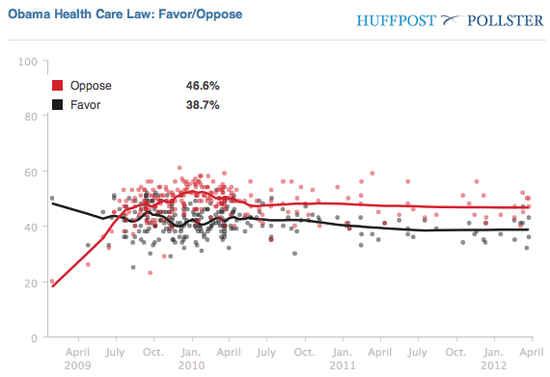
Today on the Dish, Andrew clarified his reasons for supporting Obamacare,  declared the GOP unserious until it could specify precise spending cuts, zoomed in on the evidence as to whether Christianists would vote for Romney, explained why a Mormon was a less likely theocrat than his Catholic competitor. We compiled reax to both Day 1 (here) and Day 2 (here) of the Obamacare case, examined what would happen if the mandate were struck down, reality check'd health care reform's approval ratings, figured the name we used to refer to the legislation didn't matter much, and guessed the GOP establishment was too afraid to rally 'round the Romney. Ad War Update here.

Andrew also engaged with a strong reader critique of his debate with Goldberg, deepened his explanation of Catholicism to Bill Maher, delved into NOM's divide-and-conquer attempts to split gays and minorities, and scoffed at Romney's silly remarks on Russia. We checked on whether sanctions on Iran could escalate, put ourselves in Netanyahu's headspace about a "bluff" on Iran, flagged an interesting debate that came up in the wake of Peter Beinart's book, read an awesome write-up about playing paintball with Hezbollah (for real), aired ideas about how to get out of Afghanistan with grace, thought about the psychology of drone warfare, imagined war as a virus, and debated Kiwi exceptionalism.

Readers raked Andrew over the coals for his discussion of Hillary Clinton, shared their experiences with catcalling, and developed theories about why women paid more for certain items. Marriage remained the norm, sharing commutes brought couples together, and politicians acted like humans. Neuroscience couldn't explain everything, bionic arms befuddled scientists, NPR weighed in on farting etiquette, and you couldn't get there from here. Quote for the Day here, Yglesias Nominee here, VFYW Contest Winner here, VFYW here, MHB here, and FOTD here.

Z.B.

Reality Check

Opinions about Obamacare are holding steady:

Obamacare_Views

Blumenthal investigates:

The most likely reason general attitudes about the law have not changed is that so few Americans have sense of how the law will affect them. "Two years after passage," the Kaiser analysts write, "the ACA is not yet 'real' for most Americans — six in ten say they don't have enough information to understand how the law will impact them, and two thirds say the law has not yet affected their family in either a positive or negative way."

Unless and until that experience changes, attitudes toward the health care reform law are unlikely to shift in a meaningful way.

And the responsibility for this lies with the Obama administration who have shown no talent, zest or intelligence in explaining and selling their core domestic achievement.

Negotiating Our Way Out Of Afghanistan?

Michael Cohen and Michael Wahid Hanna think that, if we ramped down military operations, a negotiated settlement might be within America's grasp:

Quite simply, it is no longer credible to argue that there is nothing to talk about with the Taliban or that the U.S. lacks a potential interlocutor among the insurgency. The question for the United States is not whether the Taliban wants to talk; it's how the U.S. can increase the chances for success.

The International Crisis Group is skeptical:

A negotiated political settlement is a desirable outcome to the conflict in Afghanistan, but current talks with the Taliban are unlikely to result in a sustainable peace. There is a risk that negotiations under present conditions could further destabilise the country and region. Debilitated by internal political divisions and external pressures, the Karzai government is poorly positioned to cut a deal with leaders of the insurgency. Afghanistan’s security forces are ill-prepared to handle the power vacuum that will occur following the exit of international troops. As political competition heats up within the country in the run-up to NATO’s withdrawal of combat forces at the end of 2014, the differing priorities and preferences of the parties to the conflict – from the Afghan government to the Taliban leadership to key regional and wider international actors – will further undermine the prospects of peace. To avoid another civil war, a major course correction is needed that results in the appointment of a UN-mandated mediation team and the adoption of a more realistic approach to resolution of the conflict.

Face Of The Day

GT_FACE-SYRIA_120327

A Syrian refugee, transfered from a camp in Reyhanli, arrives at a newly set up camp in Kilis, on March 27, 2012. Syrian President Bashar al-Assad's crackdown on dissent, which monitors say has seen more than 9,100 people killed since March 2011, triggered an influx of refugees on the Turkish border as officials say the current number exceeds 17,000. By Adem Altan/AFP/Getty Images.

Obama Embraces “Obamacare” Ctd

I_Like_Obamacare

Waldman argues that healthcare reform's name matters very little:

People get checks from Social Security every month. People get their health insurance from Medicare. So when those programs come under attack, they immediately understand what it means and rally to their defense. But while the ACA (OK, OK, Obamacare) has wide-ranging implications and effects, it won't be a program in the same sense. Though many millions of people will have insurance because of Obamacare, no one will get their insurance through Obamacare. They'll get private insurance, or Medicaid.

(Screenshot above from a new Obama campaign Facebook page)

Ad War Update

The DNC spotlights Romney's ineptitude on foreign policy: 

Meanwhile, Romney's Super PAC pounds Santorum for saying "I don't care what the unemployment rate's going to be" in Wisconsin, which votes next Tuesday: 

Heidi Przybyla profiles Restore Our Future: 

Since the contests began, Restore Our Future has spent $35 million on commercials attacking Santorum and Newt Gingrich …. The super-PAC has spent just $1.1 million promoting Romney, the data shows. … Since Jan. 1 of last year, Restore has aired the same 16 negative ads 41,612 times in the major media markets of primary states from Michigan to Florida and Colorado, according to data provided by CMAG. The committees backing Gingrich and Santorum ran 8,172 and 8,121 negative spots, respectively, according to data from CMAG.

Santorum's Super PAC fights back

More on the Wisconsin ad wars here.

Previous Ad War Updates: Mar 27Mar 23Mar 22Mar 21Mar 20Mar 19Mar 16Mar 15Mar 14Mar 13Mar 12Mar 9Mar 8Mar 7Mar 6Mar 5Mar 2Mar 1Feb 29Feb 28Feb 27Feb 23Feb 22Feb 21, Feb 17, Feb 16, Feb 15, Feb 14, Feb 13, Feb 9, Feb 8, Feb 7, Feb 6, Feb 3, Feb 2, Feb 1, Jan 30, Jan 29, Jan 27, Jan 26, Jan 25, Jan 24, Jan 22, Jan 20, Jan 19, Jan 18, Jan 17, Jan 16 and Jan 12.

The Law Fits My Views Perfectly

How ideology shapes our understandings of legality:

[T]here are vanishingly few people who believe that the Affordable Care Act was a terrific piece of legislation except that it is unfortunately unconstitutional. Nor are there more than a handful who believe that the ACA is certainly permitted by the Constitution, but is otherwise a terrible idea. … What should we learn from all of this? Mostly, that we shouldn’t take at all seriously anyone’s protests that what they’re doing is driven mainly by Constitutional doctrine.

For my part, I may just fit into the first category. I have no expertise in constitutional law so cannot say either way on the ACA's constitutionality. But as a principle, having the federal government forcing me to buy something I might not want does rub me the wrong way. But since there are clear collective consequences of my refusal to buy insurance and yet expect adequate treatment if I were to get squished on my bike by a truck, I can see the need for mandatory insurance, as with cars. This is about ending free-riders and ensuring personal responsibility – which is why the individual mandate was once regarded as a clearly conservative proposal.

But my main reason for supporting the ACA is pretty simple. The private sector has been given a chance to show it can deliver healthcare efficiently – and it has failed to such a spectacular extent that government has little choice but to try and prevent this sector bleeding the rest of the economy dry. Compared with more collective, socialized systems, the cost of the US system to achieve the same results is gob-smacking. Hence the cost-control reforms. The private sector, moreover, simply won't work for someone like me with a chronic condition, who couldn't get a personal private insurance policy if I tried.

In what other business is the private sector so vastly less efficient than the public? I suspect those businesses where consumers are vulnerable – because they know nothing compared to the seller, or because they desperately need help. Both apply in spades to healthcare.