A reader writes:
Given your experience on your flight from LA, I thought you might appreciate learning about "cropdusting" (with animation!) from the "How to Do Everything" podcast team – two producers of NPR's "Wait Wait Don't Tell Me."
A reader writes:
Given your experience on your flight from LA, I thought you might appreciate learning about "cropdusting" (with animation!) from the "How to Do Everything" podcast team – two producers of NPR's "Wait Wait Don't Tell Me."
Hilary Bok pinpoints them:
Determinism does not relieve us of the need to make decisions. And when we make decisions, we need some conception of the alternatives available to us. If we define an alternative as an action that is physically possible, then determinism implies that we never have more than one alternative. But since we cannot know in advance what we will choose, if we define "alternative" this way, we will never know what our alternatives are. For the purposes of deciding what to do, we need to define our alternatives more broadly: as those actions that we would perform if we chose them…Whether this view provides an adequate account of free will is not a problem neuroscience can solve.
Neuroscience can explain what happens in our brains: how we perceive and think, how we weigh conflicting considerations and make choices, and so forth. But the question of whether freedom and moral responsibility are compatible with free will is not a scientific one, and we should not expect scientists to answer it.
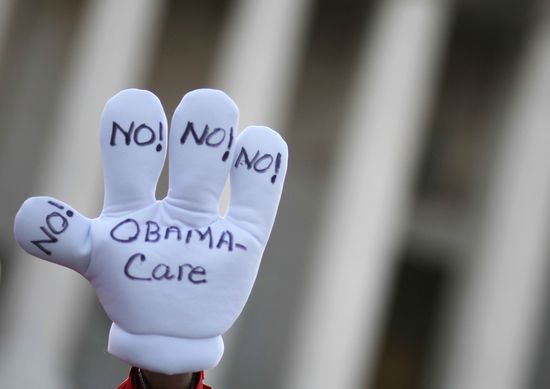
Derek Thompson rounds up the tough individual mandate questions asked by the Justices today. He calls Justice Kennedy's worries, reproduced below, "perhaps the most important paragraph of the morning." What Kennedy said:
The reason this is concerning, is because it requires the individual to do an affirmative act. In the law of torts our tradition, our law, has been that you don't have the duty to rescue someone if that person is in danger. The blind man is walking in front of a car and you do not have a duty to stop him absent some relation between you. And there is some severe moral criticisms of that rule, but that's generally the rule. And here the government is saying that the Federal Government has a duty to tell the individual citizen that it must act, and that is different from what we have in previous cases and that changes the relationship of the Federal Government to the individual in the very fundamental way.
Sarah Kliff decodes some legal jargon:
“Limiting principle” is a phrase that came up a lot in the Supreme Court Tuesday morning – 15 times, according to the transcript. It’s a legal concept you’ll probably hear a lot about in this afternoon’s analysis. When courts review a new application of Congress’s constitutional authority, they historically wanted to see the government articulate a clear limit to those powers – they look for, in legal jargon, a “limiting principle.”
Lyle Dennison puts Kennedy's comments under a microscope:
If Justice Anthony M. Kennedy can locate a limiting principle in the federal government’s defense of the new individual health insurance mandate, or can think of one on his own, the mandate may well survive. If he does, he may take Chief Justice John G. Roberts, Jr., and a majority along with him. But if he does not, the mandate is gone. That is where Tuesday’s argument wound up — with Kennedy, after first displaying a very deep skepticism, leaving the impression that he might yet be the mandate’s savior.
So does Orin Kerr:
Reading the tea leaves, it sounds like Justice Kennedy accepts the basic framework of the challengers that mandates are different and especially troubling. Instead of saying that mandates are therefore banned, however, Justice Kennedy would require the government to show some special circumstances justifying the mandate in each case. The answered question in this case is whether the special economics of the health care market justifies the mandate here.
Adam Serwer can't believe that Obamacare's defenders were so unprepared:
The months leading up to the arguments made it clear that the government would face this obvious question [about a limiting principle]. The law's defenders knew that they had to find a simple way of answering it so that its argument didn't leave the federal government with unlimited power. That is, Obamacare defenders would have to explain to the justices why allowing the government to compel individuals to buy insurance did not mean that the government could make individuals buy anything—(say, broccoli or health club memberships, both of which Scalia mentioned). [Solicitor General Donald B. Verrilli Jr.] was unable to do so concisely, leaving the Democratic appointees on the court to throw him life lines, all of which a flailing Verrilli failed to grasp.
Steve Kornacki points out that Verrilli's performance might not matter:
Keep in mind that it’s also possible that all of the justices made up their minds long before today’s arguments, meaning that Verrilli – if he really performed as terribly as firsthand observers are saying – might not have actually blown the case, no matter how badly he did.
Jonathan Cohn is more upbeat than Jeffery Toobin:
Reaction in the press room, although mixed, seemed more negative than reaction elsewhere. My canvassing of legal experts found pretty mixed opinions on how the case will turn out. (Walter Dellinger, the Duke law professor who supports the law, pointed out that the plaintiffs effectively made it clear that the only way to create national health insurance would be through a single-payer system, an idea most conservatives detest.) Truth is, it's impossible to know what the justices are really thinking – and to what extent the justices are asking questions to satisfy their own doubts before going in the other direction.
Emily Ekins doubles down on the broccoli argument:
"If the government can do that, what else can it do?" asked Justice Antonin Scalia, referring to the individual mandate portion of the Patient Protection and Affordable Care Act. He then questioned whether Congress could also require individuals to buy vegetables, such as broccoli. The recent national Reason-Rupe poll of 1200 adults released yesterday shows 87 percent of Americans believe it is unconstitutional for Congress to mandate that you buy broccoli. Eight percent think Congress can constitutionally force you to buy vegetables.
Chait rips his hair out:
[Obamacare opponents] have managed to whip themselves into a frenzy by painting fantastical, concocted stories about the government forcing people to eat broccoli – as if they truly cannot imagine a legal or philosophical principle that would allow the government to enforce a health care mandate (that conservatives invented!) and not allow the government to force-feed broccoli to its population.
Ezra Klein claims that tax economists see "no economic difference between the individual mandate and the policies leading Republicans support to give large tax credits to Americans who purchase health-care insurance and deny them to those who don’t." James Joyner nods:
[T]here’s zero doubt that Congress has the power to accomplish the same goal in a way that’s only technically different under the taxation power. That is, they could simple raise everyone’s tax bill by the amount of the current penalty for being uninsured and issue them a 100 percent credit for years in which they were covered by insurance. But they wouldn’t have been able to get 60 votes in the Senate for that, so they settled on the mandate mechanism instead.
Paul Waldman points out that Americans want something for nothing:
85 percent of the public—in other words, basically everyone—thinks we all ought to get coverage no matter our pre-existing conditions. Even Republicans think that. But over half of the public doesn't think we ought to be required to get insurance, despite the fact that universal participation in the insurance pool is precisely the thing—and the only thing—that makes it possible to do away with exclusions for pre-existing conditions and get closer to a system that operates the way it should, i.e. that you have insurance, and that insurance pays for whatever medical needs you have, full stop.
Conor Friedersdorf concurs:
Put simply, Americans want all the freedom of a market-based health insurance system, all the security of a system heavily regulated by government, and the option to put off purchasing this guaranteed insurance until it's needed. And all for no more than they're paying now. It seems whoever is in power will be doomed to disappoint.
Yuval Levin argues that the importance of the mandate to Obamacare isn't a defense of it:
Acknowledging that the system you have designed can’t function economically unless everyone is compelled to participate in it should make you wonder about the wisdom of that system, rather than making you defend the proposition that Congress has the authority to compel everyone to buy what you want them to buy. And the attempt to justify the mandate as an independent solution to a problem with American health care that existed before the enactment of Obamacare is simply not valid.
Ed Kilgore sighs:
Perhaps tomorrow’s hearing, on the “severalbility” of the mandate from the rest of the ACA, and on the constitutionality of its Medicaid provisions, will generate some new hints, but probably not. We’re in for a long wait—probably until June or July—with a truly momentous decision in very serious doubt, and the ever-erratic Kennedy in charge. That’s just great.
Ben Jacobs looks ahead:
The Court on Wednesday will focus on severability, or how much of the law could remain on the books if it decides the mandate is unconstitutional. Many observers have assumed that this argument would be relatively academic, since the mandate appeared to be in good shape. But after the government’s apparent failure to win a clear fifth vote on Tuesday, tomorrow’s arguments could help determine whether all 2,000 pages of the Affordable Care Act are thrown out.
Today's audio and transcript are here.
(Photo: A anti-Obama health care glove is worn in front of the U.S. Supreme Court building, on March 27, 2012 in Washington, DC. Today is the second of three days the high court has set aside to hear six hours of arguments over the constitutionality of President Barack Obama's Patient Protection and Affordable Care Act. By Mark Wilson/Getty Images)
As Matt Stopera puts it, "Humans really shouldn't be able to do this":
He's not telling:
One of the things I found in a short campaign against Ted Kennedy was that when I said, for instance, that I wanted to eliminate the Department of Education, that was used to suggest I don’t care about education … So will there be some [departments] that get eliminated or combined? The answer is yes, but I’m not going to give you a list right now.
One of the things I have found in previous elections is that announcing my plans makes people want to vote against me!
My view? Until the GOP specifies its massive spending cuts, alongside its further tax cuts and huge defense spending plans, then they deserve to be treated with contempt. If you've touted yourselves as the champions of fiscal rectitude, you'd better have the proposals clear. We know what the record of Republican presidents is: more increased spending than Democrats in far better economic times. Voting for the GOP in the past has meant voting for more and more debt and spending. If they intend to break that pattern they better show us exactly how.
A reader reacts to the post praising New Zealand:
Are you kidding? The country has a mere 4 million people. What's next? Connecticut exceptionalism?
A reader asks:
If New Zealand is so great, why is everyone leaving it? In February alone, 4,100 Kiwis left for Australia, capping off of a 12-month period in which New Zealand lost a net 39,100 people to its neighbor.
Another is more diplomatic:
My folks just returned from a multi-week trip to Australia and New Zealand. Aside from generating a decent amount of jealousy and resentment in their two 20-something sons, they came back with a respect for how New Zealand is bouncing back from the earthquakes that wrecked Christchurch and other parts of the island. In every place they visited, the people greeted them and assured all the tourists they saw that the country is back and open for business, so send your friends and their wallets!
This contrasts to the reception tourists gawking at damage receive in New Orleans, as chronicled in an in-depth NYT article this weekend. You’ve covered the moral ambiguity of "disaster tourism" before, and I was surprised to hear my parents had giddily jumped on a bus to stare at what nature wrought in New Zealand. However, they were repeatedly thanked by everyone they came across for visiting and spreading the word on recovery efforts. All that and while attending a Maori festival, my dad met and spoke with the prime minister, John Key.
Fallows explains why he thinks he is:
Even Netanyahu must see that no nation fashions a long-term peace for itself with a foreign policy based exclusively on "hard" power. That lasts for a while, but only so long. And if Netanyahu applies a "hard power" "solution" to the Iranian problem – a bombing run that, at best, buys a few years of time- but in exchange undermines Israel's long-run wellbeing, he will have done something very damaging for his nation. A crucial element of that well-being is of course Israel's ties with the only ally that matters, the United States. If an Israeli prime minister launches a "discretionary war" that his main ally plainly does not want, and that has tremendous open-ended potential to damage America and its interests, how is this not a disastrous decision for his country.
Goldberg disagrees – largely because of post-Holocaust psychology. I worry that foreign policy based on collective if completely understandable PTSD is not the best guide to a sane and self-interested foreign policy.
An apparent fan of the AAA videos edited and uploaded a key segment from last Friday's episode:
A reader writes:
So this morning me (22) and my father (52) were watching Bill Maher together – a fairly new occurrence. We're both Catholic and we both get kind of irritated with Maher when he goes on his usual reductive rants about what it means to belong to any faith other than atheism. Predictably, when that segment of the show popped up, my father groaned "here he goes again." Now, I just wanted to point out that my father, who has no idea who the hell you, applauded in my living room today during your defense of the quality of American Catholicism. From both of us, I just wanted to share a simple thank you for being so articulate and using your platform to try and strike down the notion that the Body of the Church is driven solely by the Hierarchy.
A reader writes:
I'm a fan from Brazil and I just watched you on the Bill Maher show. Indeed Catholics have to fight to change what we feel is wrong in the hierarchy of our church, specially considering rights of our fellow human beings. However, I think it's wrong to say that Santorum acts entirely according to the Vatican and Pope.
Remember this is a man who rejects macro evolution, universal health care (helping the sick), actions to help the poor (reducing social inequality) and is pro war. We know that the church has been preaching social justice for more than a century (I'm quite sure Santorum has never read the "Rerum Novarum"). Also the current and last Pope have written they accept evolution and states that it does not contradict our faith. Lastly, the Vatican was always against the war on Iraq and would be certainly be against attacking Iran. Therefore, it's not fair to say Santorum is the role model Catholic according to the Pope Benedict. I would say it's fair to say Santorum only follow the worst part of Pope Benedict sayings, which is the terrible way he has dealing with the gay's rights issue, treating them as lesser human beings, when we are all brothers.
Another:
Your comments hit home re: your local parishioners being supportive of gay rights despite an institutional bias. As a recently unlapsed Catholic (sort of), I was struck, while looking at the weekly bulletin, that my church has a group for gays and lesbians. "Hey wait a minute," I thought, "aren't we being pounded by the Pope and St. Santorum about how evil these people are – shouldn't we be storming these people's brownstones with torches?" I guess this is yet another case of using something as an institutional tool to retain power (ie, fear), although not REALLY meaning for it to pertain to people you personally know (eg, Dick Cheney's daughter.)
More importantly, dude – do you wear the same blue shirt EVERY time you go on Maher's show?
Yes, I do. It's become a tradition. They give me shit if I don't wear it. And I notice a question Bill asked in watching this that I didn't on set: how often do I go to Mass? For most of my life, weekly. In the last few years, since the sex abuse crisis, I've found it harder to overcome my anger at the instititution as a whole. There are periods when I go every week, and then lapse for a few. But I find these questions and prayers are with me more now than they once were. I'm half in the church and half in the wilderness. But the wilderness leads back to the church.
Hussein Ibish reviews Bret Stephens' caustic review of Beinart's The Crisis Of Zionism. I'm working on a review of the book myself. I hope to post it soon.
A reader writes:
I'm dismayed by your increasingly childish spat with Jeffrey Goldberg (he's been increasingly childish too, but, I have to say, you more so). It's because of you that I read Goldberg in the first place, and that you're making such a big deal of a minor disagreement with a man who agrees with you on almost all major points regarding Israel/Iran/settlements just doesn't make any sense. Now since Goldberg apparently doesn't have to time right now to immediately substantiate his claim that you've falsified his positions, let me do that for him. It's pretty simple:
1) Ever since his original Atlantic piece reporting the likelihood of an Israeli strike on Iran last year, you've been consistently confusing his reporting "Israel will probably do this" for an advocacy that "Israel should probably do this," even though he's always said that he thinks a preemptive strike on Iran would have few gains and many very bad consequences.
That is misrepresentation, and you've been doing that for a while, either suggesting that Goldberg has been "played" by the Israelis or is their willing accomplice, but without any evidence. On this point the charge that you don't understand how reporting works doesn't seem so farfetched.
2) More recently, you've said that Goldberg is changing his story, and you linked to a Roger Cohen column to the same effect: now, since there hasn't been a strike, Goldberg thinks that Netanyahu was bluffing all along in order to play Obama. But if you read Goldberg's actual column (not reporting, but exclusively opinion), you find him entertaining the idea that it's a bluff, but that he still thinks Bibi is in earnest – that he is not bluffing. So you've misrepresented him again. Or you have special insight into his serially lying heart. What evidence?
You and Goldberg agree that it's not a good idea to strike Iran. You agree on the desirability of a two-state solution. You agree that the settlements are an obstacle (and he got there before you on that one). You agree that Netanyahu hasn't really been helping the situation. All you disagree about is tactics and Peter Beinart. And while you've been hyperventilating that Goldberg is part of a conspiracy not even to consider Beinart's proposal, Jeffrey's been talking to a number of people who have considered (and rejected for various reasons) that proposal.
How about you stop fixating on Goldberg's supposed errors and explain why you think Beinart's proposal could work? That's a conversation that might go somewhere, but so far you haven't done anything of the kind, but only called his critics names. Drop the ad hominem arguments, stop picking idiotic fights with people who should be your allies, and present a real defense of his suggested policy.
My reader deserves his vent. But a couple of points. I did not misrepresent Goldberg's first column on bluffing. I accurately described his position – intrigued by the idea but not completely persuaded by it. What concerned me was his delight that the bluff might have worked, which would have made him an unwitting accessory to it, something that did not seem to concern him, but which concerns me and others at his own magazine. Secondly, the issue is not with Beinart's specific NYT op-ed proposal to boycott goods from settlements, rather than from Israel proper, but with Goldberg's dismissal of the entire book, and accusing it of errors he does not cite.
And on the core point, yes, there's agreement on the need for a two-state solution, and for not bombing Iran. But at every point when Israel has faced possible external pressure to stop the settlements, Jeffrey has opposed it. And his reporting of how some Israelis feel threatened by an existential threat was also a defense of it.
 The Dish