"In some quarters of the right it is considered, so to speak, an article of faith that the war against al-Qaeda and its ilk is really a war against Islam, and that no Muslim can possibly be trusted to be an ally in this fight. Even talk of allowing Muslim judges in Afghanistan to issue warrants for "night raids" has been greeted with contempt by some even though many Muslim Afghan soldiers now go out on those raids. Indeed, thousands of Iraqi and Afghan soldiers have lost their lives fighting alongside American allies against our mutual foes in extremist groups such as al-Qaeda, the Taliban and the Mahdist Army. Further discrediting the anti-Muslim propaganda is the fact disclosed yesterday by the Washington Post that the long-serving head of the CIA’s Counterterrorism Center–the architect of policies which have sent countless jihadists to an early grave in drone strikes–is himself a Muslim," – Max Boot, Commentary.
Month: March 2012
“You Cannot Get There …”
… you can only be there.
NOM’s Racial Agenda
Confidential memos have been released in the course of an investigation in Maine:
"The strategic goal of this project is to drive a wedge between gays and blacks—two key Democratic constituencies," says an internal report on 2008 and 2009 campaigns, in a section titled the "Not A Civil Right Project." "Find, equip, energize and connect African American spokespeople for marriage, develop a media campaign around their objections to gay marriage as a civil right; provoke the gay marriage base into responding by denouncing these spokesmen and women as bigots," advises the document, which is a road map to the successful campaign against same-sex marriage in California.
I'm in no way shocked by this strategy. It's been obvious for a whle. I am a little taken aback by the language. It reveals the ease with which a lobbying group is prepared to play racial games, and sees African-Americans (and gays, for that matter), as mere means to an end. Then this on Latinos:
"Will the process of assimilation to the dominant Anglo culture lead Hispanics to abandon traditional family values? We must interrupt this process of assimilation by making support for marriage a key badge of Latino identity – a symbol of resistance to inappropriate assimilation."
So an allegedly conservative group is trying to prevent Latino assimilation into the American norm, and to harness anti-assimilation feelings and resentment to aid their anti-gay cause. To sum up: divide by race, and oppose assimilation of immigrants. Lovely.
And it isn't working. The latest NBC/Wall Street Journal poll [PDF] shows support for marriage equality rising from 32 percent to 50 percent among African-Americans since 2009, and Latinos now backing marriage equality by 55 to 30 percent.
The Terror Of Catcalling, Ctd
A reader writes:
Thank you for linking to that essay, which I have passed on to my 23-year-old daughter. She deals with catcalling every time she turns right from her house and walks down the next block – which she now seldom does. The (mostly out of work) young men sitting on their porch stoops or leaning against cars parked in the street (which means they are blocking the sidewalk) make horrible comments to her – “Hey fucking white bitch,” “I wanna fuck you, white bitch,” etc. Lovely, no? Like the young essayist, she wears the baggiest, most unattractive clothes if she is forced to walk through that area, but to no avail. The closest bus stop is through those two blocks of catcalls, but she walks six blocks in the other direction to avoid the harassment. This is in your fair city of Washington, DC, just three blocks from Rock Creek Park. (But she is planning to move to Silver Spring in a couple of months.)
Washington City Paper did a cover story on the problem several years ago. Another reader:
It’s a conversation I’ve had with men so many times, and it’s been so hard to make a dent. Some of them do get it after a while – a lot of them don’t.
I grew up in a big city, taking public transportation, and dealt with this from about age 14 through early college. I never came to any actual physical harm, though one of the men staring at me on the bus late at night did get off the bus after me at my stop and start to follow me home. (I went to a male friend’s house, explained what was going on, and hid out there until the coast seemed clear. If my friend hadn’t been nearby? Who knows.)
But the daily gauntlet was so exhausting and so demoralizing. One day in high school I wore a short skirt and a crop top to school – it was the late ’80s, it was fashionable, and it was a warm day. I forgot that I was supposed to take the city bus to an orthodontist’s appointment after school that day. (Every time I retell this story I make sure to include that detail.) The bus was excruciating (catcalls, stares, leers, gropes, girlfriends of starers also glaring at me, etc.) and I had no leeway – pull down the top to cover my belly and there was more cleavage, pull up the skirt and there was more leg, etc. I had a small backpack and used that as a shield best I could.
I finally escaped to the haven of the orthodontist’s office. Or so I thought. Stretched out on the dentist’s chair, the ogling and inappropriate comments started all over again – from the orthodontist.
Having gotten through THAT, I waited anxiously for my dad to pick me up (he was late, and I literally hid inside the lobby, finding the least-visible corner), and started sobbing as soon as I closed the car door behind me. He of course wanted to know what was wrong, and I tried to explain. He profoundly didn’t get it. “You just look nice today,” he said.
Yes, I should have remembered that I needed to take the bus and worn something more concealing. But really, why is that the baseline? Why did that mean that 17-year-old me was “asking for” that kind of harassment?
I do think it’s something that we as women get used to and can eventually brush off. And get old enough and it stops – something I genuinely don’t mind. I prefer invisibility to that kind of visibility.
But it’s going to keep happening to new generations of girls who are ill equipped to deal with it and shouldn’t have to deal with it, unless the people doing the more “innocent” but contributory staring quit (notice how she reacts, and stop if she seems uncomfortable) and unless everyone contributes to censure of the really overt gropers catcallers.
Another:
I’m a 27-year-old woman who, ten years ago, turned down the most competitive college I’d been admitted to because there were some things about living in a big city that scared the hell out of me, including catcalling. Earlier this year, after a decade of living in different cities and growing a lot more comfortable in my own skin, I was walking down Market Street in San Francisco, south of Civic Center, when a probably homeless, probably druggy man got right up in my face and called me gorgeous, and it didn’t even phase me.
At some point, I realized that treating each whistle, holler, or unwelcome compliment as threatened rape just isn’t evidence based. Most of these men are just looking to have their existence acknowledged by a pretty woman. It’s annoying, pathetic, and I wish they’d stop, but I refuse to let it terrify me anymore.
On the other hand, later that day, a separate group of men gave off enough of a different vibe that when they started yelling comments after I passed, it was enough to make me turn the corner and take the next street down the rest of the way to my destination. Not all catcalls are created equal, and sometimes it’s hard to even pinpoint what the difference is.
Is War A Virus?
It sure acts like one:
Imagine your neighbor is a violent psychopath who is out for blood and land. You, on the other hand, are person who wants peace. You would have few options but to embrace the ways of war for defense. So essentially your neighbor has infected you with war.
In an interview about his new book, The End of War, John Horgan connects this to contemporary conflicts:
Now you've got the case of Iran, the drums of war are beating again. Why is that? Is it over resource competition? No, not at all. It's because we think Iran is going to attack us because they're building nuclear weapons. And of course Iran, if it is interested in nuclear weapons, is interested in them because they think we're going to attack them or Israel is going to attack them. So I think you see clear evidence even right now, if you look around the world, as war as something that perpetuates itself apart from any other causes or factors.
Chart Of The Day
Today's Supreme Court oral arguments focus on the individual healthcare mandate. What happens if the mandate is ruled unconstitutional but the rest of the law is left intact? A round-up of estimates:
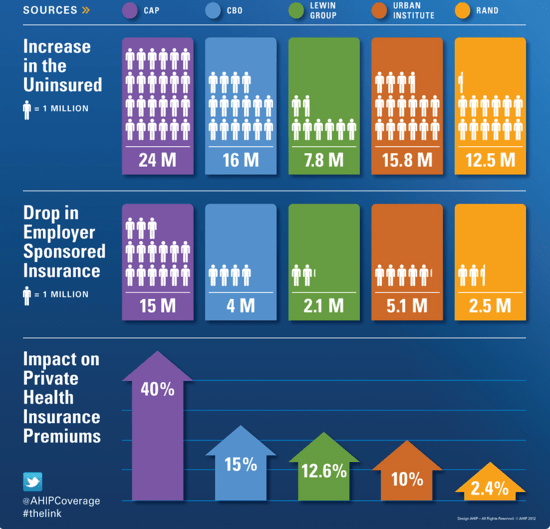
Sarah Kliff captions:
Health-care economists use different models and algorithms to game out what would happen if the high court struck the mandate down. That’s why you see some significant differences between what different studies predict. But, in general, they all expect the same outcome: Fewer Americans would gain health insurance, and it would cost more.
Jonathan Gruber, an architect of both Romneycare and Obamacare, defends the individual mandate:
There have been a variety of complaints about the individual mandate, but they are unfounded. It is important to remember that the vast majority of Americans will be unaffected by the mandate because they are already covered; indeed, when individuals are informed of this fact, public support for the mandate almost doubles. Moreover, no one will be forced to buy insurance that they cannot afford; the mandate includes an “affordability exemption” that excludes any individual who cannot find insurance for less than 8% of their income. In Massachusetts we have a similar exemption and we have had no public outcry about the mandate and only a very small number of appeals of mandate penalties.
Aaron E. Carroll points out that there are various alternatives to the mandate:
[The mandate is] fixable if people truly cared about the mandate, and the mandate only. We can have the desired effect of the mandate without the offensive, potentially unconstitutional, aspects of it. But at this point, many fighting the mandate are really fighting the Affordable Care Act, albeit with the tools available to them.
Why Won’t The GOP Establishment Rally Around Romney?
Fear:
To win over the skeptical conservative base, [Romney] needs influential figures on the right to vouch for him. But if they vouch for him, they risk being declared RINOs themselves, establishment sellouts trying to force an impure nominee on the GOP. And they know that any dramatic gesture they make now will be remembered.
What if Romney wins the nomination, loses in the fall, and the conservative base concludes they were tricked again – that it’s time to redouble their purity crusade? Or what if Romney wins in the fall and, like George H.W. before him, tries to govern from the middle as president, prompting a GOP civil war. What conservative leader would want to spend the next four years explaining why he or she played such a critical role in elevating that kind of president?
A True Bionic Arm
Despite the above video, from a few years ago, an artificial arm that works like the real thing is still a dream:
“The human arm is amazing,” says Rahul Sarpeshkar, a bioengineer at MIT who pioneered the design of ultralow-power circuitry for bionic interfaces. “It does a lot of very intelligent local computation that the brain doesn’t even do. We don’t understand the coding schemes that biology employs. We don’t understand how its feedback loops work together.” In other words, the science hasn’t yet caught up with the fiction.
A true bionic limb—one that responded to mental commands with precision and fluidity, one that transmitted sensory information, one that its user could feel as it moved through space—would require a depth of understanding and technological complexity that is simply beyond today’s prosthetic experts. “It’s not that we’re not going to be able to do it,” Sarpeshkar says. “But it’s higher-hanging fruit than people think.” In other words, this is more than just an engineering problem. It’s a problem of basic science.
Why Does It Cost More To Be A Woman? Ctd
A reader writes:
I’m sympathetic to most cases of gender pricing, but some of these examples are a bit silly. Deodorant? The reason women pay more for deodorant is because they’re willing to pay more for their deodorant. Laying everything at the market’s feet can often times be lame, but this is a perfect example of it. If women wanted cheaper deodorant, cheaper deodorant would be available. Or is there a company that has a monopoly on the women’s market? The same can most certainly be said of razors, and a host of other products. Again, this isn’t excusing all cases of this, but let’s be serious.
Another writes:
One detail in response to Lea Goldman's claim that women pay more for mortgages: The authors (one of which is female) of this paper researched that question and concluded that the behavioral way in which women select a lender explains much of the gender disparity:
While the persistence of gender disparity may suggest discrimination, we offer a different explanation: women pay higher rates because they are more likely to choose lenders by recommendation while men tend to search for the lowest rate. Our empirical test confirms that search effort is rewarded in the marketplace, and suggests that gender disparity in mortgage rates may be addressed by policies aimed at improving women’s financial literacy and search skills.
The Psychology Of Virtual War
Mariarosaria Taddeo elaborates on the new definition of war and the problems it presents:
[W]hen you have robots fighting a war in a foreign country, the population of that country is going to be slow to gain trust, which can make occupation or even just persuasion quite difficult. You can see this in Iraq or Afghanistan, where the populations have been slower to develop empathy for American forces because they see them as people who send machines to fight a war. But these shortcomings aren't weighty enough to convince politicians or generals to forgo the use of these technologies, and because of that I expect this trend towards the use of robotic weapons will continue.
Shaun Randol reviews Harun Farocki’s recent video installation at the Museum of Modern Art that juxtaposes the videos used to train soldiers for war and those used to treat soldiers suffering from PTSD:
In an essay accompanying the show, Farocki explains the use of gaming technology by the U.S. military: Technology, he says, “is not only employed on the battlefield, but is also used for recruiting, training, and therapy for battle-scarred soldiers. It is the beginning, the middle, and the end of the violence of war. Never has war been so transparent, so tangible, so efficient or so virtual.”
 The Dish