"This is my last election. After my election I have more flexibility," – Barack Obama, speaking into a hot mic, when discussing US-Russia relations with Dmitry Medvedev. In response, Dan Drezner and Daniel Larison look at the second terms of presidents.
Month: March 2012
Fantasy Politics
Pareene rolls his eyes at the 2016 speculation:
[Y]ou see where we are, at this point: Randomly tossing out names. It’s like predicting the 2016 NFL Draft. Some of these kids are still in high school!
Will SCOTUS Arguments Change Public Opinion?
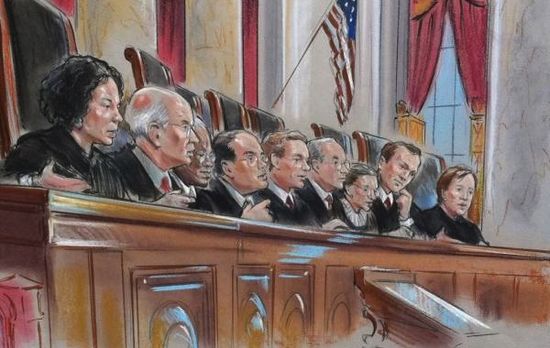
With the ACA again taking center stage, we’ll be hearing a lot of strong rhetoric, and many will wonder how that stiff language may shape public opinion. With few exceptions, the data show that the answer is very little. The federal government’s role in the health-care system has been a recurring political issue for generations, and we should be skeptical of the idea that specific rhetorical flourishes will change the basic trade-offs that Americans perceive to be at the heart of the debate.
(Illustration from the first day of ACA arguments by artist Bill Hennessy, via Lorna Baldwin)
Quote For The Day
"Look at him. He looks like us with his Kippah and Zizith. He looks like us but he is not. He is a traitor who defends Arabs. In fact, he's not even a Jew," – a settler commenting on Israeli Jews defending Palestinians in Jerusalem.
Mental Health Break
Just wow:
The Black-Market Markup, Ctd
A reader writes:
Nonsense. The weed in Amsterdam, where it is functionally legal (technically "tolerated"), is more expensive by the gram than the East Coast black market weed (imported from California) we are lucky enough to get. And the quality of the US weed is every bit as good. It isn't that easy to grow world-class pot. As Michael Pollan has so eloquently pointed out, the best botanists of our generation are working underground on cultivating stronger and stronger pot.
Another writes:
One of the issues to keep in mind with legalizing cannabis isn't just the money government would be taking in; we also need to consider the money government would be saving.
DEA, FBI, and ICE resources would be reallocated, as would prison resources, and court resources. We would be saving money on prosecution, enforcement, and incarceration costs. That has to matter, doesn't it?
And that doesn't even get into tax policy. Tobacco taxes have little to do with the production value. I doubt taxes on cannabis would either.
Finally, when did legalization become an issue of "alleviating our budget woes"? I don't think I've ever heard anyone seriously say that legalized pot would balance the budget (I've heard, and made, jokes along those lines). There are so many better arguments: it isn't as harmful as alcohol or tobacco; it undermines the rule of law because so many people break it; it's bad policy and a waste of resources. Any help on the budget is just a fringe benefit.
Another differs on that point:
I think Mike Riggs is missing the point: The massive mark-up, that right now can probably be considered "danger money" for dealers at various levels, can be imposed by the government. After all, I can't get a pound of cigarettes for $2.
Naturally, people growing their own will limit the extent to which the government can simply fill the role of the cartels (who will lose big no matter how the price is affected, something to bear in mind!), but I'm sat half an hour's drive from the Dutch border in Germany, and there is little difference in price between their legal, and our illegal marijuana.
It is not the act of legalisation that matters, but how this is done. This isn't some magic South-Park-gnome-style "weed + ? = $" equation, and I have heard nobody who has made the economic argument for legalisation indulge in that sort of simplified fantasy. I firmly believe that it is the economic argument that will win this thing in the end.
The social and moral arguments of unfairness are all true enough, but they simply have not worked, and they have not worked for decades on end. The only way we are going to win this is by making the right people realise what an incredible pile of money is to be made, and we will probably have to tell them how it can be made, too, since these people have no idea about the drug industry as it is.
Anyone up for crowdsourcing a first-draft marijuana legalisation bill?
Hewitt Award Nominee
A momentary but vile visual at the 0:39 mark:
Alex Klein is queasy:
Rick Santorum just released an incredibly weird campaign ad, complete with empty playgrounds, spinning clocks, and ghostly daguerreotypes. But beyond dystopia, there's something else that's deeply off-putting about the video: a rapid jump cut between the faces of President Obama and Iranian president Mahmoud Ahmadinejad.
In a subsequent post spotlighting Herman Cain's latest piece of performance art, Klein comments: "There must be something in the water, as kooky, creepy, post-modern dystopia is becoming a common theme in a lot of Republican ads."
Better Budgeting: Cash Or Credit?
Seth Stevenson went without paper money for two months:
Some folks swear by spending only cash because they "feel the pain more" than they do when they swipe a credit card. ([David] Wolman says economists refer to this as "the salience of the form.") It makes sense that people would want to avoid credit card debt in the simplest manner possible: by limiting their use of credit cards. But my spending experience was the opposite.
Those $20 bills seem to just float themselves away when I’m out on the town, while signing a credit card slip reminds me that I’ve contracted to fulfill a dead serious monetary obligation. I can also keep track of precisely what I’m spending my money on when I use a credit card and can even download that information into a budgeting program like Mint to analyze my outlay. Cash offers no such helpful record. (And let’s not forget those loyalty points. I buy most of my Christmas presents every year with the rewards from my Chase Amazon Visa.)
Ask Charles Murray Anything
Charles Murray's most recent book, Coming Apart: The State of White America, 1960-2010, has been discussed on the Dish here, here, here and here. The most notable coverage of the libertarian intellectual lately was his conversion on marriage equality. And the Dish for years has debated his most famous and controversial work, The Bell Curve, which he co-authored with Richard Herrnstein. But the main focus of this installment of "Ask Anything" is Murray's most recent book:
In Coming Apart, Charles Murray explores the formation of American classes that are different in kind from anything we have ever known, focusing on whites as a way of driving home the fact that the trends he describes do not break along lines of race or ethnicity. Drawing on five decades of statistics and research, Coming Apart demonstrates that a new upper class and a new lower class have diverged so far in core behaviors and values that they barely recognize their underlying American kinship—divergence that has nothing to do with income inequality and that has grown during good economic times and bad. The top and bottom of white America increasingly live in different cultures, Murray argues, with the powerful upper class living in enclaves surrounded by their own kind, ignorant about life in mainstream America, and the lower class suffering from erosions of family and community life that strike at the heart of the pursuit of happiness.
Here's your chance to ask Charles anything you want. We have primed the Urtak poll with some questions but please add some of your own (and ignore the "YES or NO question" aspect of the text field and simply enter any open-ended question). Answer "Yes" if you are interested in seeing Charles answer the question or "No" if you don't particularly care. We will air the answers in daily segments soon.
“Toward A Social Psychology Of Flatulence”
That's the name of a study exhumed from a 1980 edition of Psychology: a Quarterly Journal of Human Behavior:
How did it turn out? Well, it turns out people will rank you politely if your fart is silent and odorless (probably because they couldn't tell), but politeness ratings go down somewhat for the silent and deadly, and take a sharper dive when the fart is LOUD. Sound matters more than smell in terms of politeness, apparently.
However, while people may not think you're polite, they WILL think your loud farts are funny, with people who fart loudly being ranked as more humorous (though women did not find it as funny as men). If they know you did it deliberately, however, they are more likely they rank you as "malicious", ESPECIALLY if the fart is rank (silent and odorless apparently means you're a relatively good person here).
The sex differences were a little surprising. It turns out that women are more forgiving of loud, accidental farts (girls, we've all been there I'm sure), and don't ding the farter so much on "politeness".
Man, on the plane back from Los Angeles, the dude next to me (or someone close) was releasing silent killers for a full hour. I think I prefer the loud ones. Laughter helps alleviate the pong. Being slowly enveloped by someone else's gas, and being immobile, well … that's marriage, not air travel.
 The Dish