Xanax Nation

Just how addicted are we?

Prescriptions for benzodiazepines have risen 17 percent since 2006 to nearly 94 million a year; generic Xanax, called alprazolam, has increased 23 percent over the same period, making it the most prescribed psycho-pharmaceutical drug and the eleventh- most prescribed overall, with 46 million prescriptions written in 2010. In their generic forms, Xanax is prescribed more than the sleeping pill Ambien, more than the antidepressant Zoloft. Only drugs for chronic conditions like high blood pressure and high cholesterol do better. … Do modern realities merit an increased dependence on Xanax?

Steven Hayes, a clinical psychologist at the University of Nevada, believes that benzos stop a gap that evolution has yet to fill. As humans try to control an exponentially growing number of inputs with which they are confronted, “our attention becomes less flexible, our minds become more chattering, and the next thing we know, we’re frantic.” Humans are ill-equipped to process or accommodate all these new signals. “Our task now is to create modern minds for the modern world, and that modern mind has to be psychologically flexible.” In the absence of that flexibility, Hayes says, people need a bridge—a pill—between what life doles out and what people can realistically handle.

I’ll tell you this: after a night of live-blogging, no Xanax, no sleep. I don’t leave home without it.
The Obamacare Debates

Doug Mataconis cautions against believing either party's spin:

[T]he Supreme Court will be making audio and transcripts of each days hearings available approximately two hours after each hearing is concluded, so we’re likely to get near instant analysis of each days hearings along with much speculation about what the tenor the proceedings might mean for the outcome of the case. One of my first pieces of advice would be to not be quick to judge how a case will turn out by what questions are asked during the hearings, or which side the “experts” on cable television proclaim the winner or loser of a particular days arguments. For one thing, past Supreme Court oral arguments have made it clear that you can’t always tell how a case is going to turn out based on the questions that get asked during a hearing or a perception as to which side seems to be “doing better.”

Joey Fishkin makes a distinction between the popular debate and the legal debate: 

Outside the courts, one huge argument is if the government can make you buy insurance, can it make you eat broccoli?  This argument seems to have a lot of rhetorical bite. But the most straightforward response is the question in the title of this post.  Can your state government make you eat broccoli?  If the answer is no, as it surely is, then there must be some reason, other than limits on federal power, why that is so.  The most likely reason is that states force-feeding us vegetables would violate fundamental liberty interests protected by the Fourteenth Amendment. In other words, the “broccoli argument” does its rhetorical work by turning a question of Congressional power into a question of individual liberty.  And that, in microcosm, is what the entire public debate about the health care law is about, and why that public debate differs so much from the debate at the Court. 

Kiwi Exceptionalism?

David Hackett Fischer stands up for New Zealand in his new book Fairness and Freedom. Benjamin Schwarz reviews:

In some ways [New Zealand's] achievements seem all the greater when compared with those of the United States. In 2010, its unemployment rate was nearly half of ours. Our economic inequality is the highest of any developed country’s; New Zealand’s hovers much lower on the list. New Zealand ranks first in Transparency International’s global survey of government honesty; the United States ranks 22nd—just ahead of Uruguay!

And comparable divergences, Fischer shows, are found "in trends and measures of political partisanship, legislative stalemate, judicial dysfunction, infrastructure decay, home foreclosures, family distress, drug consumption, and social violence." … The result: by virtually every measure, New Zealand has a more just and decent society than ours—while resorting far less readily to legalistic and legislative remedies.

Tyler Cowen also spoke highly of the book.

Did The Libyan War Cause A Coup? Ctd

Elizabeth Dickinson draws lessons from Mali's fate:

The combination of these two things—weak democracy and dysfunctional security systems—has provoked not one but four coups in the last few years in the region. Niger, Mauritania, and Guinea saw similar (though of course not identical) events; Burkina Faso also saw a failed coup attempt. It has produced, in other words, the Colonel Coup syndrome that I described in 2010: middle-ranking officers with little to lose who are willing to take matters into their own hands. Generals would never be the coup-makers; they are usually close to the regime. Lower ranks don't have the resources. The middle understands what the army is up against—and how poorly equipped the system is to fight back.  Sometimes, they think the only option is to bring the system down.

The Obamacare Case Begins

Obamacare

The Economist and Ezra Klein have useful primers on the Supreme Court case. Lyle Denniston believes that "the final ruling has the potential to be the most important declaration on how the Constitution divides up power between national and state governments since the New Deal days some three quarters of a century ago":

Without exaggeration, it could be the most important pronouncement on the federal "safety net" since the Social Security Act was upheld by the Court in 1937.  Without exaggeration, a decision to strike down all or part of the new health law could be the most severe rebuff of Congress’s power over the national economy since the Sick Chicken Case in 1935.  And, without exaggeration, a nullification of the Act in whole or in part could be the most devastating blow to presidential power and prestige since the Steel Seizure Case in 1952.

Richard A. Epstein urges the justices to strike down the law:

[T]he Supreme Court should take this opportunity to reconsider the foundations of its commerce clause jurisprudence. The "wide latitude" given Congress is all too often used for enacting laws that support agricultural cartels and monopoly unions. These actions reduce social output, increase the federal footprint and stoke needless political controversy. Leaving production quotas and unionization exclusively to the states, restores to these markets a measure of competitive discipline that they desperately need, while allowing Congress to fulfill its main purpose of regulating cross-border business transactions, and interstate travel, transportation and communication.

Trevor Morrison's counter-point:

[M]any of those now arguing that upholding the ACA’s individual mandate entails abandoning the notion of any limits on Congress’s power are repeat offenders. They are rehashing their same old, long-since rejected, mantra. Ultimately, these folks are manifestly not concerned with helping the Court but are instead interested in using alarmist rhetoric to advance a very different project: returning Congress’s regulatory power to its pre-New Deal, and perhaps even pre-McCulloch v. Maryland, state. They are free to make those arguments, of course. But let’s recognize them for what they are.

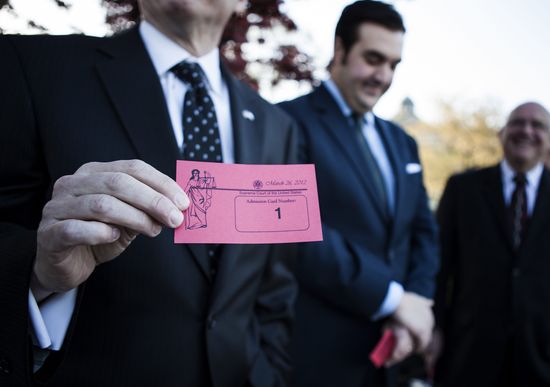
(Photo: Rev. Rob Schenk holds up the first ticket to view heath care arguments outside the US Supreme Court on March 26, 2012 in Washington, DC. The Supreme Court will hear arguments today challenging the Constitutionality of the Obama Administration's health care reforms during the first of three days of arguments . By Brendan Smialowski/AFP/Getty Images)

Your Digital Self Worth

Userdata_615

Itemized:

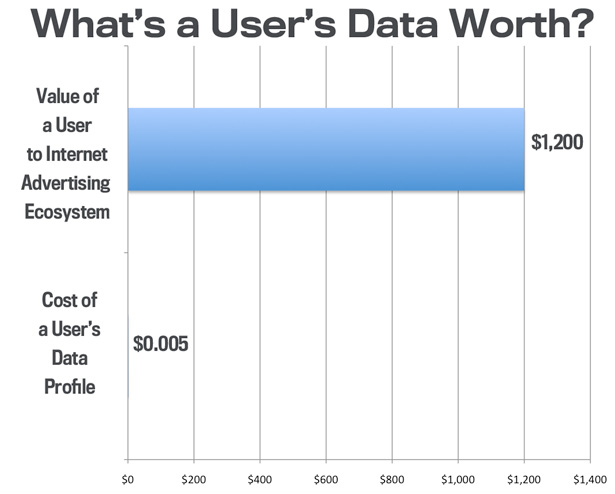
User profiles — slices of our digital selves — are sold in large chunks, i .e. at least 10,000 in a batch. On the high end, they go for $0.005 per profile, according to advertising-industry sources. But maybe that's not the right way to value the data. 

After all, online advertising "supported $300 billion in economic activity last year":

That's more than $1,200 per Internet user and much of the online advertising industry's success is predicated on the use of this kind of targeting data.  If you're keeping score, this necessarily apples-to-oranges comparison yields a difference of 240,000 times between how much a user profile sells for and how much a user, herself, may be worth to the ecosystem. That's six orders of magnitude worth of confusion.