The End Of Americanisms

A lament:

New words spring up all the time, but American language has become duller in some respects, because of the homogenizing impact of mass culture. The Subway fast-food chain has largely settled the great torpedo vs. hoagie vs. po’ boy vs. grinder vs. hero debate—most people just call a long sandwich a "sub." Yet what makes for better conversation, a cold Texas wind or a "blue norther"? A baby frog on Martha’s Vineyard or a "pinkletink"? The loss of such words almost puts a lump in your goozle.

Simon Winchester recounts the story behind the Dictionary of American Regional English (DARE), a project started in 1962 whose final installment will be published this month: 

The completed dictionary memorializes an American language that is demarcated by geography, topography, heritage, immigration. In that sense it differs significantly from the many slang dictionaries, which display a quite different, but equally informal language, that is denominated largely by craft, by age, by persuasion. The language of thieves and computer geeks, of carnival workers and sportsmen, of drug addicts and prostitutes and the homosexual world is qualitatively different from the dialect words of those who have lived for years in the valleys of West Virginia, say, or the plains of South Dakota. These two kinds of languages may occasionally overlap, but they are by no means cut from the same cloth.
Seeing Around Corners

With the help of a laser, photons and an ultrafast camera:

Geoff Marsh explains how scientists at MIT pulled it off:

They fire a pulse of laser light at a wall on the far side of the hidden scene, and record the time at which the scattered light reaches a camera. Photons bounce off the wall onto the hidden object and back to the wall, scattering each time, before a small fraction eventually reaches the camera, each at a slightly different time. It's this time resolution that provides the key to revealing the hidden geometry. The position of the 50-femtosecond (that’s 50 quadrillionths of a second) laser pulse is also changed 60 times, to gain multiple perspectives on the hidden scene.

Nudging Your Way Out Of Bad Habits

Charles Duhigg dishes out advice:

They say “Read to your kids,” which is great, because we know if you read to your kids, they’ll do better in school. But that’s not how you create a habit. It’s just ordering people around. You have to say, “Before your kid goes to sleep, have a book on their pillow. Put it there in the morning so it’s a cue for you to pick up. And you know what? You don’t have to read the whole book, just read three pages. The reward is to let yourself watch TV for a half an hour afterwards, because you did a good job. That’s how to create a habit.

Previous coverage of Duhigg's new book, The Power of Habit, here.

Defriending And Defunding

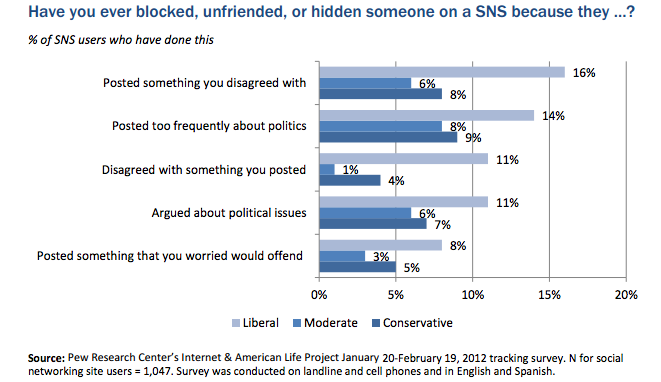
Screen shot 2012-03-20 at 12.46.06 PM

The unfriending trend could spell trouble for Facebook's business model:

In gross terms, 158 million people were unfriended in 2009, and more than a half a billion in 2011. … Experts say that the fewer friends a person has, the harder it is for Facebook to interpret the world the subscriber comes from. In turn, the less information Facebook has, the less they can charge for advertisements on the subscriber’s page.

The above chart is from a recent Pew report (pdf) that found 18% of social networking site users have decided to block, unfriend or hide someone because of their politics or posting activities. More on the rise and fall of online empires here.

Math Is Useless, Ctd

A reader puts it well:

Math is more about training your mind than equipping you with a tool for living.  It's no secret that high school math is useless, but that doesn't mean it's pointless.

Another writes:

I suppose that you were trying to be provocative with a post like "Math is Useless". It's supposed to bring people like me (an applied math Phd student at a major university) out of the woodwork to talk about all the great things that math has done for modern society. This is, of course, all true. However, we have not derived such a great benefit from math because the majority of people are required to learn how to calculate the interior angles of a polygon, but rather because of the small minority (maybe 5%, probably less) who have continued to pursue math after high school (of their own accord) and ended up in a vaunted STEM careers.

If we want to talk about useless subjects, I think we have to recognize that math, as it is currently taught to American high school students, is just about as useless as Shakespeare that is being taught to these same students.

Another:

I suppose for a moment that mathematics is only useful "if you engineer planes" or something. When is the decision of whether a person will engineer planes to be made? Should I tell my kids who are in middle school, "Decide now whether you would like to engineer planes, this stuff is useless otherwise." Should this be decided in high school? Before college? By whom?

It should be noted that without a certain level of mathematical proficiency, about half of the available college majors are essentially eliminated for that student. Many Americans seem to be okay with that choice; students from many other countries are not. Even if one does not wish to spend their lives "engineering planes" an educated populace requires a certain level of numeracy. People rightfully worry about illiteracy; what about innumeracy? Should people be able to solve a simple equation? Understand the notion of compound interest? Percentages? Understand the exploding amount of "data" and "studies" being fed to them daily, especially on unscrupulous "news" sources?

90 Days Of Sobriety

Kevin Sessums celebrates his:

I've been working on the penultimate chapter in my next book, I Left It On the Mountain. The chapter is titled The Pilgrim and concerns my spiritual trek across northern Spain for 31 days in May a couple of years ago when I walked the 600 miles of the Camino de Santiago de Compestela. On the 31st day as I was walking into Santiago I heard myself quietly singing – without really thinking about it – the hymn Amazing Grace. When I sang to myself the words, "… that saved a wretch like me …" something came over me – exhaustion? gratitude? an amazing moment of grace? – and I began to weep. I had to walk over to the side of the path and sit behind a tree and gather myself as I thought about all that those 31 days had shown and taught me.

It was, that moment of surrender, a kind of penultimate one itself. There was yet another I didn't quite see coming that was waiting for me because of that one.

But I had not reached that particular destination yet. I did gather myself that day outside Santiago, Spain. I fished into my back pack and pulled out my iPod. I put my earphones on and began to listen to my favorite version of Amazing Grace sung by the Soweto Gospel Choir. I had listened to it often during those 31 days when I was on my spiritual trek. I listen to it often still for the end of that 31-day trek was not an ending at all but the beginning of a the spiritual journey I remain on this very morning.

Indeed, this morning during the Eucharist when I was kneeling at the altar at St. Mary's Episcopal Church perched here on the harbor in Provincetown with my outstretched cupped palms humbly waiting for the rector to place the "host" into them and humble them even more, my mind stopped its meandering and went back to the shade of that tree on that last day on the Camino. I placed the host in my mouth and at that moment behind me the congregation began softly to sing Amazing Grace. Kneeling today I heard those words once more " .. that saved a wretch like me …" Something again came over me – exhaustion? gratitude? an amazing moment of grace? – and I began to weep.

What Is A Catholic Doctor’s Duty?

The same as any other doctor's:

“Conscience,” or personal beliefs, was …. used to deny care to HIV/AIDS patients. I started practice well before HIV-AIDS was recognized, when little was known about its transmission. I clearly recall the struggles both of patients and of health care workers who wanted to refuse to provide care to AIDs patients—either because of their religious beliefs or because of their own fears of becoming ill. Despite these concerns, it was demanded that health care workers care for all, and put the patients’ needs first.

… Catholic hospitals provide 20-30% of the hospital care in the United States.Religious health systems received more than $45 billion in public, taxpayer-supported, funds, including Medicare and Medicaid funding. The Catholic Health Association, for example, also receives huge tax breaks as a “non-profit, charitable” organization. Thus, religiously-affiliated health systems have an enormous influence on health care, especially in rural areas, where they are often the sole provider.

A Poem For Sunday

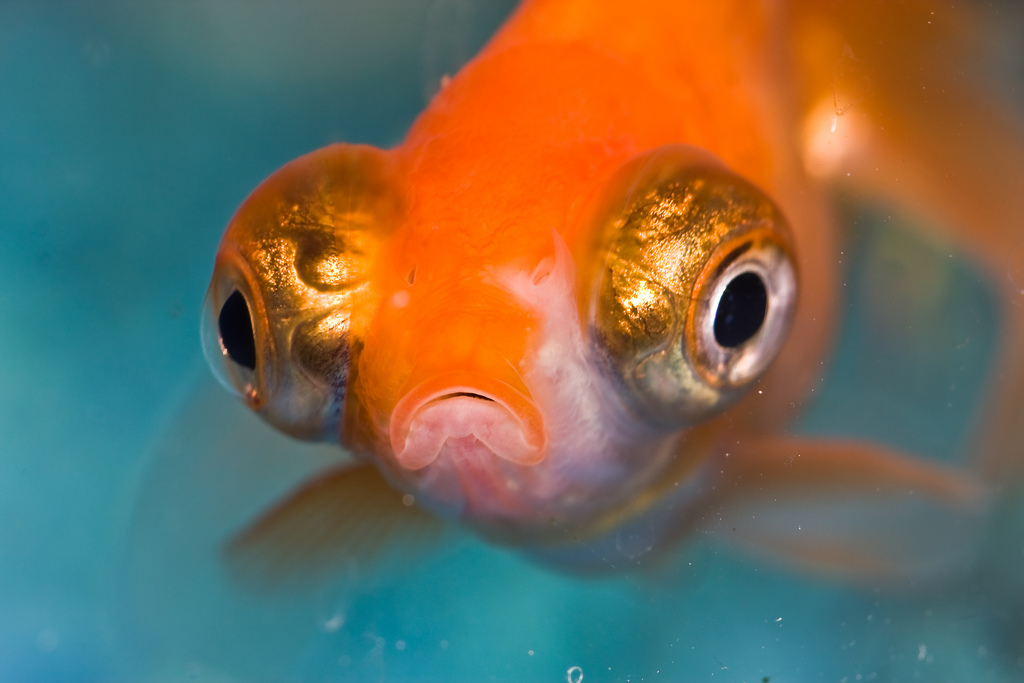
Fish_Flickr

"The Fish, the Man, and the Spirit" by Leigh Hunt:

To a Fish

You strange, astonished-looking, angle-faced,
Dreary-mouthed, gaping wretches of the sea,
Gulping salt-water everlastingly,
Cold-blooded, though with red your blood be graced,
And mute, though dwellers in the roaring waste;
And you, all shapes beside, that fishy be—
Some round, some flat, some long, all devilry,
Legless, unloving, infamously chaste—

O scaly, slippery, wet, swift, staring wights,
What is’t ye do? what life lead? eh, dull goggles?
How do ye vary your vile days and nights?
How pass your Sundays? Are ye still but joggles
In ceaseless wash? Still nought but gapes, and bites,
And drinks, and stares, diversified with boggles?

Billy Collins relishes the poem's take on hubris.

(Photo by Flickr user Benson Kua)

The Limits Of Biology

We live in a world where everything appears to be explained by neuroscience, evolutionary psychology and biology. And yet, and yet:

Allow children to interact with real people, therefore, and the grammar of first-person accountability will emerge of its own accord. Undeniably, once it is there, the I-to-you relation adds a reproductive advantage, just as do mathematical competence, scientific knowledge and (perhaps) musical talent. But the theory of adaptation tells us as little about the meaning of “I” as it tells us about the validity of mathematics, the nature of scientific method or the value of music.

To describe human traits as adaptations is not to say how we understand them. Even if we accept the claims of evolutionary psychology, therefore, the mystery of the human condition remains. This mystery is captured in a single question: how can one and the same thing be explained as an animal, and understood as a person?

Mental Health Break

A stunning new timelapse from the International Space Station:

Adam Mann spoke with the creator:

While other videos have mostly focused on the nighttime Earth rolling by, photographer Alex Rivest wanted to highlight something new. He enhanced publicly available data from NASA’s Johnson Space Center to focus each shot on the background moving stars. The result is enough to make any backyard stargazer incredibly jealous. … [Rivest wrote in an email,] “This particular track, to me, made it feel like one was taking a stroll in low earth orbit, watching the stars.”