Endowed By Their Creator

Marilynne Robinson contemplates Thomas Jefferson's phrasing in the Declaration of Independence:

Jefferson says that we are endowed with “certain” rights, and that life, liberty, and the pursuit of happiness are “among these.” He does not claim to offer an exhaustive list. Indeed he draws attention to the possibility that other “unalienable” rights might be added to it. And he gives us that potent phrase “the pursuit of happiness.” We are to seek our well-being as we define our well-being and determine for ourselves the means by which it might be achieved.

This epochal sentence is a profound acknowledgment of the fact that we don’t know what we are. If Jefferson could see our world, he would surely feel confirmed in the intuition that led him to couch his anthropology in such open language. Granting the evils of our time, we must also grant the evils of his and the cultural constraints that so notoriously limited his vision. Yet, brilliantly, he factors this sense of historical and human limitation into a compressed, essential statement of human circumstance, making a strength and a principle of liberation of his and our radically imperfect understanding.

Ukraine As “The Cherry Orchard”

118960501

A stimulating attempt to explain and understand post-Soviet history through the greats of Russian literature. To wit:

The year is about 1900. A charming but feckless aristocrat, Lyubov Ranevskaya, returns from Paris to her family estate in eastern Ukraine and must sell the house and its famous cherry orchard to pay off a mountain of debt. A veritable social slide show of the era passes through the house: a rich new businessman, Yermolai Lopakhin, the son of a serf who can now afford to buy and cut down the cherry orchard; a revolutionary "eternal student" who announces that he is "above love"; an uprooted German governess; down-at-the-heels aristocratic neighbors; and uppity servants who make fun of their masters.

They are all in the same house, thinking they are talking to each other but actually talking past each other. We see that, and they don't.

The play builds to a dramatic close.

A party is held as the estate is put up for auction, and the ex-serf Lopakhin triumphantly buys it. He extravagantly orders the gypsy musicians to play and then tries to console Ranevskaya, "Oh, how I wish it would all pass and our disjointed unhappy life would change quickly!" But there is no revolution, only more gentle muddle. Everyone just moves on — or back to Paris, in the case of Ranevskaya. Her indolent aristocratic brother takes a job in a bank. Only Firs, the elderly deaf servant, is left behind in the abandoned house, and that is by mistake.

A mixed inheritance, missed opportunities, the triumph of new money, transition without arrival. This is the story of Ukraine, a modern European country of 45 million people that is not really going anywhere.

(Photo: A girl jogs through a lavender field near the Crimean city of Bakhchisaray, Ukraine, on July 4, 2011. By Sergei Supinsky/AFP/Getty Images.)

The Ghosts Of Facebook

In a new paper, philosopher Patrick Stokes contemplates how social media sites complicate the idea of death:

[The Australian philosopher Mark Johnson says] that when you fear death, what you fear is not the extinction of this extended physical and social being, but rather you fear that the sense of self that you experience right now is going to be extinguished. … You go to someone's Facebook page and it says "here I am" and "this is what I like" and "here's a bunch of photos of me" and "here's a bunch of interactions between me and my friends that you can see on my wall." When that person dies all of that stuff is still left there and though the profile has become in some sense unresponsive, it's still existent and people continue to interact with it. The social identity of this person continues. 

In an excerpt of his book The Undead, Dick Teresi explains how even the medical establishment has trouble determining when the moment of death actually is:

The old standby — and not such a bad standard — is the stopping of the heart. But the stopping of a heart is anything but irreversible. We’ve seen hearts start up again on their own inside the body, outside the body, even in someone else’s body. Christian Barnard was the first to show us that a heart could stop in one body and be fired up in another. Due to the mountain of evidence to the contrary, it is comical to consider that “brain death” marks the moment of legal death in all fifty states. The search for the moment of death continues, though hampered by the considerable legal apparatus that insists that it has already been found.

Religion As Practice

Today's Christianity is all about doctrine – and the policing of it. That may be a mistake:

If you ask people in modern western societies whether they are religious, they tend to answer by telling you what they believe (or don't believe). When you examine religion as a universal human phenomenon, however, its connections with belief are far more tenuous.

The fixation on belief is most prominent in western Christianity, where it results mainly from the distorting influence of Greek philosophy. Continuing this obsession, modern atheists have created an evangelical cult of unbelief. Yet the core of most of the world's religions has always been holding to a way of life rather than subscribing to a list of doctrines. In Eastern Orthodoxy and some currents of Hinduism and Buddhism, there are highly developed traditions that deny that spiritual realities can be expressed in terms of beliefs at all. Though not often recognised, there are parallels between this sort of negative theology and a rigorous version of atheism.

Viewing Nature As A Person

Mark Vernon locates the sacred in the natural world:

[T]he moment you feel the landscape offering you something, rather than being there for the taking, is the moment you sense the world as gift. … [Roger] Scruton writes [in The Face of God]: "It is an attempt to see our relation to the world as we see our relation to each other – as reaching through the tissue of objects to the thing that they mean … finding subjectivity enfolded, as it were, in the world around us. If there is such a thing as the real presence of God among us, that is how his presence must be understood."

How Religion Evolves

A new book represents Robert Bellah's returning to what began as his life's work. And human faith, which must tackle the meaning of everything, needs to start outside of the human perspective entirely. This is what sub specie aeternitatis must entail:

The book unexpectedly starts…from the start, that is, from the Big Bang and the origin of the universe. Even if the strictly non-sociological stuff fills barely 40 pages within a 700-page book, some critics have paid it a disproportionate degree of attention, often without trying to understand its place within the wider line of reasoning; one such critic is, regrettably enough, Alan Wolfe, who in his New York Times book review wrote: “I never thought I would read a work in the sociology of religion that contained a discussion of prokaryotes and eukaryotes. I now have.” In the book, Bellah vindicates his comprehensive and deep narrative out of a more general sense of universal connection, according to which “we, as modern humans trying to understand this human practice we call religion, need to situate ourselves in the broadest context we can, and it is with scientific cosmology that we must start.”

How can we not if we are to take religion's claims to ultimate truth seriously?

(Youtube explained here.)

“Let The Ritual Be”

Michael Peppard decided not to explain to his preschooler what the Ash Wednesday ritual means:

Sometimes the gesture is the meaning, and anything I say will make it  less  understandable. As a case in point, our kid loves watching baptisms, and she has not yet asked what that ritual means — she just gets it, through the different logic of ritual practice. This conclusion doesn’t apply to all, or even most, aspects of our shared ritual life. And in the coming years, our daughter will get more and more explanations of what we do — ways of wedding the logic of practice with the logic of words. But for now, I am learning a new lesson in catechizing: it’s appropriate in some cases to let the ritual be. Or, we might say, to let the ritual do. Its meaning resonates deep in the bones of humanity, deeper than words can go.

De Vita Contemplativa

129548559

"Contemplation, in other words, is a deeper appropriation of the vulnerability of the self in the midst of the language and transactions of the world; it identifies the real damaging pathologies of human life, our violent obsessions with privilege, control, and achievement, as arising from the refusal to know and love oneself a creature, a body … The hope professed by Christians of immortal life cannot be a hope for a non-mortal way of seeing the world; it is rather a trust that what our mortality teaches us of God opens up the possibility of knowing God or seeing God in ways for which we have, by definition, no useful mortal words," – Rowan Williams, On Christian Theology.

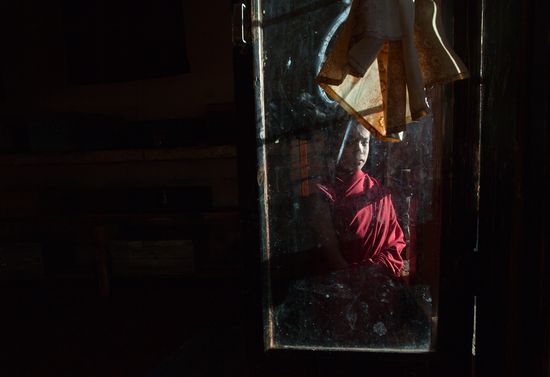
(Photo: A novice Bhutanese monk looks out the window after hours of prayer waiting for class to be over at the Dechen Phodrang monastery October 18, 2011 in Thimphu, Bhutan. By Paula Bronstein/Getty Images)