"Iranian agents have successfully infiltrated American think-tanks, universities, and our political system as part of a plot to keep the United States from attacking the Islamic regime as it continues to expand terrorism worldwide and pursue its nuclear weapons and missile programs. The infiltration goal is to mold American opinion and create doubt about the advisability of attacking Iran's nuclear facilities — all part of a longstanding strategy to pull the strings of America and the West," – Reza Khalil, The American Thinker.
Month: March 2012
The Future Of Advertising
A new film imagines it:
Dan Lyons talks to the filmmaker, Jeff Rosenblum:
His advice to big brands: instead of pumping millions of dollars into advertising, why not invest that money into actually fixing your company? Don’t just say you’re great—actually try to be great. Once you’ve done that, you can use social media to spread the word.
PETA Kills, Ctd
Douglas Anthony Cooper picks apart PETA's excuses for its mass euthanizing of shelter animals:
[L]et's address the standard PETA slander regarding no-kill shelters: sorry, but they do not attain this status by simply turning away the most sickly. Some organizations are selective, yes, but the No Kill movement is overwhelmingly headed in the direction of open-admission shelters. They define "no-kill" as a euthanasia rate of not more than 10 per cent. No Kill Communities offers a list of organizations that have achieved this status: "More and more shelters are managing to be both open-admission and no-kill, which is a revolution in animal sheltering." Study that quotation.
Where The Smokers Are
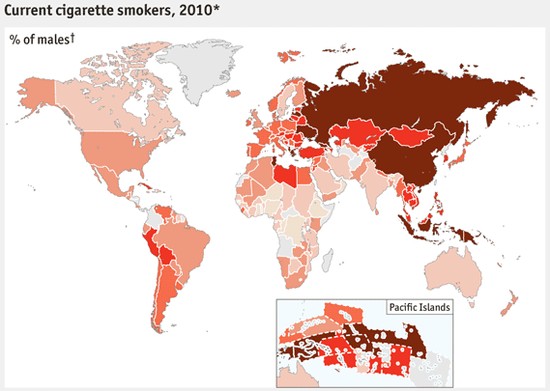
The developing world:
1990 to 2009 … consumption jumped by 57% in the Middle East and Africa. In emerging markets, men are leading the trend. About 800m men smoke cigarettes, compared with fewer than 200m women. More than 80% of these male smokers are in low- and middle-income countries. The problem is particularly acute in China, where 50% of men smoke (compared with just 2% of women), consuming one-third of the world's cigarettes in the process.
The Terror Of Catcalling
Alice Xie recounts it:
I was sexually harassed on a regular basis from the year I turned fourteen until the year I left for college. I tried so hard, every day, to ignore it. But I couldn’t. It changed me. The irrepressible nervousness when a stranger approached. Being afraid to look any man on the street in the eyes. Worrying I was being followed. Not wanting to leave my house unless I had to. Crying. Not crying until I got home, then crying. Hating myself for crying. Playing the faces of dozens of men back in my mind—I remember them all. Wondering what would have happened if I had bumped into them in a deserted area. The rape nightmares. But the worst part was how it warped my own view of myself.
The Fundamental Awkwardness Of Sex Scenes
Gavin Polone asked three prominent actors to explain, anonymously, what it feels like to film a sex scene. "Archie" shares his story:
I once did a sex scene with a girl I had just started to date on the film we worked on. But it ended up being really awkward, because it felt like we were letting strangers into the bedroom. It also was odd because I became aware of the notion that we were just cliché actors doing what was expected of us; and worse, the notion that both of us started the relationship — more her, I know I'm pointing fingers — in order to help our "performances."
Are American Soldiers Automatically Heroes? Ctd
A reader writes:
A coworker of mine and I go round and round on this question. His view is that yes, they are heroes because something MIGHT or COULD harm them. My view is that for someone to be a hero they must do something heroric. Because someone joined the military because they had no other options and end up working on jeeps or pushing papers does not make them heros. Their job is important, but not heroic. To call them a hero deminishes those soldiers who DO heroic actions like jumping on a grenade to save another soldier's life.
Another writes:
I'm with Stephen Marche: a hero is someone who does something heroic, whether that be rescuing a buddy on the battlefield, finding a cure for disease, or defending the rights of the unjustly accused. The problem with Ari Kohen's calculus is that even without a draft, there is no way of knowing how many soldiers, if any, join the military out of pure patriotism. Many soldiers join the military because of lack of economic opportunity at home, or because they're bored, or for any number of other reasons, none of which are particularly heroic (see here for a good article on the subject).
Let's also distinguish between the grunts that are trudging through the sands of Afghanistan, and the officers who went to West Point and are likely never to be on the business end of a weapon in a real-life situation, or the Air Force intelligence personnel (like my nephew) who spends his life in front of a computer screen in McLean, Virginia. He joined because he liked the structure and discipline of the military, not out of any great need to defend his country.
Finally, even if a person joins out of pure patriotism (like Pat Tillman, who probably now regrets his decision) why should I bestow hero status on that person merely for having joined? What if that person's values that make him want to join are not shared with me? If people who fight wars are all heroes, then maybe what the world really needs is fewer heroes and more cowards.
Another:
Speaking as someone who had alternatives but instead enlisted and served nearly five years from 1967 through most of 1971, including three tours in Vietnam: No, enlisting does not make one a hero. A hero is someone who had no choice but who did the job once drafted. A hero is someone who moved to a different culture to avoid killing people. A hero is like my friend Brad who, smarter than I at the time and less fooled by the lies, used boiling water, vodka, and a sharp knife to amputate his own trigger finger to avoid having to fight someone else's war.
Oof.
Big City, Fast Walkers

Eric Jaffe revisits several studies on the relationship between population and perambulating:
Stanley Milgram, for instance, believed that the sensory overload of the city prompted a social withdrawal response — in this case, a rapid motor action — to limit a person's environmental stimulation. In 1989 the geographers D. Jim Walmsley and Gareth Lewis pointed out some flaws in the "cognitive overload" theory. For starters, some people obviously thrive on an active, stimulating environment. Besides that, a very slow pace of life no doubt creates cognitive and behavioral changes of its own. …
In line with the previous work, the researchers found that the bigger the city, the faster the walkers — though the effect was not quite as profound as it had been in the Bornstein study. As one possible explanation for the relationship between city size and foot speed, the researchers suggested that economic factors might play a key role. When a city grows larger, they wrote, wage rate and cost of living increase, and with that the value of a resident's time. As a result, "economizing on time becomes more urgent and life becomes more hurried and harried," Walmsley and Lewis suggest.
The Rise Of Mormon Feminism, Ctd
A reader writes:
By starting her story with the tale of two soon-to-be ex-Mormons, and acknowledging that only some of the twenty (count ‘em: 20!) feminist bloggers are actually members of the LDS Church, it seems Frieda Klotz’s point is that so-called Mormon feminists are likely to be or become ex-Mormons. While I’ve resided here behind the zion curtain for the last 30 years (including several years of employ at LDS Hospital), my conclusions are no less anecdotally-based than Ms. Klotz’s. And I most certainly do know some very independently thinking and progressive Mormon women. And as is the case with every religion, there exists a wide spectrum regarding Mormon individuals’ adherence to dogma. Just as there exist prochoice Catholics who would have eaten chicken on Fridays way back when, there are Mormon women who have sex and drink beer – not necessarily in that order.
That said, I’ve never seen one hint from true believers that Mormon women should be eligible to hold the Priesthood (now exclusively a male entitlement; and until the 1970s a white male entitlement).
The absolute power over, and fear of empowering, women is evidenced by laws passed this last session by the overwhelmingly Mormon and male state legislature: one that further restricted access to sex ed and forbade mention of contraception, let alone homosexuality (vetoed); the other that imposes a 72-hour waiting period for abortions (signed and being challenged by those "gentiles" over to the ACLU). A BYU coed recently accused by a classmate of dressing provocatively may have won applause outside this land of Mormonism, but within it, as evidenced by comment boards on the Church-owned radio and TV station website, KSL, her critics far outnumbered supporters – particularly among women. I’ve seen no decrease in triple-wide baby strollers being pushed by teen moms in downtown Salt Lake City. I’ve seen no sign from my smart and goodhearted Mormon neighbors, or here on the streets of the big city, that women are clamoring for more freedom.
In short, I’ve seen nothing here in Utah that might signal anything even approaching a bra-burning moment.
Another shows signs of optimism:
Hopefully you are aware of Joanna Brooks, whose blog, askmormongirl.com, and more recently her memoir The Book of Mormon Girl, has made her rather prominent, especially because of the Mormons in the GOP primary. (Here is a CNN.com story on her.)
Brooks is a feminist Mormon in an interfaith marriage and family, and openly loves and struggles with her church. She has been particularly at odds with the Mormon church for its anti-marriage equality campaigns here in California. I would especially recommend the chapter of her memoir when, during her college days, her beloved Mormon feminist leaders and BYU professors are excommunicated by the church. This happened in the fairly recent past, and Brooks is treading on ground that is still dangerous and unpredictable.
Perhaps things are in flux because of the scrutiny the church is receiving due to Romney's campaign, and things will change after the election (but in which direction?). Regardless, her openness about doubt and faith seems to have hit a chord in many younger Mormons, and her blog is beginning to attract non-Mormon readers who have similar questions of faith. I recommend you check her out.
The Daily Wrap
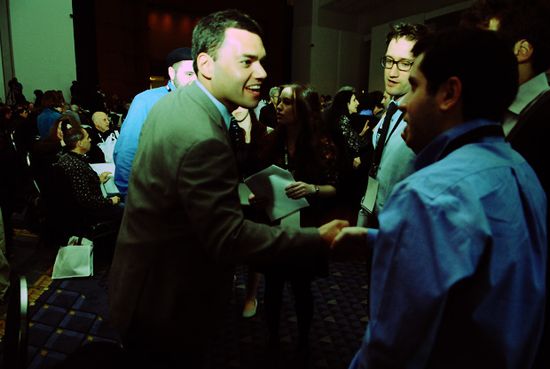
Today on the Dish, Andrew chronicled the offensive against Peter Beinart, went another round with Jeffrey Goldberg on related issues, flagged Roger Cohen's critique of Goldberg's reporting, called him out again, and restated his basic position on Beinart's boycott. Peter himself challenged opponents to articulate an alternative for restricting settlement growth, the Libyan war might have precipitated a coup in Mali, size of a state's economy was an ambiguously useful metric of global power, and traumatic brain injury was a serious problem for soldiers.
Andrew also explained in great depth why the Etch-A-Sketch gaffe was so devastatingly embarrassing for the Romney campaign while we followed up on some reactions from blogosphere to it, dug up one instance of his Etch-A-Sketchness, compared The Gaffe to equivalents in campaigns past, gave Mitt a chance in Louisiana, yawned at Jeb Bush's endorsement, wondered when the losers would drop out, and noted the importance of the Presidential race for shaping who controlled the Senate. Ad War Update here.
Finally, we posted an Urtak for Ask Steven Pinker Anything, charted the rise of Mormon feminism online, explored the "cost of being a woman," updated you on a victory for marriage equality in NH, aired a critique of Christianist "freedom," and looked at how a self-defense law enabled the murder of Trayvon Martin. Striking down the health care mandate looked likely to make premiums skyrocket, environmentalism hurt asthma sufferers, mapping the brain appeared capable of revolutionizing medicine, and referring to former politicians by their ex-titles seemed silly. Sexual desires were inextricably linked to your identity, fairy tales returned to their dark roots, an amazing chess story might be corrupted by Hollywood, the truth's imperfections helped create a story's value, the Clintons got an airport, and men cheered. AAA here, FOTD here (follow-up to yesterday's here), VFYW here, and MHB here.
– Z.B.
 The Dish
