The Gaffe Worth A Thousand Ads, Ctd

Yes, it does take a while to sink in. But, like Joe Klein, I'm beginning to think that Eric Fehrnstrom's description of his own candidate as an Etch-A-Sketch, capable of erasing anything he has believed or said in the past instantly, is close to a disqualifying comment.

It doesn't just imply, it asserts a cynicism and a hollowness that should disqualify anyone for the presidency. And it comes not from some radio moron or minor staffer – but from Romney's closest confidant. It's the Mother of all Gaffes, making any Romney shift in the general election an Etch-A-Sketch moment for his opponents. Joe:

There is a gestalt to every campaign, a deep organic spirit … In Romney’s case, this spirit expresses itself in embarrassing gaffes, often at the moment of victory — and it reflects the sterile management-consultancy ethos at the heart of the candidate.

He sees himself as a product, to be re-marketed and even reinvented for different markets. The problem with Romney is that there is no there there. There is merely product, which is him. Unsurprising then that the Obamaites are getting a little cocky. But what does it say about Obama's strength that he's still polling only four or five points over this gaffe-prone robot?
Why The Healthcare Mandate Matters

New Jersey's attempt at healthcare reform, which lacked a mandate, didn't pan out very well:

[T]he mix of people left in the program changed dramatically. According to a study published in Health Affairs, the median age for enrollees jumped from 41.9 years to 48.4 years in just five years, and premiums rose by between 48 percent and 155 percent, depending on the plan.

What's likely to happen if the Supreme Court strikes down the mandate but leaves the rest of the law intact:

[Massachusetts Institute of Technology economist Jonathan Gruber] has suggested that removing the mandate from the law would diminish the number of newly insured by nearly two-thirds and raise premiums overall by 30 percent. 

You Are What You Want

Noah Brand wants people to understand the unchosen character of specific sexual desires as a means of coming to peace with their self-identity:

[K]ink theorists think of libido as simply a part of oneself, like the color of one’s eyes. Too many people, especially men, think of their sexual desire as something apart from themselves. We’ve all heard the jokes about the penis having a mind of its own, possibly emotional holdovers from puberty and its unwanted erections, but it’s amazing how many guys take that seriously. They have a thing for feet, or spanking, or voyeurism, or whatever else gets them off, and they think of that kink as something other, something alien, something they can purge from themselves in some way. It never works, and all it does is hurt the poor guy in the meantime.

Jeb Bush Endorsed Romney Yesterday

So what?

In the modern, post-machine-politics era, individual endorsements simply don’t matter as much as we sometimes pretend they do. The exceptions are, typically, the endorsements from those politicians who still do have a machine—or at least a robust activist and fundraising operation—that can be employed on the endorsee’s behalf.

Marriage Equality Update

Yesterday the New Hampshire's Republican-dominated House of Representatives refused to overturn New Hampshire's marriage equality law. Avlon cheers:

[S]ome legislators were concerned that an ideological over-reach by social conservatives could alienate independent voters—who make up a plurality of registered voters in the Granite State—in the next election. “I am concerned about the message it could sends to Independent voters,” said Schroadter. “I'm a Republican for small government, low taxes, and pro-business initiatives. This [marriage equality] is just one of those issues that government should probably stay away from.”

Did The Libyan War Cause A Coup?

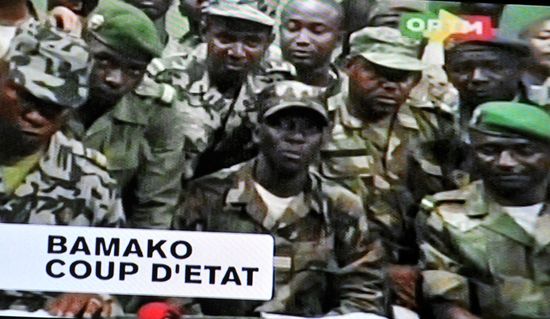
GT_MALI_120322

Soldiers in Mali, a reasonably democratic West African country, have taken over [NYT] the presidential palace in an attempted coup. Joshua Keating flags some evidence that the war in Libya was the cause. Larison agrees that ousting Qaddafi has destabilized surrounding countries:

[T]he Libyan war's worst impact may have occurred outside of Libya. The neighboring country of Mali, which also happens to support U.S. counter-terrorist efforts in western Africa, has been roiled by a new Tuareg insurgency fueled by the influx of men and weapons after Gadhafi's defeat, providing the Tuareg rebels with much more sophisticated weaponry than they had before. This new upheaval benefits al Qaeda in the Maghreb (AQIM), and the Tuareg uprising threatens the territorial integrity of Mali. The rebellion has also displaced nearly 200,000 civilians in a region that is already at risk of famine, and refugees from Mali are beginning to strain local resources in Niger, where most of them have fled. "Success" in Libya is creating a political and humanitarian disaster in Mali and Niger.

Ken Opalo casts some doubt on that interpretation:

The proximate cause of the mutiny and eventual (attempted) coup in Mali might have been a confluence of weak state coercive capacity and the resurgence of the Tuareg rebellion in the north of the country (fueled by weapons from Libya); but one cannot rule out the significance of the enabling structural conditions.

(Photo: A TV screen taken on March 22, 2012 shows a group of soldiers announcing a curfew in Bamako starting from March 22 following a military coup. The putschists, calling themselves the National Committee for the Establishment of Democracy, said they had acted due to government's 'inability' to put down a Tuareg-led insurrection in the north and tackle terrorism. By Issouf Sanogo/AFP/Getty Images.)

When Environmentalism Makes It Harder To Breathe

Nick Baumann advocates on behalf of asthma suffers:

In 2009, at the urging of the drug lobby, the EPA started banning asthma inhalers that run on ozone-depleting CFC aerosols. As a result, inhalter prices jumped from as little as $5 to as much as $60. The drug companies were thrilled—they got a new round of patent protection (and got to charge higher prices) for non-CFC inhalers that dispense exactly the same medicine as their CFC-based predecessors. But everyone else got screwed. By 2017, the switch to the new inhalers will cost consumers, taxpayers, and the government some $8 billion, according to the EPA's own estimates, just to avoid a tiny amount of CFC emissions.