The Rise Of Mormon Feminism

Frieda Klotz heralds the birth an online community centered in part on The Exponent, a group blog devoted to a Mormon understanding of feminism:

Blogging suits Mormon practices because it draws on the tradition of keeping a journal, and church leaders have explicitly encouraged it – three years ago, Elder M Russell Ballard made a speech urging Mormons to use new media to share the Gospel. The church's official website, Mormon.org, is a pretty exceptional example of persuasive use of social media; and on the wider web a "Bloggernacle" flourishes, with conversations running the gamut from orthodoxy to dissidence. All of this suggests the church may be willing to relax its stance on feminism.

Dropout rates from Mormonism are high, with some estimates indicating that 80% of young people leave. By giving women a space to articulate their struggles, feminist blogs could stem that flow; but whether real change will occur on the issues feminists care about remains to be seen entirely.

Via Liberal Japonicus, who comments:

As a (very) lapsed Methodist from the deep South, the possibility that a religion can encompass a lot of opposites and contradictions is something I'd grown up with, but it is fascinating to see it from the outside.

Who Will Control The Senate?

The race for the White House could determine it:  

[P]residential coattails could be key, and we can’t over-stress the importance of the presidential race on the battle for the Senate. This is a hyper-partisan era, and one effect of party polarization is a reduction in ticket-splitting in years like 2012. A Senate candidate in a competitive race will have difficulty swimming against a strong presidential tide in most of these states.  

When Self-Defense Laws Go Too Far

Emily Bazelon takes a close look at Florida's "Stand Your Ground" law, which protected the man who killed Trayvon Martin:

It’s that decision not to press charges that makes Stand Your Ground laws, which a bunch of other states have adopted, a crazy departure from the past. It’s one thing to raise self-defense at trial. It’s another to have what the Florida Supreme Court calls “true immunity.” True immunity, the court said, means a trial judge can dismiss a prosecution, based on a Stand Your Ground assertion, before trial begins.

Gregory O'Meara, a former prosecutor, thinks basic self-defense laws are enough:

To claim self defense or defense of others under current statutes, a person under attack (the defender) needs to raise credible proof: first, that he reasonably thought he (or another) was unlawfully under imminent deadly attack by another; second, that each forceful action, including deadly force, he took in response to this attack was necessary to stop the attack; and third, that he acted solely with the intent to thwart the unlawful attack. In many jurisdictions, the defender must withdraw from the fight before using deadly force if he can do so in complete safety. If the defender meets these requirements, he will be found not guilty. 

The Complexities Of Jeffrey Goldberg, Ctd

I was hoping in vain it seems for some sort of partial retraction of Jeffrey Goldberg's latest series of harrumphs against yours' truly. I believe private conversations should not be used as weapons against others in public debate. I also don't pretend to speak for anyone but myself. On both counts, Goldberg violates the ethics I try to live up to, by misrepresenting a conversation we once had that I assumed was confidential and by the following:

As we've learned over time here at The Atlantic, there's no arguing with the guy.

Who is "we" at the Atlantic? Speak for yourself, Jeffrey. Don't co-opt others. What I think Goldberg is referring to is my refusal to back down on Israel's intransigence toward the US these past three years. There is plenty of arguing with me, as readers well know. But there isn't much bullying that works. As for the ad hominems, I'll leave those to the experts in such matters.

But the accusation of conscious lying is a serious one. And just as Goldberg simply asserts that Peter Beinart's book is "filled with errors and omissions" but refuses to cite any, so his bald claim that I have "lied about what have written, what I think, what I believe, and what I've reported" is unsubstantiated. Because it cannot be substantiated. And because such an accusation is a serious professional one, I challenge him to name the alleged lies, or withdraw the accusation.

Here, I might add, are actual untruths:

"[Sullivan] consistently grants the regime in Iran the benefit of the doubt on the nuclear issue."

Where have I done this once – let alone "consistently"? Here's another:

"[Sullivan] is oblivious to the existence of anti-Semitism."

There are simply far too many passages and essays and posts and reviews in my own work – including, I might add, robust condemnations of my own church's disgraceful history – that prove this is utterly, inalterably untrue.

And my point was not that he got something wrong, which is his non-defense defense; we all do. It wasn't even that he might have been lied to by Netanyahu in order to produce a cover-story to advance the Israeli government's agenda over the American administration's. (Who in the world hasn't been lied to by Netanyahu, as even the fiercely pro-Israel French president, Nicolas Sarkozy, has observed?). It was Goldberg's reaction to suspecting he could have been misled that stopped me in my tracks:

I'm not saying Jeffrey was in on the bluff. I am saying that his reaction to the idea of being misled is not exactly outrage, which troubles me.

His 201009by possibly being misled is that it is clear he'd be quite delighted to have played a part, even if unwitting, in a possible game of bluff, even if implausible, because it might work to America's and Israel's advantage.
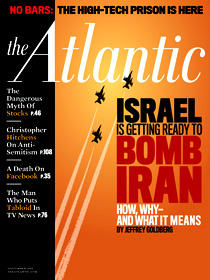
But you cannot both express this excitement and pose as "merely a reporter". A person who is excited about being a player in a game of bluff that could lead to war or peace … is a player, not a reporter. And a player with real fire, with the lives and deaths of human beings at stake. It was not his "thinking out loud" that "offended" me, as he now tries to spin it. It was that his thinking out loud raised serious questions about his role as an objective reporter, who was caught musing hopefully about his having written a cover-story about Israel's determination to go to war with Iran that was, in retrospect, fed by possible lies, bluffs and deceptions.

Look: you cannot be a player delighted in retrospect to have conveyed bluffs in a game of lethal geopolitics and also claim to be a mere reporter. It's about as convincing as Rush Limbaugh's self-description as a mere entertainer. The right response of a journalist to the possibility of being lied to and misled by a source in a foreign government is anger and introspection. Goldberg's response wasn't. That's worth knowing. It makes his latest conviction that Israel isn't bluffing … well, subject to an asterisk.

Goldberg On Netanyahu: Bluffing? Ctd

Jim Fallows, in a thoughtful post, asks this question of his colleague:

You've raised, in your recent reports, the possibility that the Netanyahu government has actually been carrying out an elaborate high-stakes bluff. Eg, "How has Obama convinced the world that these sanctions [on Iran] are necessary? By pointing to Netanyahu and saying, 'If you don't cooperate with me on sanctions, this guy is going to blow up the Middle East.' Obama's good-cop routine is then aided immeasurably by the world's willingness to believe that Netanyahu is the bad cop."

If it was a bluff, it's one you've had a unique opportunity to see and assess. If they really were bluffing, presenting you with the evidence and data for your 2010 cover story would have been a very important step. As you think back, Chazz Palminteri style, on what you heard and saw in 2010, knowing what you now know — about two years with no attack, and about the "bluff" hypothesis you've now raised — is there anything that seems different to you in retrospect? Anything that now increases your suspicions that they were bluffing at the time?

Jeffrey's reply is appended. You should read both – and Bob Wright's attempt to wrestle with a core question at issue: whoever has been responsible for what in the past, what is the main obstacle to peace now?

His answer – and mine and Peter Beinart's – is the settlements and their intensification. And by the way, of course both sides have in the past done great damage to the chances of a peaceful resolution in a two-state solution. From the era of the attempted partition to the age of the PLO, my view is that it's the Palestinians who have missed more opportunities than the Israelis. But in the last few years, the reverse has been true, in my view, and the possibility that the settlements may have already passed the point where a two-state solution is now on life-support makes a breakthrough a matter of urgency.

The Assault On Peter Beinart

Beinart_032112_620px58

The Tablet explains part of the context: that Peter's Zionist and Jewish credentials are deep, that he, like me, was an editor of The New Republic, the bastion of domestically liberal American Zionism, and has a long history of serious intellectual and historical work and analysis. And indeed his views on the necessity of an urgent two-state solution to save Israel from itself, and an end to the settlements his peers merely pretend to oppose but enable with every non-step they take, is not that radical. Allison Hoffmann notes:

New York Times columnists Thomas Friedman and Roger Cohen have vociferously accused Netanyahu, with the help of the pro-Israel lobby in Washington, of making Israel into a pariah state by undermining the Obama Administration’s early efforts to jump-start the peace process. Last fall, the American-born Israeli journalist Gershom Gorenberg released The Unmaking of Israel, a jeremiad arguing that the 45-year Israeli occupation has been a cancer on the country’s body politic; the book scored a glowing endorsement in the New York Times Book Review from Atlantic writer Jeffrey Goldberg.

Goldberg himself made such an argument, for Pete's sake, if you'll pardon the expression. But Peter must be destroyed, marginalized and attacked. This I expected. It is part of the hazing process any writer has to go through to speak honestly about what Israel is becoming and its consequences for the US across the globe. What I didn't expect was the dismissive, evasive bile of Goldberg. And then this:

“It’s a narcissistic book, and the narcissism of privileged and haughty people is never particularly attractive,” Martin Peretz, the former owner of the New Republic and Beinart’s earliest patron, told me. “I always knew he was a very vain man, but a lot of us are vain, and if you had his mother, or if I had his mother, I’d be even more vain than I am.” Peretz put on a mocking falsetto—“this is the most brilliant boy, he’s so smart, he’s so touching”—before going on: “It’s a Jewish mother situation. You can use that—even if it makes me sound a little bitchy.”

Good God. The utter lack of engagement with the arguments of a book that has yet to be published is revealing – and the deployment of personal matters as a way to smear someone is exactly the same tactic as Jeffrey Goldberg's abuse of private matters, like his version of a conversation we once had. Then there is the Goldberg assertion that Peter is unqualified to sit in the celestial recliners of the truly informed, guarded by Leon Wieseltier. Funny how these condescending memes cascade all at once:

“Peter’s a quick study, but some things you can’t study quickly. He had a hit, and ran with it.”

I've been through my share of personal vilification over the years – because of my stands on marriage, or HIV, or Iraq, or race, or Israel, or you-name-it. But this level of vicious personal obloquy from people who once advanced and supported him? It beggars belief.

There is something rotten here. And something utterly bankrupt. You want to know why these people have become so unhinged? Read the book. They're terrified of its truth.

(Photo: J Street/Flickr via the Tablet.)

The Gaffe Worth A Thousand Ads

It really is staggering to me that the almost certain Republican nominee has run a campaign so full of cringe-inducing, gob-smacking, eye-ball popping gaffes that he should have been consigned to the Perry folder by now – and yet still manages to stagger forward. The Etch-A-Sketch analogy from his closest and most senior aide is, however, the most devastating so far.

It sums up every single worry about Romney in one metaphor: that he is a machine, that he can say or stand for anything, and that, from time to time, depending on which segment of the population he is appealing to, he will simply become something completely different. Which is, of course, per Kinsley, the true definition of a gaffe. Fehrnstrom told the truth. And Etch-A-Sketches, because they can draw anything and remove anything, are also a perfect metaphor for liars, opportunists and soulless re-invention.

EtchHow, in other words, can such an allegedly professional campaign have larded itself up with statements and misstatements to such a degree you really would need a bungee cord to keep them all strapped to the roof? How did the Romney campaign beat all its rivals in finding ways to make him seem completely insincere, absurdly rich and socially clueless? And boy are they exploiting it – check these new ads out.

Weigel claims that Eric Fehrnstrom has scored a "cleaner hit on his candidate than Rick Santorum ever has":

Aspects of this analogy make sense to me. An older etch-a-sketch has little lines and remainders from older sketches embedded in it, stuff you can't make people forget. To a large extent, Romney will be able to campaign on new positions when he makes it out of the primary. He's winning voters who want an electable candidate, not a Barry Goldwater clone, so, yes, there's an expectation that he'll move on from opposing the auto bailout, and agreeing with the Blunt amendment. But you don't need to say this! It's realpolitik, which means you should never, ever reveal it to voters.

Philip Klein was equally taken aback by the candid metaphor: 

The fact that it's coming from one of Romney's long-time aides is stunning. An even scarier thought for conservatives: if the Romney campaign is willing to take them for granted before even clinching the nomination, imagine how quickly Romney would abandon conservatives if he ever made it to the White House.

James Poniewozick adds, "In one short sentence, Fehrnstrom defined his boss as not only a blank slate but a toy." Jamelle Bouie reassures conservative Romney skeptics: 

Conservatives widely believe that the party establishment will betray conservative values to win an election. For them, it explains the failed candidacies of George H.W. Bush, Bob Dole, John McCain, and the failed presidency of George W. Bush. But now that they’re in the driver’s seat of the Republican Party, they can avoid this obstacle—it’s well within their power to keep Romney from running too far to the center, and distancing himself too much from the persona he’s built over the last five years.

Tim Noah nonetheless explains what makes this gaffe different: 

Fehrnstrom's Etch-A-Sketch crack will inspire parody images, Web widgets, and apps downloaded onto computer screens, tablet computers, iPhones, and of course Etch-A-Sketches. These images can effortlessly be e-mailed, Facebooked, and tweeted hither and yon. Competitive impulses will be stirred among rival campaigns, amateur and professional Web designers, and legions of wiseacres with too much time on their hands. Already we have this and this and this and this. There will be much, much more, and to Romney it will feel like it's coming in the windows, down the chimney, and up the bathtub drain.

Aaron Goldstein isn't so sure

Romney's comments about pink slips and firing people didn't stop him from winning in New Hampshire, his Cadillac comments didn't stop him from winning in Michigan while his NASCAR comments didn't stop him from winning in Ohio. So there's an argument to be made that l'affaire Etch a Sketch won't damage Romney either.