A different kind of dance:
Month: March 2012
Has The Post-9/11 TSA Done More Harm Than Good? Ctd
Schneier continues the debate:
In 2004, the average extra waiting time due to TSA procedures was 19.5 minutes per person. That’s a total economic loss—in –America—of $10 billion per year, more than the TSA’s entire budget. The increased automobile deaths due to people deciding to drive instead of fly is 500 per year. Both of these numbers are for America only, and by themselves demonstrate that post-9/11 airport security has done more harm than good.
Why Did SCOTUS Surprise?
Jay Cost argues that liberal legal analysts were blind to conservative arguments against Obamacare:
The problem for the left is that they do not have a lot of interaction with conservatives, whose intellects are often disparaged, ideas are openly mocked, and intentions regularly questioned. Conservative ideas rarely make it onto the pages of most middle- and high-brow publications of news and opinion the left frequents. So, liberals regularly find themselves surprised when their ideas face pushback.
Of course, conservative legal analysts also underestimated the Supreme Court's willingness to entertain certain arguments. Ilya Somin, who authored an amicus legal brief against Obamacare's individual mandate, said in the video above, from a few weeks ago, that the odds were against opponents of Obamacare. Allahpundit, who thinks Cost makes some fair points, nevertheless counters:
Even I was surprised at how hostile the conservatives on the Court seemed to be towards the mandate. That’s not because I’m reading back issues of The Nation, it’s because the painful fact remains that the Supremes almost always let Congress do any ol’ thing it wants when it comes to regulating commerce.
How Chait defends liberal legal analysts:
[T]he shock of the liberal analysts who expected a landslide does prove they misjudged the case, but their error lies not in underestimating the arguments, which they imbibed closely, but in overestimating the Republican justices.
Beinart vs Stephens
Peter hits back at some of the slimier parts of the Bret Stephen's review of his book. Money quote:
After ignoring my repeated criticisms of Palestinian leaders, Stephens wrongly accuses me of denying Palestinians moral agency by, well, not criticizing Palestinian leaders. But let’s turn the question around: How much moral agency does Stephens grant Israel? Does he grapple at all with the moral problems inherent in holding millions of West Bank Palestinians as non-citizens for 44 years? Does he concede that subsidizing Israelis to move to the West Bank—including to settlements deep in the West Bank—is self-defeating if you believe in a two-state solution? No, he ignores those uncomfortable questions almost entirely.
“The More We Drag It Out, The Harder It Is To Win In November”
Paul Ryan, like Rubio, endorses Mitt Romney because not doing so would improve Obama's re-election odds:
Weigel notes that this is not the norm:
Endorsements don't have to be rote. They're usually quite florid. The modern standard for a hell-yeah endorsement is Ted Kennedy's 2008 anointing of Barack Obama.
John Cassidy examines Romney's endorsements:
Romney’s campaign is understandably eager to show off all the people who are supporting him. But the actual endorsements bear inspection. Most of them are respectful. A few are warm and gracious. But many, particularly those from ardent conservatives, appear to have been drawn from the endorser with a pair of dental tweezers. Often, what they don’t say is as significant as what they do say.
He uses a rough taxonomy to classify Romney endorsers.
SCOTUS’ Crisis Of Legitimacy?
Jonathan Cohn worries that striking down healthcare reform would damage the Supreme Court's reputation. Scott Lemiuex counters:
Really, striking down the ACA isn’t even testing the far reaches of the Court’s power. The Court would have substantial support in Congress and, at least as of now, would appear to have the support of the majority of the public. I wish it weren’t so, but I don’t think the Court would face any significant loss of public legitimacy should they strike down the ACA.
David Bernstein's view:
At most, a ruling against the ACA will have the same effect as Bush v. Gore or Citizens United, or Roe v. Wade and Boumediene for that matter; a fair amount of caterwauling, with the Court as an institution remaining unscathed.
The Terror Of Catcalling, Ctd
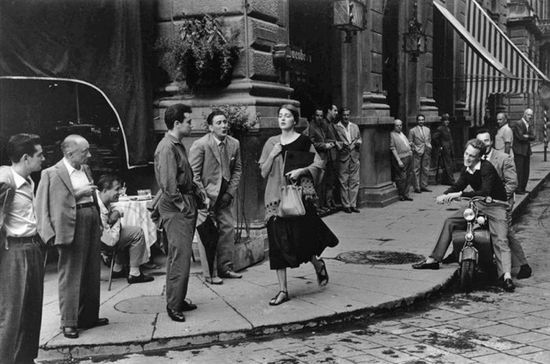
Some remaining thoughts from readers:
There is a difference between catcalling and men noticing you as a woman and smiling at you or giving you a second glance. The first is based on anonymous objectifying and the latter is normal human attraction/attention. And if both women and men can't tell the difference, that's sad. I've always wondered what men who catcall actually hope to achieve. Do they imagine the woman stopping and engaging them and then magically hooking up with them? Please, in what universe is that going to happen?
Another:
Isn't making insulting comments to someone a form of assault and couldn't that assault require police intervention? With cellphones having cameras, women should film their catcallers as they walk by and provide the evidence to the police. This would seem to be something that could be solved through technology. People film everything else, why not this?
Another suggestion:
I work out almost every day with a friend of mine, who cycles to the gym in a bicycle skirt. She told me one day about the catcalls she got on her way over, and when I asked her what she did (I assumed she just rode her bike faster), she said, "Well, I stopped and pointed to my skirt said, 'Yep. I did it for you.' And they shut up." As I like to wear short skirts myself, I made a note to try this.
About a week later, I got my chance. On my way into work, a group of men started in ("hey baby! nice legs! oh yeah!") and I turned to them and said, "Yeah. I did it for you." Sure enough, their jaws dropped. I'm sure I didn't stop them from doing this to someone else, but it was mighty satisfactory to shut them down that way. I use the line all the time now, and it works.
Another reader:
I've been reading the series on cat-calling and had a moment where the tumblers finally clicked, opening a door to a new understanding regarding behaviour I witness frequently. I live in Toronto and commute every day to work on public transit. This offers the opportunity to people watch and of course, appreciate the beauty of women on the bus/streetcar/subway I am taking to and from work. I have definitely noticed a certain pattern whereby more objectively attractive women appear somewhat harried, never making eye contact and very briskly sitting down at the front of the vehicle (instead of walking down the aisle to seats further back). Of course not all such women do this, but I have noticed this approach being taken more often than not among the "most attractive" group.
I wondered at this sometimes and let it lead me to negative thoughts like "what's her problem" or "wow I guess she wants to avoid everyone cause she's so beautiful – don't kid yourself honey you're not that great". In reading the series of reader comments on this, many coming from women describing in detail the way cat-calling/ogling affects them, I realized why these women pick the shortest path to a seat and avoid making all eye contact: its likely based on years of being cat-called, stared at and otherwise harassed by men on public transit!
What I saw as perhaps the result of a big ego was rather more likely the result of years of men wearing them down until a simple ride on a streetcar – something I think nothing of – can become a gauntlet of sorts for them to navigate. All of this is to thank you for providing the venue for a series that has given me a fresh understanding and more empathy.
Previous discussion here, here, here and here.
(Photo: "American Girl in Italy" (1951) by Ruth Orkin)
Long Odds
The lottery has reached $640 million, which is "the biggest lottery jackpot in U.S. history." Brad Plumer examines winning strategies and their downsides:
[One] strategy would simply be to buy up every single ticket combination. That would cost $176 million. But you’d be guaranteed to win about $293 million in taxes. Good deal, right? But there’s one big hitch: “First, if it takes five seconds to fill out each card, you’d need almost 28 years just to mark the bubbles on the game tickets. You’d also use up the national supply of special lottery paper and lottery-machine printing ink well before all your tickets could be printed out.” (Also, if just one other person picked the winning number, you’d end up losing $30 million all told.)
Is Big Football The Next Big Tobacco? Ctd
A reader writes:
Your reader makes a good point about the fact that brain fractures and resulting death have decreased as helmet technology has progressed, but at the same time brain injuries in general have gone up. This is because as they make the helmet "safer" for the people wearing it, they are also making it more dangerous for those it is being used against. Helmets used to be made of leather, which is not exactly a lethal material, but today’s football helmets are like weapons. Almost all head injuries in football, in fact, occur due to "helmet-to-helmet" contact. In my opinion, it might not be a bad idea to get rid of helmets altogether, as that would probably discourage a defensive player from throwing his head full force into an offensive player’s left temple.
Another adds, "One of the things that NFL Commissioner Roger Goodell is going to have to address is that tacking without extending your arms will draw a 15 yard penalty." Another reader:
I have also encountered speculation that helmet design is making things worse.
The guesstimating runs this way: as the helmets become ever more able to cushion physical shocks to the head it becomes ever more possible for the shocks to become stronger, and along with that the shocks not severe enough to cause a player to be knocked unconscious (stopping the game) but still severe enough to cause long-term degenerative damage become more frequent.
If this hypothesis turns out to be true, then it would have been better for football to have adopted rugby's no-helmet uniform. Rugby has lots of players with misshapen noses thanks to the battering those noses take on the field, but to the best of my extremely limited knowledge rugby doesn't have a history of players with long-term brain injuries and progressive neurological degeneration caused by collisions on the field of play.
A reader with more experience agrees:
As an American who has played rugby for over ten years, let me offer an explanation of why football players suffer so many head injuries: it's the helmets. Because American football players wear helmets (and pads), they are not taught to tackle correctly; they use their heads as battering rams, instead of protecting them as they should. American kids, especially in high school, are not taught proper tackling technique, but in a way that gives the "big hit" the fans love and the helmets fail to guard against. But ruggers are taught to wrap the man they are tackling, placing their head on the side away from the ground, and using the body of the man they are tackling to lessen their impact on the ground. They are taught to tackle with their heads.
While head injuries do occur in rugby, they are the result of failure to tackle correctly; head injuries in the NFL result from tackling just like they teach you to. In every season I've played and coached rugby in the US, I've had to spend time teaching guys who had played American football the basics of safe tackling. They simply didn't know how. It was always a race to teach safe tackling before they injured themselves, or someone else, in practice. The best thing American football could do to deal with this issue is import rugby coaches to teach American football coaches the basics of safe tackling.
Healthcare Wasn’t In The Constitution
For good reason:
There is no mention of health care, or how to pay for it, in the Constitution, because for the men who wrote it health care wasn’t worth paying very much for. It remained that way until relatively recently. The science of medicine didn’t begin to resemble what we know today until the late nineteenth century. Until about 1900, many American medical schools were no better than the shadier for-profit colleges of today. In “The Great Influenza,” John M. Barry writes that at the time “it was more difficult to get into a respectable American college than into an American medical school…. Many schools bestowed a medical degree upon students who simply attended lectures and passed examinations; in some, students could fail several courses, never touch a single patient, and still get a medical degree.”
 The Dish