The Top Brass Making Bank

Screen shot 2012-03-19 at 4.35.31 PM

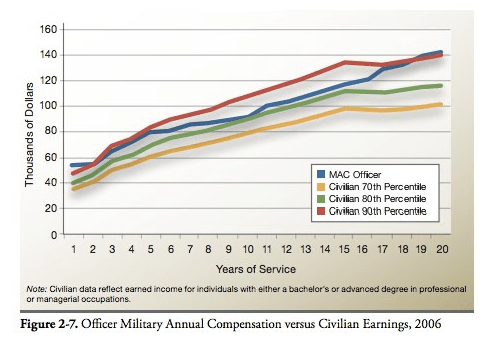
James Gerrond researches the exceptionally high pay of military officers (once benefits are factored in):

Military compensation, like all government spending, should be limited to the minimum amount necessary to achieve goals; in this case the maintenance of a certain quality of life for the All Volunteer Force.  The problem is that this has to simultaneously be balanced with the need to maintain adequate personnel numbers and sustain retirement benefits.  Unfortunately, no one seems to really want to delve into what that actually means.

Why Sober Up In Secret? Ctd

Several AA members sound off:

I wish Paul Carr every success in getting sober, and I don’t pretend to judge his method. But his understanding of anonymity is a little different than the one I have come to in 23 years in the program. (I got my "poker chip" this morning.) As I understand the concept, anonymity means (1) you don’t tell the world who you see or what you hear at an Alcoholics Anonymous meeting. You don’t blow others’ anonymity. However, many AAs find it helpful to disclose their situation to  their bosses, their friends, their families and others who they feel need to know. And (2) we in AA may know a little or a lot about our fellows; that depends on how much each is willing to disclose.

But we know one at least thing about each other: that we have trouble with alcohol. That helps build a sense of unity in our common struggle. As the tradition says, principles before personalities. (The traditions say we DO stay anonymous at the level "of press, radio or film," however. That’s partly because a public relapse could reflect as much on AA as the individual.)

Another writes:

The original founders of AA in 1935 were definitely concerned about protecting their members identities, because of the attitudes of the time. Within a few years, anonymity took on a spiritual context for the members. I’ve been in AA since 1988 and anonymity keeps me from feeling like "I" beat this thing. It would be very easy for me to feel powerful regarding my alcoholism and that is the opposite of what AA teaches. Keeping my trap shut unless it’s necessary to help someone else or myself keeps me humble.

Another:

The AA aversion to leaders and spokespeople stems from AA's democratic, anarchic, and Christian roots. It's a leaderless organization. They have intuited that egotism is one of the character defects leading alcoholics to drink. "Self run riot" they call it. Self appointed spokespeople are the ones most likely to relapse. Individuals are encouraged to find selfless ways of helping other alcoholics. 

I find an organization that eschews spokespeople and "big shots" to be refreshing. We all belong to hierarchical organizations (jobs, corporations, churches, schools etc.) where we are unconsciously ranked according to status. At AA meetings I've mingled with investment bankers, doctors, famous actors, as well as janitors, busboys, and HIV+ homeless people. As Charles Murray points out, there aren't many organizations left in America where class lines are ignored. And AA does a fabulous job in erasing those lines. Some people aren't comfortable with that (notice Carr's contemptuous dismissal of AA as that "roomful of strangers"). In any event, I think AA fills the role that used to be filled by groups like Kiwanis, Rotary, Knights of Columbus, etc.

Another veers from the rest:

Your post struck a deep chord with me; it has been just over 12 years since I last had a drink. I stopped without Alcoholics Anonymous because I don't believe in the whole disease paradigm – I at least don't believe that it is helpful to people who are trying to stop. I was heavily influenced by the book Rational Recovery, but I'm not writing in to plug any one book or program. Instead, I want to express how I believe secrecy ties into the disempowering tenets of AA.

For as much as AA encourages people to confront their mistakes and make amends to those they have harmed, the whole enterprise seems to me to encourage secrecy – as a larger part of encouraging dependence on AA itself. AA, with the exception of making a decision to come to a group (excepting those, of course, who come via judicial mandate) seems to be about giving up control. You must come to this group, you must believe in a higher power, you have a disease, that you are not in control of your own behavior … why on earth would you share that with the world?

Telling others, on the other hand, is about taking control for yourself. Honestly, I can't say I came right out and told a lot of people that I had stopped drinking. It was still a personal decision. And AA or not, lots of folks out there take a pretty negative view of it. So I pick my spots – but I'm the one doing the picking.

The Daily Wrap

Today on the Dish, Andrew went after Jeffrey Goldberg's dismissal of The Crisis of Zionism, noticed two other instances of a growing "Ignore. Peter. Beinart." movement, explained how the Israeli-Palestinian conflict fuelled Bin Laden's fanaticism, and decried some home-grown religious craziness from a Santorum supporter. We compiled reax to Romney's win-verging-on-blowout in Illinois, heard the "primary is over" chorus out, checked on how long it would take for Romney to wrap it up, explored his extraordinary underperformance, wondered if Mitt's military non-service would become an isssue, and gathered evidence that Rubio would be a terrible VP pick (electorally speaking). Ad War Updates here and here.

Andrew also blasted two cardinals' nigh-GOP endorsements, reacted to thoughts from the Dish's female readership on the gender imbalance, and brought Ask Jonah [Lehrer] Anything back to your attention. We spotlighted the spate of recent debt ceiling debate autopsies, rubbished fears of dumb voters, continued debate on the Alexandra Pelosi Obama voter video, waited for Obama's reelection for an about-face on marriage equality, bet SCOUTS would leave Obamacare alone, and dug up some old-but-relevant remarks from Obama on striking Iran. India might not have begun a rise to great power status, Iraq didn't help the victims of "emo killings," and Apple wasn't any worse about immoral outsourcing than its competitors. Steve Jobs led his company to an enormous fastly rise, Google fell by trying too hard to fight Facebook, a dictator used Photoshop, and an iPad met concrete. Glenn Beck profited online, hockey loved the gays, historians verified chop suey's authenticity, yellow fever got filmed, spring came early, and Ryan Gosling aged like scotch. Chart of the Day here, Malkin Nominee here, Quote of the Day here, AAA here, VFYW Contest Winner here, VFYW here, MHB here, and FOTD here.

Z.B.

Illinois Reax: Big Win, Low Turnout

Romney_Supporter_GT

Romney has been declared the victor and currently leads by around 12 points. Earlier, Nate Silver calculated that Illinois was a must-win for Santorum, not Romney:

According to an analysis that I conducted earlier this month, a path in which Mr. Santorum narrowly carried Illinois would still leave him considerably short of the benchmarks he needs to hit to win the plurality of delegates (winning a majority of delegates is almost out of the question at this point). To win a delegate plurality, Mr. Santorum would potentially need to win states like California, Maryland or Oregon where the demographics are even more challenging to him than they are in Illinois.

Howard Kurtz says unenthusiasm is Romney's friend:

It might be most accurate to say at this point that Romney wins by not losing. That is, while he generates limited enthusiasm for his candidacy, he has succeeded, though negative tactics, in taking down a series of surging challengers: Rick Perry, Herman Cain, Gingrich and, depending on the week, Santorum.

Relatedly, Eliza Shapiro points out that turnout was dismal:

Republicans in Chicago were not quite fired up and ready to go today. Election officials in the Windy City predicted that today will be the lowest turnout in the city's presidential primary history.

Chris Cillizza wonders when the race will finally end:

Romney remains the all-but-certain winner but without the ability — at least so far — to land the single knockout blow he needs to convincingly end this race. Illinois didn’t change that. But in defense of the Prairie State, it’s hard to see any state playing that role at this point in the process.

Timothy P. Carney believes that Romney could get 80 percent of Illinois delegates. Weigel thinks the primary electorate may have some fight left in it:

One dark note for Romney from the exit poll: Voters were given a choice between their candidate winning the primary, and the primary ending early. Sixty-six percent of voters preferred a drawn-out primary with their guy on top. Those voters split 40-40 between Romney and Santorum.

Electionate notes that Newt has tanked:

Gingrich seems to be doing worse *everywhere* in Illinois. It seems to me that Gingrich voters broke toward the candidate who led otherwise. Might help explain why Romney’s overperforming in the suburbs and Santorum’s overperforming in the south.

Allahpundit asks:

How much longer can Newt hold on? He already has as much campaign debt as cash on hand and the donations are drying up.

Jim Geraghty echoes:

What is Gingrich adding to the campaign at this point? Besides issuing statements that the frontrunner’s most recent victories shouldn’t really count or are somehow not legitimate?

(Photo by Whitney Curtis/Getty Images)

The Brokered Convention Fantasy

Romney_McCain

Jeff Greenfeld indulges in it: 

[D]elegates who are bound or pledged to a candidate are only obligated to follow his wishes when it comes to voting for a nominee. And in most contentious conventions, it is a fight over the rules that has effectively determined the nominee. … Imagine a platform plank that repudiated health care individual mandates "at the national or state level," a clear stick in Romney's eye (and, I suspect, a sentiment the majority of delegates would embrace). Or imagine a proposal that the candidates participate in a debate in front of the convention before the balloting begins.

First Read does some preliminary math: 

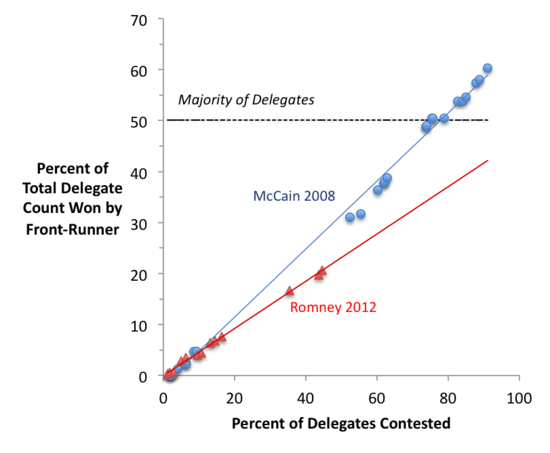
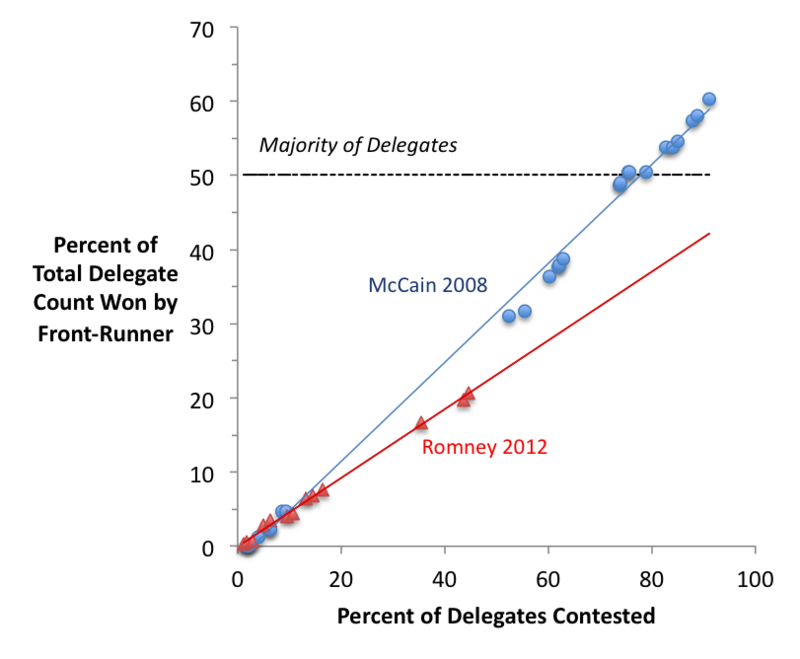
The earliest Mitt Romney could win the 1,144 delegates needed to capture the GOP nomination, per our count, is May 29, and that’s assuming he wins every single delegate after today. If you assume that he wins a 60%-40% split of the remaining the delegates, Romney won’t get to 1,144 until June 26, when Utah holds its primary.

Seth Masket provides the above chart and comments:

[M]y expectation is still that Romney will have this thing wrapped up before the primaries and caucuses are over. But it may take some time — NJ and CA aren't until June 5th.

Face Of The Day

GT_FACE-BABY-BOOTH_120320

Landon Peterson peeks out of the voting booth while his mother Meghan votes at Christian Union Church in Metamora, Illinois on March 20, 2012. White House hopeful Mitt Romney eyed a big win in President Barack Obama's home state Tuesday as he sought to clinch the Republican nomination and focus on November's general election. Polls across Illinois opened for the state primary at 6:00 am (1100 GMT) with Romney the odds-on favorite to win. By Don Emmert/AFP/Getty Images.

Ad War Update: Romney Spendin’ Scared

He hammered Santorum on the airwaves in Illinois: 

Santorum’s campaign and super PAC have been outspent by a margin of 7 to 1 in the Illinois primary, with forces supporting Mitt Romney shelling out a total of about $3.7 million on the airwaves, according to a GOP media-buying source. … The gulf was even more enormous in the crucial, expensive Chicago media market. There, Romney’s campaign spent $710,158 and his super PAC spent $1,367,125. The only pro-Santorum spending was $97,119 from the campaign, the same source said. That amounts to a spending disparity of 21 to 1 in Romney’s favor.

A quick look at spending in upcoming states, via First Read

Louisiana: Restore Our Future $612,000, Red White and Blue Fund $244,000, Winning Freedom $50,000, Santorum $32,000, Winning Our Future $2,900
Wisconsin
: Restore Our Future $1.3 million, Santorum campaign $39,000

Meanwhile, as the ACA heads to Court, the RNC ramps up its healthcare attack in six key states: 

Devin Dwyer has more

The RNC accurately notes that the “change” Obama promised on health care premiums has not yet come come about as his first term draws to a close. Annual premiums for a family health plan rose 9 percent, or $1,300, last year, topping $15,000 for the first time ever, according to the nonpartisan Kaiser Family Foundation and Health Research and Educational Trust. The annual increase was triple the rise from 2010. The study also found that up to 2 percent of the higher premiums were because of the Affordable Care Act’s provisions, such as allowing parents to keep young adult children on their policies up to age 26. … 

Obama’s campaign aides insist immediate cost-saving measures for individuals included in the health law, and longer-term projections of lower costs overall, will win eventual support of voters.

Previous Ad War Updates: Mar 19Mar 16Mar 15Mar 14Mar 13Mar 12Mar 9Mar 8Mar 7Mar 6Mar 5Mar 2Mar 1Feb 29Feb 28Feb 27Feb 23Feb 22Feb 21, Feb 17, Feb 16, Feb 15, Feb 14, Feb 13, Feb 9, Feb 8, Feb 7, Feb 6, Feb 3, Feb 2, Feb 1, Jan 30, Jan 29, Jan 27, Jan 26, Jan 25, Jan 24, Jan 22, Jan 20, Jan 19, Jan 18, Jan 17, Jan 16 and Jan 12.
Does It Matter That Mitt Didn’t Serve?

Alec MacGillis offers another reason for Romney's failure to connect with Southerners: 

In the region that prizes military service more than any other, Bush’s aviation heroics, Dole’s paralyzed right arm and McCain’s years in North Vietnamese captivity lent them fundamental credibility and a connection with voters, particularly fellow veterans. McCain might’ve disagreed about voters in South Carolina about immigration or climate change, but he could crack one of his Marine jokes, or go on one of his solemn Country First turns, and have the crowd eating out of his hand. With Dole and Bush, the appeal was less explicit, but it was still there; everyone knew where they’d been. 

Romney has nothing to draw on here.

Quite the opposite—when he was asked in 2007 why none of his five sons had served in the military, he answered, to widespread derision, "One of the ways my sons are showing support for our nation is helping to get me elected." Making matters trickier for Romney, this factor is in fact linked with his religion: He avoided being drafted during the Vietnam War by claiming an exemption for his 30-month missionary duty in France. 

How Dangerous Are Dumb Voters?

Not very, says Weigel:

Most voter ignorance, if it was cured by logic and reason and long sessions of NPR, would be replaced by the same voter preferences, justified in different ways. There are Mississippi Republicans who hate Obama because they think he’s a Muslim. Take that away, and they’ll hate him because they’re conservatives and he isn’t. Only 11 percent of Mississippi whites voted for Barack Obama, but only 14 percent voted for John Kerry. These aren’t people who’ll change their minds if they fully grokked the president’s bio.

That is why ignorant voters don’t get to swing a presidential election. 

Ignore. Peter. Beinart. Ctd

The smears continue – the latest from Commentary even linking him to Father Coughlin's anti-Semitic rants in the 1930s. I agree with Bob Wright. The attacks on Peter will be brutal because of his deep and devout Zionism. He wants a two-state solution, and is prepared at this late stage to make clear proposals for how to stop Israel's AIPAC-assisted suicide. Boycotting goods from non-democratic Israel is something worth debating. Does anyone have any other ideas?