Question? askandrew@thedailybeast.com Video archive here.
"On May 2, 2011, Obama, in a fit of political correctness, sent a SEAL team to kill Bin Laden in Abbottabad, Pakistan. The SEALs, upon entering Bin Laden’s compound, inexcusably failed to call him a radical Islamist … Bin Laden wanted a religious war. Bush and Obama refused to let him have it. At the end of his life, isolated by left-wing drone strikes and marked for death by PC commandos, this was Bin Laden’s chief lament. And that, Sen. Santorum, is why you don’t call it a war on radical Islam: because choosing your words carefully is part of winning the war," – William Saletan, Slate.
TNC sighs:
That a person who would use journalism to render whole geographies as cartoons, would journey to friendlier environs and pull the same vapid trick should be expected. If your work doesn't actually acknowledge people as full human beings, there's no real reason–short of naked racism–why you wouldn't deploy the white toothless hoarder as a weapon, with the same zeal that you would deploy the black layabouts and drag-behind.
Dreher agrees. Joyner argues that these interviews are not statistically significant:
It’s doubtless true that there are a lot of ignorant racists in Mississippi. Or, for that matter, anywhere. Similarly, some percentage of those collecting government assistance are doubtless slimeballs who are too lazy to work and have no shame at living off those who do. But sticking a camera in their faces to record the fact doesn’t shed much light on how representative they are of the population we’re attempting to understand. Instead, these examples reinforce existing biases, doing much more harm than good.
Harold Pollack drives Joyner's point home:
Suppose you went over to the welfare office last Thursday and surveyed every current recipient of Temporary Assistance to Needy Families (TANF). Many of these TANF recipients would have been long-term recipients. Why? Because the people who only needed a little help left the welfare rolls before you had the chance to meet them. The stock or cross-section of TANF recipients you met yesterday was a very different, more needy group than you would have found, had you specifically surveyed every low-income single mom who signed up for TANF that same day.
A reader writes:
In response to your "If You Can Play…" post, thought you might be interested in seeing even more evidence of the NHL's commitment to inclusiveness: Two women getting engaged on the ice at a game in Ottawa.
TDW's reaction to the footage:
Turns out the homophobes were right: Same-sex marriage is a slippery slope. A Sens fan marrying a Leafs fan? Abomination.
If you want to see what forms the base of Rick Santorum's support, look no further than this declaration by a pro-Santorum preacher ahead of Saturday's Louisiana primary:
Now you know why most Catholics are leery of this bigotry, intolerance and xenophobia masquerading as Christianity. The truth, of course, is that Americans do worship Allah. They do practise Buddhism. They are gay. And they are gay and married. Brian Tashman has details:
Greenwell Springs Baptist Church pastor Dennis Terry introduced presidential candidate Rick Santorum and Family Research Council president Tony Perkins [Sunday night] in Baton Rouge, Louisiana, with a rousing speech railing against liberals and non-Christians and condemning abortion rights, "sexual perversion," same-sex marriage and secular government. Terry said that America "was founded as a Christian nation" and those that disagree with him should "get out! We don't worship Buddha, we don't worship Mohammad, we don't worship Allah!" Terry, who has a long history of attacks against the gay community, went on to criticize marriage equality for gays and lesbians, and said that the economy can only recover when we "put God back" in government.
Tashman updates with a video of Terry blessing Santorum on stage. So far as we can tell, Santorum made no attempt to distance himself from this bigoted rant.
Aging can make you look hotter – if you're Ryan Gosling.
His favorability is underwater:
To win in November, Romney will have to make history. Not by being one of the wealthiest men elected president, or even the first Mormon, but by changing more minds that are more deeply set against him than any other nominee in recent memory. If he can’t convince the unprecedented number of voters who have already decided they don’t like him that, actually, they do, he will be heading back to Massachusetts—or New Hampshire, or California, or Utah—come November 6.
And his share of the primary vote is below historical precedents:
One of Mitt Romney’s basic arguments these days is that he is well ahead of his Republican presidential rivals in both the number of delegates and popular votes won. That is true. But if he goes on to win his party’s nomination, it is likely to be with the lowest share of the nationwide GOP primary vote since the era of the primary-dominated nominating process began in the 1970s.
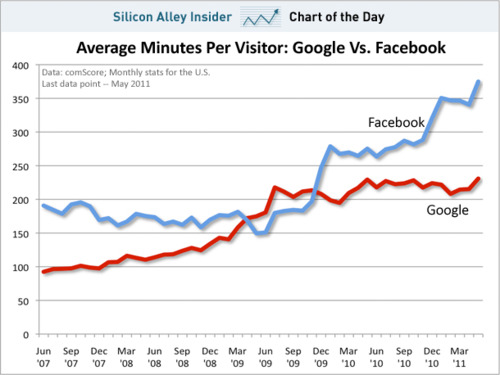
In a lengthy "Why I quit" letter, former Google software developer James Whitaker blames Facebook envy for the company's decline:
Advertisers and publishers cherish [detailed] personal information, so much so that they are willing to put the Facebook brand before their own. Exhibit A: http://www.facebook.com/nike, a company with the power and clout of Nike putting their own brand after Facebook’s? No company has ever done that for Google and Google took it personally.
Larry Page himself assumed command to right this wrong. Social became state-owned, a corporate mandate called Google+. It was an ominous name invoking the feeling that Google alone wasn’t enough. Search had to be social. Android had to be social. You Tube, once joyous in their independence, had to be … well, you get the point. Even worse was that innovation had to be social. Ideas that failed to put Google+ at the center of the universe were a distraction.
Joshua Gans generalizes the lesson:
[T]he start-up turned into a corporation. It faced a threat that required a coordinated response and that response necessarily had to crimp the innovation system that had built it. The problem is that coordinated response had its own flaws. As I have argued previously, Google+ didn't offer consumers much more, if anything, than Facebook did.
(Chart from tumblr user The Asphyxiated Pecker)
"I've heard Church insiders call the cardinal "Wuerl the girl," a reference to his precious personality. He has many fine qualities. He seems a little less common to me than some of his hackish colleagues. But cufflinks, starched shirts, learning, and reasonably civilized manners do not a good bishop make. Jesus Christ never required that his disciples place roses in his room or mints on his pillow," – George Neumayr, objecting to Wuerl's objection to public denial of Communion without individual consultation and prayer with the allegedly sinful recipient.
Amrit Dhillion disses the idea that India is going to be the world's next great power:
While the rich consume luxury goods and the middle class buys fancy cars and gadgets and holidays in Bangkok, they blind themselves to the reality for 700 million or so immiserated Indians. In their vainglorious dinner-table talk about ''superpower'' status, they forget that a country that cannot meet a poor person's most basic needs – enough food, clean drinking water, and electricity – has no business aspiring to superpower status.
Shashi Tharoor counters:
India expresses itself in many ways. Its strength is that it has preserved an idea of itself as one land embracing many – a country that endures differences of caste, creed, color, culture, conviction, costume, and custom, yet still rallies around a democratic consensus.
That consensus is the simple principle that, in a democracy, it is not necessary to agree – except in terms of how to disagree. The reason that India, despite predictions of its imminent disintegration, has survived the stresses that have beset it during more than six decades of independence, is that it has maintained a consensus on how to manage without consensus. This is the India that Mahatma Gandhi fought to free, and its turbulent politics is well worth celebrating.
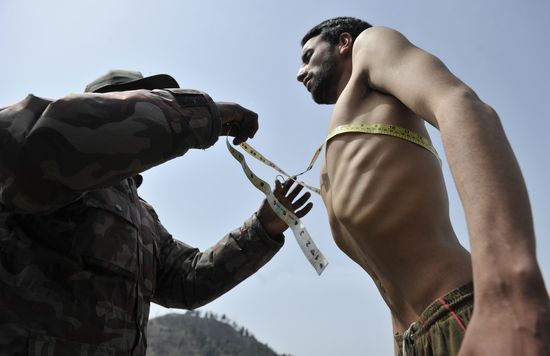
(Photo: An Indian army officer measures the chest of a Kashmiri youth during a recruitment rally in Anantnag, some 65kms south of Srinagar, on March 16, 2012. A separatist insurgency against Indian rule in the Himalayan state that began in 1989 has claimed more than 47,000 lives, according to official figures. Seperatists put the toll twice as high. By Tauseef Mustafa/AFP/Getty Images.)
 The Dish