Catholics vs Santorum, Ctd

141487810

What's fascinating to me is that Santorum is the current Vatican's ideal Catholic: daily-mass attending, embedded in elite politics, dedicated to Opus Dei style reactionaryism in the Church, contemptuous of any division between church and state, and dedicated to legislating and governing according to Catholic moral doctrine (with core issues such as universal healthcare and torture and economic justice excised from the relevant debate).

And just as American Catholics overwhelmingly dissent from the Vatican's sexual obsessions and fusion of politics and religion, so they don't even recognize Santorum as one of their own:

Catholics in the exit polls tend to look more like the typical Romney Republican. Catholics are less deeply conservative and less likely to back the Tea Party movement. They have more formal education than non-Catholics and higher incomes, with 74 percent reporting annual household incomes over $50,000, compared with 67 percent of non-Catholics.

Unlike theocon Santorum, American Catholics are secular pluralists in politics:

Only 1 in 5 Catholics on average said it mattered "a great deal" that a candidate share their religious beliefs, compared with one-third of non-Catholics in exit polls that asked the question.

And most instinctively (and rightly) see the manner of Santorum's faith as closer to Christianism than to Catholicism:

Less than half of the Catholic Republicans surveyed knew Santorum's faith, the survey showed, while 11 percent of Catholic Republicans and 35 percent of white evangelical Republicans thought Santorum was an evangelical.

It's worth remembering this when you hear pundits say "the Catholic church" says this or that. What they mean is "the Catholic hierarchy," which in this country is increasingly code for the GOP's evangelical and Randian policies. The last thing it means is American Catholics.

(Photo by Whitney Curtis/Getty Images.)
Criminalize Crime, Not Hate, Ctd

Last Friday, a jury found Dharun Ravi guilty of, among other charges, "bias intimidation" against Tyler Clementi because of his sexual orientation. R.M. at DiA is troubled:

For many this will be seen as a victory against homophobia and cyberbullying. But others will see it as overkill by prosecutors bent on avenging the death of Mr Clementi. Despite holding nothing but contempt for Mr Ravi, I tend towards the latter interpretation. Society's harsh moral judgment of Mr Ravi could not be adequately reflected in the law, nor could the law properly account for Mr Clementi's suicide. So prosecutors piled bias intimidation charges on top of the more appropriate spying and tampering ones, essentially doubling the possible sentence, in an effort to express the public's disdain for the defendant and somehow balance Mr Ravi's callous acts with Mr Clementi's tragic death.

I find it repellent as well. This was a bigoted online hazing followed by a judicial witch-hunt. Jacob Sullum explains how tenuous the hate crime charges really were:

Under New Jersey's law, bigotry is not even necessary.

Assuming the underlying offense (in this case, invasion of privacy) was intentional, there need not be any evidence that the intimidation was. Surmising how Clementi felt in this situation based on the available evidence—in particular, distinguishing between anger and intimidation—is fraught with uncertainty, and the judgment as to whether his imagined feelings were reasonable is even harder to make. In a case like this, where the victim cannot testify about what he was thinking and no one else knows, these elements have reasonable doubt built into them. …

Had Clementi not killed himself a few days after what he dismissively called Ravi's "five sec peep," leading to the completely unproven conjecture that Ravi's spying drove him to suicide (a claim the prosecution never made during the trial), Ravi probably would not have faced criminal charges at all, let alone a possible 10-year sentence.

Earlier Dish coverage of the trial and my general take on hate crimes here.

An Abortion In Texas

Halfway through her pregnancy, Carolyn Jones found out her fetus had a serious condition that meant her expectant son’s brain, spine and legs wouldn't develop correctly and that he would "suffer greatly". Before receiving an abortion, a new Texas law required her to undergo a sonogram and have the doctor describe it to her:

"I’m so sorry that I have to do this," the doctor told us, "but if I don’t, I can lose my license." Before he could even start to describe our baby, I began to sob until I could barely breathe. Somewhere, a nurse cranked up the volume on a radio, allowing the inane pronouncements of a DJ to dull the doctor’s voice. Still, despite the noise, I heard him. His unwelcome words echoed off sterile walls while I, trapped on a bed, my feet in stirrups, twisted away from his voice. 

"Here I see a well-developed diaphragm and here I see four healthy chambers of the heart…" I closed my eyes and waited for it to end, as one waits for the car to stop rolling at the end of a terrible accident.

Can Domestic Production Solve Our Oil Problems?

Bingaman-gas-2

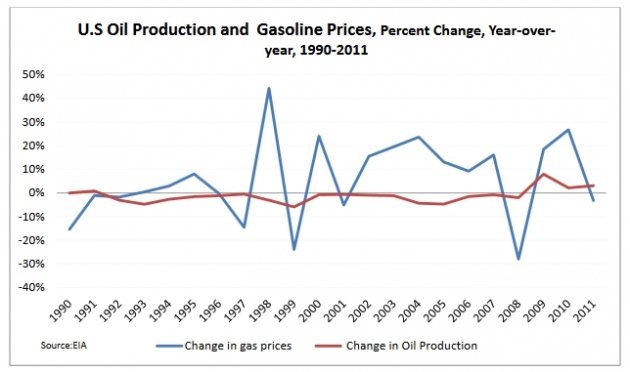
Senator Jeff Bingaman (D-NM) says no, contra Gingrich. David Roberts examines the above chart from Bingaman:

The price of gasoline bears very little relationship to U.S. oil production, for the simple reason that U.S. oil production is a small fraction of the world’s total. See any relationship? Me neither.

Michael Klare doesn't expect prices to come down any time soon: 

The simple truth of the matter is this: most of the world’s easy reserves have already been depleted — except for those in war-torn countries like Iraq.  Virtually all of the oil that’s left is contained in harder-to-reach, tougher reserves. These include deep-offshore oil, Arctic oil, and shale oil, along with Canadian “oil sands” — which are not composed of oil at all, but of mud, sand, and tar-like bitumen. So-called unconventional reserves of these types can be exploited, but often at a staggering price, not just in dollars but also in damage to the environment.

Do Film Critics Matter Anymore?

Jonathan Kirshner, reviewing a collection of books on the '70s heyday of critics like Roger Ebert and Pauline Kael, thinks not:

The blockbuster model was … a terrible blow to the critical enterprise. With movies opening everywhere at once, aggressively marketed and highly dependent on the first few weeks of box-office receipts, filmmakers and viewers relied little on the opinions and influence of serious critics. The relationship between the movies and their audiences was changing.

Lightbulbs In The Shower

In his new book Imagine: How Creativity Works, Jonah Lehrer explains how relaxation fuels our imagination:

Although we live in an age that worships focus—we are always forcing ourselves to concentrate, chugging caffeine—this approach can inhibit the imagination. We might be focused, but we're probably focused on the wrong answer. And this is why relaxation helps: It isn't until we're soothed in the shower or distracted by the stand-up comic that we're able to turn the spotlight of attention inward, eavesdropping on all those random associations unfolding in the far reaches of the brain's right hemisphere. When we need an insight, those associations are often the source of the answer.

In a follow-up, he emphasizes the merits of boredom:

After all, when we’re bored we begin to daydream, and studies suggest that people who daydream more score higher on tests of creativity. This is why I now force myself to leave my phone behind a few times a week. When I have my phone, I check my email or twitter or the WSJ the second I get bored – the daydream is always being interrupted. So I’ve learned to embrace the possibilities of boredom.

In the above video from David Shiyang Liu, Ira Glass touches on the other element to creative success: hard work.

Big Data Detectives

Emily Badger reports on the success Memphis police have had using reams of police paperwork for real-time data-mining:

Each piece of information is connected to myriad others: convicted criminals are linked to the names of every accomplice and victim known in the system, every car and street address they’ve ever been associated with, every alias they’ve gone by and arrest warrant they’ve been served. IBM has even been working on software that can reconcile typos and misspelled identities, correctly pegging Chriss Knisley, Chris Knisley and Chris Knisely as the same man.

Urban Jungle

3652287326_8e2018e70d_b

Several cities have more trees today than in the past: 

By way of example, take this from historian William Cronon: "There are more trees in southern Wisconsin now than at any point in the last 7,000 years." That’s in part due to more than a century of fire suppression, but also the intense pace of urban development.

(Photo by Alyssa L. Miller)

The Danger Of A Glass Half Full

A warning against overoptimism:

"One of the benefits of an optimistic temperament is that it encourages persistence in the face of obstacles," [Daniel Kahneman author of Thinking, Fast and Slow] explains. But “pervasive optimistic bias” can be detrimental: "Most of us view the world as more benign than it really is, our own attributes as more favorable than they truly are, and the goals we adopt as more achievable than they are likely to be."

For example, only 35 percent of small businesses survive in the U.S. When surveyed, however, 81 percent of entrepreneurs assessed their odds of success at 70 percent, and 33 percent of them went so far as to put their chances at 100 percent. So what? In a Canadian study Kahneman cites, 47 percent of inventors participating in the Inventor’s Assistance Program, in which they paid for objective evaluations of their invention on 37 criteria, "continued development efforts even after being told that their project was hopeless, and on average these persistent (or obstinate) individuals doubled their initial losses before giving up." Failure may not be an option in the mind of an entrepreneur, but it is all too frequent in reality.