
Horses Out Of Luck

HBO last week canceled its lackluster series "Luck" following the death of a third horse during production. Given that about 800 horses a year die at racetracks, Cord Jefferson questions the logic of the decision:

It's a strange society in which a television show can't kill horses with impunity but the more than 50 thoroughbred tracks in the United States can. Perhaps the producers of Luck have more of an affinity for the horses, agreeing to quit after killing only three while people in the racing industry destroy thousands. Perhaps people believe a death on the racetrack is somehow more honorable than a death for HBO. Whatever it is, America's loyalty speaks volumes about how it prefers its horse deaths: Luck averaged only around 625,000 viewers per episode, but 14.5 million people watched the Kentucky Derby last year.

The Decaf Dilemma

The quest for naturally caffeine-free coffee continues:

Researchers have long sought a better bean, harvested directly from the plant caffeine-free. This would preserve coffee's complex flavour and give growers a high-end slice of the decaf market. But developing such a bean through conventional breeding or even genetic modification has proved more difficult than anyone anticipated. … Today, companies may instead douse raw green coffee beans in high-pressure liquid carbon dioxide or soak them in hot water for several hours to remove the caffeine before roasting. Aficionados say that all these methods destroy the taste, but the decaf market is still worth US$2 billion a year.

Veronique Greenwood eyes the hurdles:

Hope and heartbreak mix in equal proportions in this story: find a promising plant, watch its flowers wither before they are ready to be fertilized; come with a dynamo technique, suffer cripplingly small yields. John Stiles of University of Hawaii, after triumphing over the mysterious unwillingness of C. arabica cells to take up new genetic material and starting a private lab to develop his creations, found that as they grew, caffeine began creeping into their tissues. Nearly a decade after Paulo Mezzaferra found that he’d made plants with miniscule levels of caffeine, he is still struggling to get them to thrive.

The Hierarchy Versus The Future

ASHPUNKRaulArboleda:AFP:Getty

Here in America, we see a Catholic hierarchy all but joining forces with the Republican party to insist on their right to control what is offered as healthcare to their employees in religiously-affiliated schools and hospitals and public services. In Britain, we see a furious campaign to prevent gay couples from having civil marriage licenses, a reform backed by the Conservative prime minister, and both opposition parties. And for much of the moment, this will be what the Church presents to the world: an attempt to control the medical care for women in its employ and its determination to keep homosexuals out of the word "marriage" and, thereby, "family."

There is a spiritual and religious cost to this. And I do not mean that the Church should always "keep up with the times." There are moments when a Church's role is precisely to abandon the contemporary world in order to uphold what it takes to be eternal truths. But the narrowness of the current crusades – against a pill used by 98 percent of Catholic women, whose consciences are their own, and against people of a different sexual orientation that the Church acknowledges is unchosen – damages Christianity in the culture, and, in my view, misses the forest for the trees.

Christianity is not about the control of others; it is about the liberation Christ brings to each of us, and how we can learn to trust that incarnated love in escaping our daily failures, sins, weakness, cruelties – in order to bring love into being in the world.

And so the following thoughts from a dissident priest in Wales seem to me to get the balance right in our current trials. Read it all. Money quote:
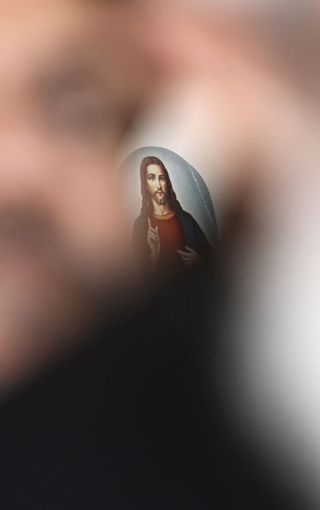
COPTJESUS1MohammedAbed:GettyI welcome the debate on the meaning of marriage and its role and purpose in a liberal diverse society. But growing ever stronger in my mind is the fear that while as a Church we worry about language and words – Welsh or English or Latin; rock or plainsong; marriage or civil partnership – the message and meaning that we are here to proclaim is passing us by.

Surely if there is one constant and common theme throughout the scriptures it is in the gradual discovery and recognition of the reality of God as a God of an inclusive and all-embracing Love whose ultimate expression is found in the Paschal Mystery of Death and Resurrection of his “Word” incarnate, Jesus of Nazareth.

The purpose and mission of the Church, surely, is to be an effective and coherent witness to and expression of that love in our world and our time – however we do it, and in whatever language, for everyone

Society sees little of that, sadly, when it sees a church hierarchy that all too willingly goes into convulsions when moral issues are called into question but remains silent when faced with the real social scandals of our time.

But I do see it in the people, young and old, who still come faithfully to fill the pews and celebrate the mystery of a love that defies all our definitions and the limits we place on it. I see it in their acts of sacrifice and solidarity, in their innate sense of dignity, justice and a shared and sacred humanity. Perhaps when as a Church we begin to speak about that a bit more, the world will once again sit up and listen.

(Photos: Raul Arboleda/AFP/Getty, and Mohammed Abed/Getty)

Quote For The Day II

"Love remains forever that part of life we can never control. As Bruckner says, it continues to resist indoctrination and ideology. It does not yield to the inquiries of theory. The world has tried to bring it within the realm of reason and ethics, make it modern and progressive. Bruckner is here to tell us that  'there is no progress in love. It will always be a surprise,'" – Robert Fulford.

Do Insects Have Personalities?

A new study indicates that some bees are more adventurous than others: 

The researchers found that thrill-seeking is not limited to humans and other vertebrates. The brains of honeybees that were more likely than others to seek adventure exhibited distinct patterns of gene activity in molecular pathways known to be associated with thrill-seeking in humans. The findings present a new perspective on honeybee communities, which were thought to be highly regimented and comprised of a colony of interchangeable workers taking on a few specific roles to serve their queen. It now seems as though individual honeybees differ in their desire to perform particular tasks and these differences could be down to variability in bees’ personalities. This supports a 2011 study at Newcastle University that suggested that honeybees exhibit pessimism, suggesting that insects might have feelings.

The Opium-Eating Tory

Adam Gopnik considers the origins of contemporary English conservatism by looking at Thomas De Quincey. Author of Confessions of an English Opium-Eater and editor of a paper called the Gazette, De Quincey paved the way for The Sun and Fox News. Gopnik's takeaway:

In a time of more straitened and anxious conservatism, there is even something vaguely encouraging in De Quincey’s authorship: Toryism, it seems, at least need not be uptight. There are paths to a view of the world not always welcoming to central control and local variety, and moved by a fear of Utopianism that doesn’t depend on some model of personal virtue rooted in a panicky Puritanism. It is nice to know that, drilling down towards the Tory bedrock, what one may find at the bottom is a field of poppies.

Oakeshott – who read the Telegraph for the sports pages – was the archetypal bohemian Tory – and far less authoritarian than De Quincey. But, in today's Christianist era, it's worth reminding ourselves that one can be conservative in politics and yet radical in all other areas of life. In fact, a restrained, sober, conservative government above is, in my view, the best guardian of the glorious riot of human freedom below.

Face Of The Day

GT_SYRIAREFUGEE_120315

A woman carries a child at the Reyhanli refugee Camp in Antakya, on March 15, 2012. Around 1,000 Syrian refugees, including a defecting general, crossed into Turkey in the last 24 hours, the foreign ministry said on Thursday, the one-year anniversary of the Syrian revolt. Ankara accused the Syrian leadership of planting landmines near its border with Turkey along routes used by refugees fleeing the Damascus regime's deadly crackdown on dissent. By Bulent Kilic/AFP/Getty Images.

Addicted To Waitressing

Jackie Kruszewski confesses:

Waiting tables is not (surprise!) intellectually demanding. You just have to be efficient, organized and mildly articulate. And you need patience, serenity and stamina (read: cocaine, for some). The reason so many creative, scenester types work in restaurants — besides the flexible schedules and the decent haul — is that it doesn’t suck out your mental energy and soul like office jobs can.

… My day jobs, god bless them, have noble pursuits (the environment, science education) but I am, and likely always to be, a mere cog in the machine, churning out memos and carefully crafted databases that are utterly crucial and utterly banal. I come home, my body flaccid and my brain withered away by ostensibly productive but uncreative pursuits, and all I can muster the energy to do is watch Law & Order and resew a button on my Ann Taylor cuff.

Earlier in the week, the Dish covered the staggering number of young people working in service jobs today.