A Statement Of Fashion Or Faith?

GT_FASHIONCROSS_120313

In an upcoming case, British government lawyers will argue that Christians do not have a right to wear a cross openly at work. The former Archbishop of Canterbury, Dr. Rowan Williams, sided with the defense by characterizing the cross as "a religious decoration." Andrew Brown disagrees:

Does Christianity demand that its adherents wear a cross? The courts here have decided that it doesn't, but I'm not sure the question is well framed. You might as well ask "does Christianity demand that you go to church on Sundays?" or "does it demand pacifism?" There are just too many Christianities for such a question to make sense. 

David Gibson finds a reason for Christians of all stripes to finally unite:

The federal government in the U.S. has had to argue that a cross is not explicitly Christian in order to keep such symbols on federal lands. That is ironic, and unfortunate. But barring such symbols in the workplace — and by claiming they have no religious content? Wow. It seems French ant-hijab laïcité has infected the British — sacre blue!

(Photo: A model walks the runway during the Lanvin Ready to Wear Spring / Summer 2012 show during Paris Fashion Week at Jardin des Tuileries on September 30, 2011 in Paris, France. By Pascal Le Segretain/Getty Images.)

Digital Willpower

Evan Selinger contemplates apps that help control our urges. How this relates to our understanding of free will:

Shaun Gallagher, philosophy professor and editor of Phenomenology and the Cognitive Sciences, is sympathetic to viewing the will as contextually located. "It's a mistake to think of the will as some interior faculty that belongs to an individual–the thing that pushes the motor control processes that cause my action," Gallagher says. "Rather, the will is both embodied and embedded: social and physical environment enhance or impoverish our ability to decide and carry out our intentions; often our intentions themselves are shaped by social and physical aspects of the environment."

Could Smaller Humans Save The Planet?

In his new paper, S. Matthew Liao proposes biomedical modifications to help humans consume less: 

[A] car uses more fuel per mile to carry a heavier person, more fabric is needed to clothe larger people, and heavier people wear out shoes, carpets and furniture at a quicker rate than lighter people, and so on.  And so size reduction could be one way to reduce a person's ecological footprint. For instance if you reduce the average U.S. height by just 15cm, you could reduce body mass by 21% for men and 25% for women, with a corresponding reduction in metabolic rates by some 15% to 18%, because less tissue means lower energy and nutrient needs.

Ronald Bailey finds that this isn't the first time the idea has been suggested. Steve Clark doesn't believe the proposal counts as "voluntary":

Unless the techniques that are being proposed are somehow made reversible then the children in question will have no choice in the matter. Their parents are deciding for them. As a society we do not give parents an unlimited right to make decisions on behalf of their children. 

Duncan Geere offers a critique to another of Liao's bioengineering suggestions, using hormones to make people more empathetic:

Hormone tweaking can have unintended side-effects, and a community that's more empathetic and altrustic could be taken advantage of by others who have less scruples. Liao's response to these criticisms? "These risks should be balanced against the risks associated with taking inadequate action to combat climate change. If behavioural and market solutions alone are not sufficient to mitigate the effects of climate change, then even if human engineering were riskier than these other solutions, we might still need to consider it."

Leo Hickman rounds up the paper's harsher critics:

Climate sceptics were the first to vent their anger. Somewhat inevitability, terms such as "eugenics", "Nazis" and "eco fascists" were quickly being bandied around. One sceptic blogger said that the "sick" Liao and his co-authors should be "kept in Guantanamo". Another said the paper "presages the death of science, and indeed the death of reason, in the West". But prominent environmentalists were also keen to denounce the paper. Bill McKibben tweeted that the paper contained the "worst climate change solutions of all time". Mark Lynas tweeted that he thought it was an "early April Fool". It was hard to disagree.

Barack Obama, Man Of Faith

GT_OBAMAPRAYER_120312

Faux historian and Christianist David Barton rants about Obama's alleged sins against religion: 

[P]erhaps the most accurate description of [Obama's] antipathy toward Catholics, Protestants, religious Jews, and the Jewish nation would be to characterize him as anti-Biblical. And then when his hostility toward Biblical people of faith is contrasted with his preferential treatment of Muslims and Muslim nations, it further strengthens the accuracy of the anti-Biblical descriptor.

Paul Harvey can't believe his ears:

[F]or the anti-Obama agonists, the president’s overtly Christian testifying, praying with Billy Graham, championing of C. S. Lewis, and quoting of the Old Testament in major public speeches simply shield the fact that the enemy always comes clothed in righteousness—and that the Great Deceiver is among us.

David Barton summarizes it most succinctly: “Many of these actions are literally unprecedented—this is the first time they have happened in four centuries of American history. The hostility of President Obama toward Biblical faith and values is without equal from any previous American president.” Roll over, Thomas Jefferson.

Earlier coverage of biblical messages in Obama's speeches here.

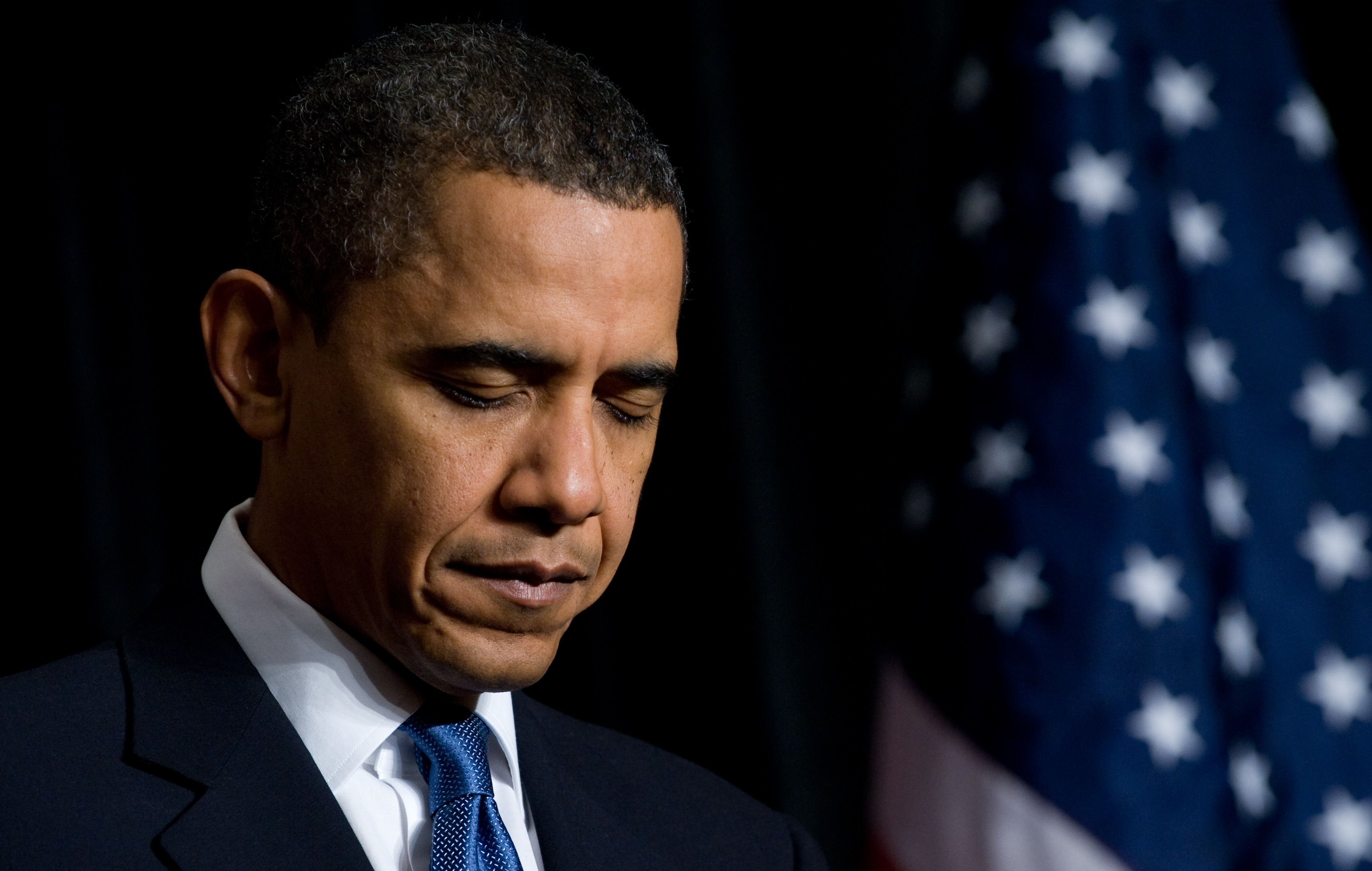
(Photo: US President Barack Obama bows his head during a prayer at the Republican GOP House Issues Conference in Baltimore, Maryland, on January 29, 2010.By Saul Loeb/AFP/Getty Images)

“Not A Possession But A Hope”

In 1966, Time Magazine ran the cover story, “Is God Dead?,” which featured the beliefs of "Christian Atheist" William Hamilton. Hamilton passed away this month. Jon Meacham recalls his theology:

In his view that faith was “not a possession but a hope,” Hamilton was tapping into an ancient tradition. As the author of the New Testament Epistle to the Hebrews wrote, “Faith is the substance of things hoped for, the evidence of things not seen”—in this sense, religious faith is way of interpreting experience that allows for the possibility of the redemptive.

Faith in this sense assumes that scripture and tradition are the works of human hands and hearts, efforts undertaken to explain the seemingly inexplicable. Faith in this sense is inextricably tied to doubt; it is an attempt, sometimes successful and sometimes not, to squint and struggle to “see through a glass darkly,” as Paul wrote in Corinthians. Faith without such doubt has never been part of the Christian tradition; it is telling, I think, that one of the earliest resurrection scenes in the Bible is that of Thomas demanding evidence—he wanted to see, to touch, to prove. Those who question and probe and debate are heirs of the apostles just as much as the most fervent of believers.

The Rise And Fall And Rise Of The Vibrator

The sex toy was originally marketed as a medical device:

Despite their popularity, vibrators disappeared from the market in the 1920s. The devices were devised for middle-class women, but in a nation as racially and ethnically diverse as the United States in the early 20th century, there were many competing sexual norms. Many working-class women, less affected by middle-class sexual norms, knew what the vibrator could do. The large-scale prostitution industry, although under attack after the crackdown on semi-legal and regulated red-light districts in the 1910s, adapted to new technologies and began creating pornographic films. These films began deploying the vibrator, destroying the fiction that the device was divorced from human sexuality.

It seems that as soon as the connection between sexual pleasure and vibrators became firmly established in American culture, their acceptability as medical treatment vanished and the product disappeared from mainstream society. It was not until the early 1970s that the vibrator again became a common product.

A Poem For Saturday

Charlie1a

"The Fornicator" by Robert Burns:

Ye jovial boys, who love the joys,
The blissful joys of lovers,
And dare avow wi’ dauntless brow,
Whate’er the lass discovers;
I pray draw near, and you shall hear,
And welcome in a frater,
I’ve lately been in quarantine,
A proven fornicator.

Continued here. Pauline Gray fills us in on the inspiration for the 1784 poem:

It is widely believed that Robert Burns first came under the censure of the church in 17841785 owing to his affair with a servant girl Elizabeth Paton.  … 'The Fornicator' is a defiant and unashamed assertion of Burns's belief that sex conquers all. And so, Burns's declaration that he is indeed a 'Fornicator' becomes a defiant affirmation of his sexuality as opposed to a label of debauchery and impiety.

(Photo from Joseph Gerhard’s series Unmade Beds, via Judy Berman. Gerhard writes on his website that "There is an intimacy to an unmade bed that makes a photograph … both immediately familiar and vaguely transgressive.")