All Eyes On Puerto Rico?

GT_SANTORUMPR_120315

Ben Jacobs hypes the Sunday primary: 

[Romney's disappointing performance in the South] makes Sunday’s primary in Puerto Rico, with 20 delegates at stake—more than New Hampshire, Vermont, or Hawaii among the states that have voted so far—a very big deal. Until Tuesday, the Caribbean territory, which has never played a big role in a GOP primary before, had been written off as a gimme for Romney, who is backed by the Republican governor, Luis Fortuno, and has been racking up delegates in territorial primaries that his less well-funded competitors have effectively conceded. …  If Santorum holds Romney below 50 percent there, it would deny the former Massachusetts governor at least 10 delegates—effectively removing the cushion he picked up with his two wins Tuesday. While there’s been no recent polling on the island, turnout is expected to be as high as 400,000—which would be more than Iowa and New Hampshire combined.

Meanwhile, Santorum has dubbed himself "Senador Puertorriqueño." But he screwed up royally on the language question. A reader reacts to our most recent Ad War Update:

Craig Romney’s heavily accented, Spanish 101 pitch in a recent local Puerto Rico radio commercial was a curious little drama to the few of us here who care about US politics, in this blind, insular, USA-forgotten island.

His father’s even heavier accent at the end of that commercial – the "I approve this message" – was less funny and folksy than it was ludicrous.  Few stateside people know how foreign these commercial sound and how desperate the fly-down trips of these Republican candidates appear to the people of an island that has been all but forgotten by US politics. 

Santorum was completely blind to local problems during his visit, catering, with his "English only"  insistence, to the crudest of Amurrican right-wing yahoos.  He met with out wildly out-of-touch conservative governor.  I wonder how absurd their conversation must have been.  Romney will visit the island, we hear, in the next few days.  Not much more is expected from him.  But both he and Santorum want those 20 Puerto Rican delegates.  And so a tropical and heartless Kabuki will be played out.  (Sadly, Obama flew down a few months back, delivered some boilerplate, collected some money, and then flew away in a blink of an eye.)

A century ago, this island was thrown in as booty, to sweeten the pot after the 1898 Hispanic-American War.  Cuba was the plum back then.  And now with Cuba opening up, God help us.

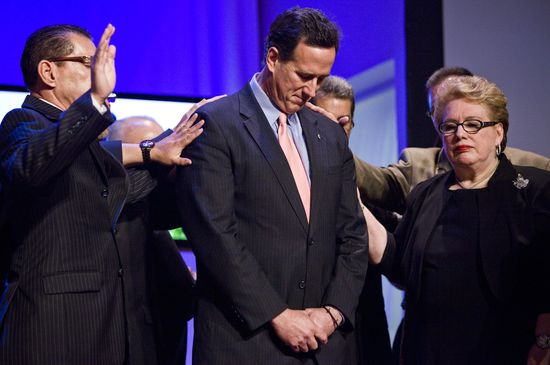
(Photo: Former Senator Rick Santorum (R-PA) attends a prayer service at the Path of the Cross Evangelical Church in San Juan, Puerto Rico on March 14, 2012. Santorum's two-day campaign on the island is meant to win the 20 of 23 GOP delegates up for grabs on the island commonwealth. His religious views are likely to entice the vote of the island's large Catholic population. By Christopher Gregory/Getty Images.)

The GOP’s Geography Problem

Joel Kotkin worries about the party's unhealthy dependence and relentless focus on rural areas: 

Rural America constitutes barely 16 percent of the country, down from 72 percent a century ago, but still constitutes the party’s most reliable geographic base. It resembles the small-town America of the 19th century, particularly in the South and West, that propelled Democratic Party of Nebraska’s William Jennings Bryan to three presidential nominations. Yet like Bryan, who also lost all three times, what makes Santorum so appealing in the hinterlands may prove disastrous in the metropolitan regions which now dominate the country. 

Desperate Ad Watch

Internet Explorer has launched a new website, TheBrowserYouLovedToHate.com, to win back the cool kids on the Internet. It features this ad:

Joe Coscarelli cringes:

[F]orced corporate hipness almost always commits the worst sin of all: trying too hard.

A reader differs:

I thought this ad was brilliant. I totally identify with the rabid fury toward IE "back in the day" (before I just moved on) and the ad made me laugh. I think most techies know that sucky products can be improved or rebooted – and a little humble self-awareness helps. Windows Vista was universally panned but Windows 8 is considered really, really good. Apple is the biggest comeback of all. (It never really sucked but it turned many people off.) I'm ready to try IE9. Why not?

College Splits The Parties

Ryan D. Enos finds a connection between political orientation and views on higher ed:

The importance of ideology to the value that the typical American attaches to higher education is tremendous. When I construct a statistical model that accounts for a person's income, gender, education, race, where they live, and whether or not they are the parent of a minor child — conservatism is the single most powerful predictor of whether a person thinks a college education is important to financial success, the effect a person thinks college has on political ideology, and their opinion of college professors. In fact, political ideology is more strongly associated with a person's views on college professors than it is their views on President Obama!

Dystopia Is The New Vampire

Abby McGanney Nolan ponders The Hunger Games, which has replaced Twilight as the book series of choice among teenage girls:

Why have readers been so drawn to catastrophic futures when the present seems troubled enough? Why are young heroines thrust into ruined worlds and then routinely hunted, harassed, or beaten into unconsciousness? A New York Times forum on the grim dystopia boom featured one novelist in the genre asserting that teens in our mismanaged times are demanding to read "something that isn’t a lie." Writing on the phenomenon in The New Yorker, critic Laura Miller wondered if the authoritarian societies that dominate the trend are analogues to the oppressive world of high-school students, who are constantly monitored and hassled and forced to compete. 

Kevin Drum's view:

It doesn't actually surprise me all that much that teenage girls, a demographic practically defined by angst, would find these kinds of narratives appealing. If you think the world is heartless and authoritarian, what's not to like about a fictional world where a teenage girl fights and beats an establishment that's heartless and authoritarian?

The 4G Hype

Farhad Manjoo deflates it:

[T]he iPad now carries the most consumer-unfriendly spec in all of tech: “4G.” That label, which theoretically specifies a device’s wireless data speed, doesn’t really tell you anything about how fast your gadget might surf the Web. If you see any phone, tablet, toaster, or fridge that’s capable of “4G” networking, you should assume the guy who’s selling it to you thinks you’re a fool. And if you do put any stock in the label, you are a fool. 4G—and, relatedly, “3G”—means nothing. It never has, it never will, and it’s time we banished it from our devices for good.

How Should We Treat Chronic Pain? Ctd

A reader writes:

I am a sufferer of chronic pain and want to respond to the doctor who wrote that its treatment is "asinine because pain is not a disease." This is a matter of semantics for the sufferer. It's wonderful that pain is caused by some "underlying anatomic pathology," but if doctors cannot determine what that pathology is, or decide it is neurological condition that cannot be "righted," or give up and label it fibromyalgia, then you have to treat the pain. Being in pain 24 hours a day, 7 days a week is quite literally incomprehensible to anyone who only experiences occasional pain as the result of injury. I can't tell you how many doctors either didn't believe, didn't take seriously, or didn't appreciate my pain. Years and scores of doctors went by before someone listened to me. The toll that pain has had on my psyche I wouldn't wish on any human being.

Are there some pain patients who need to take more responsibility for their general health, their bad habits and their lifestyles?  Of course.  Are there lazy people who would rather pop a pill than stretch?  Of course.  But when a doctor minimizes their pain by saying "you're not gonna die from pain," that kind of attitude can be devastating. I am absolutely sure there are people who killed themselves or self-medicated to death rather than have to face a lifetime of unending pain.

Another:

I hurt my back in 1996 and needed surgery in 1999. The surgery was ineffective and, because of nerve damage, the pain was even worse. How worse? By 2001 I had devised a plan to drown myself.

But I also talk in my sleep and have nightmares, so my wife confronted me. I was hospitalized briefly and started on oxycontin. What a miracle! It does not completely remove the pain. I am in some level of pain daily (and some days are horrible). But it allows me to Live.

I have a contract with my doctor. I am subject to random drug tests to insure that I am taking the pills and not diverting them. He calls and I have four hours to produce a urine sample. No excuses. If I lose them – tough! If they are stolen – too bad! These practices are to protect the doctor from unscrupulous patients and keep patients from diverting drugs (even the retail cost is amazingly high) and becoming dealers and felons.

Without oxycontin I would be dead.  I am lucky and I am alive – really living!  But I know people who need them and cannot get them because of their doctors fear of being branded as pushers.

Another:

My brother suffers from a rare degenerative nervous condition, CIDP. As with many lifelong, neurological conditions there are several options in the associated pain management. The first is to gradually destroy his body by taking increasingly large amounts of highly addictive opiates. The second is the safe, non-addictive drug you've blogged about so much.

As a further twist, although he lives in California and was already smoking illegally to treat his pain, his neurologist refused to refer him for a medicinal marijuana card for fear of the damage to his professional credibility. Instead he had to go to one of the seedy weed-mills in order to get the medication he was more than qualified to take. Why is it that obtaining marijuana illegally is so easy but obtaining it legally is so difficult? If this isn't a damning statement about the dysfunctional state of drug enforcement in this country I don't know what is.