Obama’s Imaginary Tax Increase

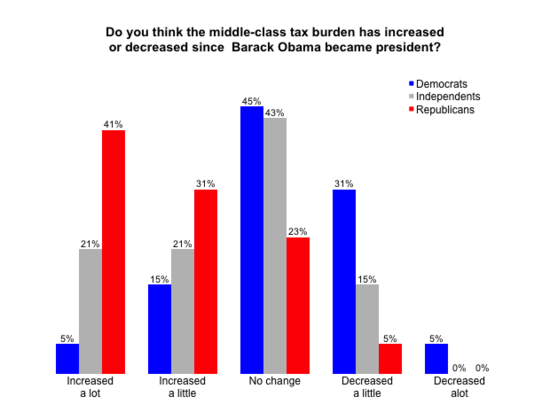
Most Americans, and the vast majority of Republicans, don't realize that taxes have decreased under Obama:

Taxes_Obama  

Larry Bartels contemplates the finding and others like it:

We often think of election outcomes as collective verdicts on the state of the nation under the incumbent president. As political scientist Morris Fiorina put it long ago, "In order to ascertain whether the incumbents have performed poorly or well, citizens need only calculate the changes in their own welfare." Are we better off now than we were four years ago? What happens, then, if citizens are not really up to calculating "changes in their own welfare"—if our judgments about even the most salient and straightforward aspects of our collective well-being are based more on partisan biases and media buzz than on reality?

The Weakest Field Ever?

Scott Galupo looks back at "hobbled incumbent presidents and their opponents":

[T]he weak-versus-weak phenomenon might have less to do with Obama (who, a short while ago, was an extraordinarily popular figure) and Romney (who, in the pre-Tea Party era, might have seemed a much stronger candidate) and more to do with other, exogenous factors: the economy, most obviously; the sharp ideological divisions of the electorate; the frenzied media culture that seems to magnify such divisions and, on a human level, create many more opportunities for embarrassing gaffes than existed just a generation ago.

Ad War Update

The DNC capitalizes on Romney's promise to defund Planned Parenthood: 

The full context

The ad features a comment made by Romney Tuesday on the campaign trail in Missouri. The former governor was asked what programs he would eliminate or defund to balance the federal budget. "You get rid of ObamaCare, but there are others," Romney said. "Planned Parenthood, we're gonna get rid of that. The subsidy for Amtrak, I would eliminate that. The National Endowment for the Arts, the National Endowment for the Humanities, both excellent programs, but we can't afford to borrow money to pay for these things." 

Steve Benen runs with it: 

As the former governor sees it, the way to improve the deficit is to cut taxes, increase military spending, and block access to contraception, family planning services, pap smears, cancer screenings, and tests for sexually-transmitted diseases. … It's also worth noting that Republican support for Planned Parenthood was the norm for nearly a half-century.

Barry Goldwater and George H.W. Bush championed the health organization; Reagan never balked at PP funding in the budget; and none of this was considered controversial in the slightest. There's no clearer example of the GOP's shift to the extreme than its newfound disgust for Planned Parenthood. But the point I keep coming back to is Romney himself having supported the health organization, including having attended a Planned Parenthood fundraiser.

Here is the DNC on Romney's 65th birthday decision to forgo Medicare: 

Meanwhile, Moveon.org released this spot on the GOP's "war on women" (airing on national cable): 

Previous Ad War Updates: Mar 13Mar 12Mar 9Mar 8Mar 7Mar 6Mar 5Mar 2Mar 1Feb 29Feb 28Feb 27Feb 23Feb 22Feb 21, Feb 17, Feb 16, Feb 15, Feb 14, Feb 13, Feb 9, Feb 8, Feb 7, Feb 6, Feb 3, Feb 2, Feb 1, Jan 30, Jan 29, Jan 27, Jan 26, Jan 25, Jan 24, Jan 22, Jan 20, Jan 19, Jan 18, Jan 17, Jan 16 and Jan 12.

PETA Kills

… "out of love," according to the group. James McWilliams disapproves:

In 2011, People for the Ethical Treatment of Animals (PETA) behaved in a regrettably consistent manner: it euthanized the overwhelming majority (PDF) of dogs and cats that it accepted into its shelters. Out of 760 dogs impounded, they killed 713, arranged for 19 to be adopted, and farmed out 36 to other shelters (not necessarily "no kill" ones). As for cats, they impounded 1,211, euthanized 1,198, transferred eight, and found homes for a grand total of five. PETA also took in 58 other companion animals — including rabbits. It killed 54 of them.

PETA counters:

PETA refers adoptable animals to the high-traffic open-admission shelters rather than taking them in ourselves, thereby giving them a better chance of being seen and re-homed. As for the "no-kill" shelters, their figures are great because they slam the door on the worst cases, referring them, in fact, to PETA. We operate a "shelter of last resort," meaning that when impoverished families cannot afford to pay a veterinarian to let a suffering and/or aged animal leave this world, PETA will help, free of charge. 

(Hat tip: JMG)

The Slaughter We Don’t See

Mark Bittman ponders the new book Every Twelve Seconds: Industrialized Slaughter and the Politics of Sight by Timothy Pachirat:

12 seconds is the frequency with which the Omaha slaughterhouse where Pachirat worked for five months killed cattle, a total of around 2,500 per day. Pachirat, whom I interviewed by phone earlier this week, took the job not as an animal rights activist but as a doctoral candidate in political science seeking to understand the normalization of violence. Like others, he concluded that our isolation from killing allows us to tolerate unimaginably cruel practices simply because we don’t see them. But Pachirat emphasizes that it’s not only we — consumers — who are isolated from the killing, but workers: at his plant only seven people out of 800 were directly involved with live cattle, and only four with killing.

Chart Of The Day

Tpm first term spending

Brian Beutler elaborates

Obama’s economy has benefitted from less of Washington’s largesse than did crypto-Keynesian Ronald Reagan’s. But this is actually part of a broader pattern. Recently, Republican presidents have benefited from accommodating Congress during times of economic weakness, while Democratic Presidents Clinton and Obama watched Congress suddenly grow stingy under their watch.

How Should We Treat Chronic Pain?

Balko continues his series on pain pills:

There is agreement that there are bad doctors running "pill mills" who are too loose with the prescription pad. And there's agreement that far too few doctors get effective training in pain management (but disagreement over what that training ought to be). But that's about where the agreement ends.

Patient advocates say the pill mills are the result of bad policies that have had a chilling effect that has scared good doctors out of pain management. They add that more laws aimed at curbing access to opoids will only worsen the problem. Portenoy, for example, points to a new law in Washington state requiring doctors to go through a number of detailed procedures before prescribing opioids to chronic pain patients. The result, as the Seattle Times reported last August, has been for doctors to stop treating those patients, and for clinics to turn them away.

Earlier posts on the subject here and here. Reader push-back here

Can Santorum Pull It Off?

First he needs to find a way to get rid of Gingrich:

Alana Goodman agrees that a Gingrich drop-out would make Santorum's nomination a real possibility:

Coming off his two victories in Alabama and Mississippi, Santorum has the momentum at this point to potentially take Illinois – and deal a devastating blow to the Romney campaign in the process. The latest poll from the Chicago Tribune shows Romney leading Santorum by just four points, 35 percent to 31 percent, with Gingrich trailing at 12 percent. If Gingrich drops out, endorses Santorum, and urges his supporters to vote for him, it could easily push the former Pennsylvania senator over the top in the state. And if, after dropping out, Gingrich agreed to pledge the delegates he’s already won to Santorum, it could completely change the dynamic of the race and actually make it competitive again.

Aaron Blake, on the other hand, appreciates Mitt's consistency in the South: 

He has taken between 26 percent and 30 percent of the vote in every Southern state dominated by conservative voters — Alabama, Georgia, Mississippi, Oklahoma, South Carolina and Tennessee. The thing is, while that consistency cost him on Tuesday, it’s likely to benefit him going forward. While the voting is just halfway done, Romney is almost done with his most troubling region, the South, and his most troubling contests, Midwestern caucuses. Even in the remaining Southern states, things may get better; both Texas and Louisiana feature more concentrated urban populations (a Romney strong suit) than other Southern states, which should help him perform better. 

Weigel also looks on the bright side: 

Romney muddled through the South while picking up 48 delegates — five times as many as he won in the Southern states that voted while Romney was still in the 2008 race. The numbers: In 2008, Romney won zero of 24 South Carolina delegates, three of 69 Georgia delegates, six of 40 Tennessee delegates, and zero of 45 Alabama delegates. In 2012, Romney won two of 25 South Carolina delegates (not great, true), 19 of 72 Georgia delegates, 16 of 55 Tennessee delegates and 11 of 47 Alabama delegates. He improved on his vote percentage in each state — except Georgia. Hey, the picture's even better than that: Romney lost Mississippi's popular vote narrowly, but may pick up a one-delegate plurality because of where he won it.

Meanwhile, his campaign is doubling down in the Northeast: 

The Romney campaign's Pennsylvania-focused activities may just be a combination of psychological warfare and messaging — demonstrating Santorum's limitations in his home state and trying to rattle the former senator a bit. But it's also notable that Pennsylvania votes on the next mega-primary day of April 24, along with Connecticut, Delaware, New York and Rhode Island. Those are all Romney-friendly states, with the exception of the one Santorum represented in the Senate, and if the race ends up dragging on that long then embarrassing Santorum in Pennsylvania could be Romney's next great opportunity to knock him out of the race.

Squatting With A Cell Phone

A reader points to new census data from India comparing toilet use to cell phone ownership:

Cell phones in a landslide. I'd bet the same holds in much of the developing world – the astonishing pace and penetration of cellular communications over the last decade. The developed world had 150 years of telegraph/telephone poles; the developing world just skipped that step. The savings that represents (just imagine the infrastructure costs they avoided!) are available for other projects. In 50 years, I bet wireless communications will be seen as the "break" that helped kickstart many of these countries out of the cycle of perpetual poverty. Anyway, they are startling stats.

On an unrelated note, our reader digs up a gem on physics:

Your post on the myth of the deadly penny made me remember the famous essay "On Being the Right Size" by the remarkable J.B.S. Haldane. Money quote:

You can drop a mouse down a thousand-yard mine shaft; and, on arriving at the bottom, it gets a slight shock and walks away, provided that the ground is fairly soft. A rat is killed, a man is broken, a horse splashes.