Pew Shows An Obama Blow-Out

If these trends persist, we could be in for a landslide:

Among all voters, Obama leads Romney by 12 points (54% to 42%) and Santorum by 18 points (57% to 39%). Obama’s advantage among women voters, while largely unchanged from a month ago, remains substantial – 20 points over Romney and 26 points over Santorum.

Obama also holds an enthusiasm advantage over both of his main GOP rivals. In a matchup with Romney, 41% say they support Obama strongly, compared with only 28% who strongly support the former Massachusetts governor. Obama holds a commanding 45% to 28% lead over Santorum in strong support.

A gender gap of more than 20 points is pretty devastating. Congrats to the Catholic hierarchy and their talk radio fans. But the poll of polls shows a much tighter race:
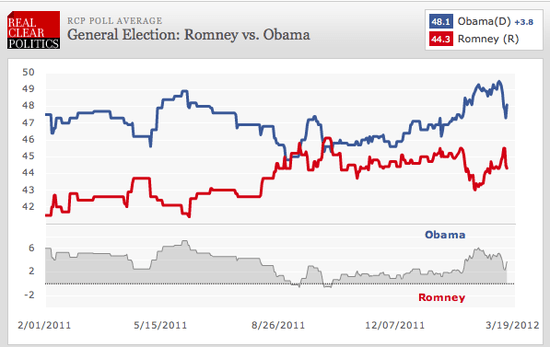
Screen shot 2012-03-14 at 12.26.44 PM

But enthusiasm matters. My fear is that Romney's inability to generate enthusiasm and willingness to go negative will mean one of the ugliest, nastiest campaigns in memory.

“Brokered” Or “Open”?

A reader writes:

You seem to be using the phrase "brokered convention" to describe a convention with no de facto nominee. "Open convention" would be more accurate.

A brokered convention is a subset of open conventions – that is, one whose nominee is determined by brokerage among a small group of leaders. That is, a brokered convention has brokers. In an open convention in the modern era, who would the brokers be? The candidates themselves, or their campaigns? Doubtful – if they couldn't win a delegate majority at the polls, they're unlikely to be able to do so in the metaphorical smoke-filled rooms of the convention. The party's Washington establishment? Them and what army? That is, how many delegates does anyone who might pass as a party leader control? The answer is a little over 100.

There is no precedent for an open convention in the modern primary era, so we simply don't know whether such a convention could be brokered – or even if it could be, whether it would be. Given how delegates are selected, and the lesser institutional loyalty they tend to have to any figure or machine within their party than in the pre-primary era, it seems most likely that any deal-making would be done by and among state delegations and cross-state informal coalitions (Texans and Californians trying to stick together, say, or a Tea Party caucus arising). That is to say, it would be the delegates themselves, and if so, then there would by definition be no broker.

Will Tampa be an open convention? Quite possibly. Will it be a brokered convention? We don't know; it could be an open convention that selects a nominee without brokering.

This Is Your Brain On Chemo

John Derbyshire is currently undergoing chemotherapy:

The base state for a chemotherapy patient, at least for this one, is listless apathy. Everything seems to move at half-speed. Tasks I could accomplish in a couple of hours now take all morning. This isn’t particularly unpleasant, just income-diminishing for a freelancer on piecework.

There is also the phenomenon of “chemo brain.” It strikes different people different ways. The way it strikes me is that nothing’s interesting anymore. Part of my editorial duties is trawling through news sources looking for interesting items. With chemo brain, there aren’t any. Nothing’s interesting. My kids aren’t interesting. My neighbors aren’t interesting. The movie we rented from Netflix isn’t interesting. My opera CDs aren’t interesting….

Not unlike depression – or the effect of having to analyze this GOP primary race for months. But my best wishes to the Derb, and hopes that it comes out fine.

Why Did John Carter Flop At The Box Office?

Claude Brodesser-Akner largely blames the movie's first trailer and the solipsism of the director:

[John Carter director Andrew Stanton] (who also nixed all mentions of his Pixar work in the teaser for fear that people would think this film was for little kids) was working from the belief that John Carter was still as universally iconic a figure to people as Dracula, Luke Skywalker, or Tarzan. “It was my Harry Potter,” he said during an interview at Google last week that was streamed live on YouTube. “All I ever wanted when I read that book was to believe it.”

He believed that audiences would gasp in delight at John Carter’s very appearance in much the same way that a Batman teaser might only need to flash the Bat Signal. As such, he felt that the very first John Carter trailer needed only to intrigue, not explicate.

“To him, it was the most important sci-fi movie of all time,” recounts one Disney marketing insider present for the pitched battles. “He could see no idea in which someone didn’t know who John Carter of Mars was. But it’s not Frankenstein; it’s not Sherlock Holmes. Nobody cares. People don’t say, ‘I know what I’ll be for Halloween! I’ll be John Carter!’”

The GOP’s Super PAC Conundrum

Despite Super PAC excess, the primary season is on track to be the cheapest in years. Pema Levy lays out the Republican predicament: 

The Post attributes the dampened fundraising to a lack of enthusiasm over a weak candidate field. If anything, it seems super PACs’ largely negative ads would help suppress overall enthusiasm for the race. The slower fundraising by the campaigns has, in turn, increased super PACs’ influence. As David Donnelly, executive director of the Public Campaign Action Fund, told the Post, if super PACs were around in 2008, when campaign spending was high, they would have had less of an impact. In February 2008, the Obama campaign raised five times what Mitt Romney raised in February 2012, $57 million to $11.5 million. If the 2012 campaigns were raising at that clip, super PACs might not feel as compelled to spend as heavily.

Meanwhile, according to the ABC News/Washington Post poll (pdf), seven in 10 Americans want to see an end to the Super PAC experiment.