The Red Carpet For Cameron

141293486

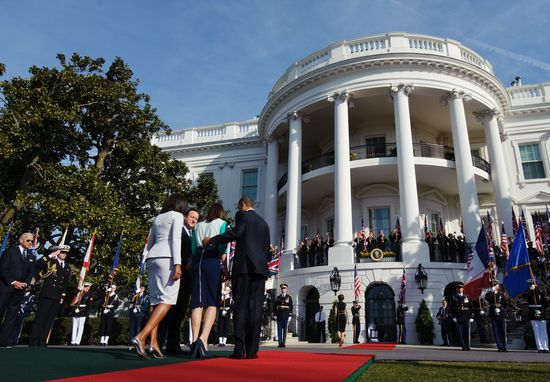
It's basically a state visit – which is normally reserved for the Queen, with a slight difference: a 19 gun salute rather than 21. But who's counting? The Telegraph's Janet Daley wonders what's in this for Obama? Well: bonding with an English conservative always helps his post-partisan image, especially since Cameron's politics – except on immediate economic austerity – are closer to Obama's than to the current Republicans. Cameron proudly champions socialized medicine and marriage equality, for example.

But isn't it also obvious, after the Netanyahu circus last week, that Obama is undercutting the Romney line that he doesn't back America's closest allies, and prefers to reach out to enemies? That's absurd, of course, but the images of a state visit help erase this mendacious meme. Win-win. And Cameron, for his part, gets some Obama magic rubbed off on him. The Brit press are lapping it all up.

Meanwhile, Obama gets to play the following card:

"Sometimes when we have foreign visitors, they're only visiting the coasts. They go to New York, they go to Washington, they go to Los Angeles, but the heartland is what it's all about."

(Photo: Mandel Ngan/AFP/Getty Images.)

Will The Religious Right Back Assad?

GT_SYRIA-CHRISTIANS_120314

Bob Wright foresees a split between neocons and Christians:

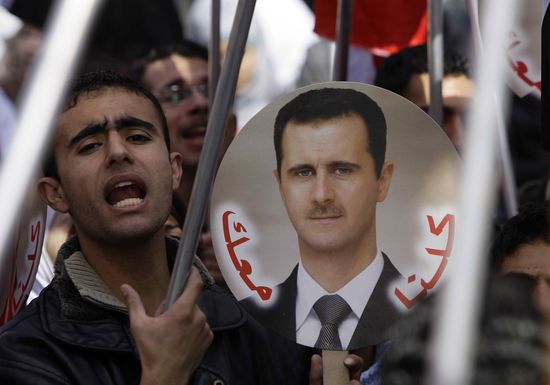
The evangelical press is reporting that Syrian Christians fear Assad’s fall and is quoting them as warning against foreign intervention. Catholic periodicals convey similar concerns, and illustrate them with, for example, reports that Syrian rebels are using Christians as human shields. And Jihad Watch, the right-wing website run by Robert Spencer, a Catholic, bemoans what will happen to Syrian Christians as “Assad’s enemies divide the spoils of the fallen regime.” (Spencer has in the past been skeptical of interventions, but he reaches conservative Christians who have been less skeptical.) The alliance between neocons and conservative Christians that has worked in the past is going to be harder to put together this time.

(Photo: Syrian supporters of President Bashar Assad rally outside a Greek Orthodox church ahead of a mass held in Damascus on January 9, 2012 in memory of two victims of recent fighting in the country, Saria Hassoun, the son of Syria's grand mufti who was killed in October in Homs, and a 10-year-old Christian boy, killed recently in the central flashpoint city as he ventured out to buy cookies. The opposition accused Assad's troops of killing the boy, but his mother appeared on official Syrian television to say 'armed gangs' were behind the murder. By Joseph Eid/AFP/Getty Images)

How Fast Can We Get Out Of Afghanistan?

GT_AFGHANISTAN_120313

Daniel Serwer wants a withdrawal ASAP:

It would be a mistake to await the outcome of the negotiations with the Taliban, which could drag on for a long time.  Better to go into these negotiations stating a willingness to withdraw–by the end of this year if feasible, or shortly thereafter–provided a satisfactory political solution can be agreed.  That could actually accelerate the diplomacy rather than hinder it.  And in any event the Taliban will know full well that public and political support for the war is fading in the United States.

David Dayen notes that, contrary to popular perception, US troops are planned to stop fighting in 2013. Joshua Foust thinks we can't accelerate the status quo timeline:

[A] more rapid withdrawal would be the worst possible outcome for Afghanistan right now. The desire to cut losses is understandable, even justified, but it would plunge Afghanistan into madness and anarchy. That’s because there remains no political process at work in Afghanistan than can address the fundamental conflict driving the war: a political contest between the current, corrupt government and the insurgency that rejects that government. The current line about so-called reconciliation – the negotiations process, which demands the Taliban accept the very Afghan constitution they’re fighting to upend – doesn’t account for any of Afghanistan’s politics. It is merely a call to surrender.

Peter Feaver worries about what comes next.

(Photo: French soldiers in armoured vehicles move towards a combat outpost base in Usbeen village in Surobi district of Kabul province on March 13, 2012. Some 600 soldiers are based in this camp, located east of the capital Kabul. All the combat troops are due to leave Afghanistan by end 2014. By Shah Marai/AFP/Getty Images.)

Your Server Will Be With You Indefinitely

Nona Willis Aronowitz explores restaurant work:

Nearly half of people ages 16 to 29 do not have a job. A quarter of those who do work in hospitality—travel, leisure, and, of course, food service. A study of 4 million Facebook profiles found that, after the military, the top four employers listed by twentysomethings were Walmart, Starbucks, Target, and Best Buy. The restaurant industry in particular is booming; one in 10 employed Americans now work in food service—9.6 million of us. Those numbers are growing each year. Even though more and more laid-off, middle-aged Americans are turning to restaurant jobs, as of 2010 about two-thirds of food service workers are still under age 35. And the industry’s workforce is more educated than it was just 10 years ago. In major U.S. cities, about 9 percent more food service workers have been to college.  

(Hat tip: Pareene)

Deep South Reax

Highlights from Santorum's speech last night:

John Cassidy sets his sights on Illinois:

A Santorum victory in Illinois would upend all the reassuring calculations about Romney eventually accumulating the one thousand one hundred and forty-four delegates he needs for the nomination, and all manner of crazy scenarios would merit consideration. (Jeb Bush or Chris Christie as a White Knight? A Santorum/Gingrich conservative dream ticket? Some sort deal between Romney and Ron Paul?)

Silver is more cautious:

Mr. Romney will have a significant lead in delegates even if he loses Illinois. But a loss there would be more characteristic of those scenarios where he falls short of a delegate majority and needs help from super delegates and other unpledged delegates to win the nomination. The bar for Mr. Santorum to actually overtake Mr. Romney in delegates is much higher.

Allahpundit wonders whether Gingrich will drop out:

[Gingrich] voters need to decide their next move. If they break for Santorum and he starts beating Romney head to head — starting next Tuesday in Illinois — then he’s got a compelling narrative headed into the convention even if Mitt ends up winning a plurality of delegates. Namely, “the only reason Romney ended up with a delegate lead is because Newt and I split conservatives in the early primaries. Once Newt faded and it turned into a binary choice, I was the clear preference of the majority.” That is to say, if Santorum can put together a winning streak against Romney, he can point to tonight’s results as a de facto “reset” of the primary.

Bill Kristol hungers for a two-man race:

[Gingrich has] won only twice so far—and Santorum, his rival for conservative standard-bearer, has beaten him in twenty of the twenty-four states where they've both been on the ballot. If Newt chooses to end his campaign in late March or early April, and with Ron Paul having yet to win a single state, we'd be in a two-man race. As the examples of Ford-Reagan in 1976 and Obama-Clinton in 2008 suggest, the victor in such a contest tends to seem by its conclusion a worthy winner, and is able to run a strong general election campaign coming out of the convention.

Patricia Murphy thinks money will determine Gingrich's options:

[T]he decision to stay in the race will not be Gingrich’s alone. More likely it will be up to donors to his campaign and super PAC, including billionaire Sheldon Adelson, who will have to decide if they are making a worthwhile investment in Gingrich and his ambitions or throwing good money after bad. No campaign can compete at this stage of a presidential race without significant funds to pay for staff, travel, and organizational muscle.

Jonathan Bernstein analyzes Gingrich's snake oil:

Newt's basically peddling a conspiracy theory: the "elite media" (whatever that is) and the GOP establishment have conspired to select a "Massachusetts moderate," but ordinary grass roots Republicans like him with his ordinary grass roots money and his outsider history are going to stop them. …Isn't it, as someone might say, profoundly and fundamentally dangerous to the GOP? He's basically saying that the nominee is completely illegitimate, isn't he?

Michael Walsh worries about the evangelical vote:

[O]ne possible explanation is that Romney’s Mormonism is playing poorly in the Deep South. And while the Constitution is explicit that there can be no religious test for public office, what goes on in voters’ hearts is another thing entirely. Should Romney be the nominee and evangelicals remain resistant, the result will be disastrous for the GOP.

Massie makes related points:

Romney's problem is not Mississippi or Alabama. Nicolas Sarkozy is as likely to win in the Deep South as Barack Obama. Mitt Romney's problem is whether cultural conservatives in other states – Virginia, North Carolina and Ohio most especialy – will rally to him in November. Nevertheless: would you measure a candidate's appeal to Middle America by his performance in Alabama and Mississippi? I doubt it.

Frum asks Santorum voters to consider the consequences of their actions:

The Santorum candidacy pushes Republicans toward an election in which the issues are religious, cultural, and sexual, not economic. It's a candidacy that pushes the party away from metropolitan areas, away from areas of growing population, and rebases the party everywhere that is not dynamic, not growing. … [A] Santorum candidacy offers an airing of resentments and grievances. Is that really where party conservatives want to go?

John Holbo is enjoying the drawn-out primary:

One of the many, many reasons to hope the unusually silly GOP primary season stretches on and on is that eventually we get to New York (April 24). Maybe all the way to California (June 5). What if California actually matters? If Newt and Santorum are still hanging on, how are they going to pander shamelessly to California voters?

Drum suspects that Santorum would have a shot in The Golden State:

[A]lthough Romney seems like he'd be the best bet to win California — it's a big, media-driven state; he's ahead in the polls; he's got good connections; etc. — a guy like Santorum has a chance. Maybe even a pretty good one.
Idea People

Megan Garber spotlights TED stars:

A TED talk, at this point, is the cultural equivalent of a patent: a private claim to a public concept. With the speaker, himself, becoming the manifestation of the idea. And so: In the name of spreading a concept, the talk ends up narrowing it. Pariser's filter bubble. Anderson's long tail. We talk often about the need for narrative in making abstract concepts relatable to mass audiences; what TED has done so elegantly, though, is to replace narrative in that equation with personality. The relatable idea, TED insists, is the personal idea. It is the performative idea. It is the idea that strides onstage and into a spotlight, ready to become a star.

A Data-Driven Self-Portrait

On_Phone_Probability

Stephen Wolfram shares his personal analytics. Josh Rothman is impressed:

What strikes Wolfram most is how "shockingly regular" his schedule is — a choice on his part, he explains, because routine enables him "to be energetic—and spontaneous—about intellectual and other things." What strikes me is how hard he works: the probability that he will be on the phone talking to a colleague at 11 p.m. on a weekend is 50%.

Syria’s “Chemical Powder Keg”

Bilal Y. Saab, Chen Kane and Leonard Spector worry about Syria's chemical weapon stockpile, which is "one of the largest and most developed in the world." The regime "allegedly has large quantities of mustard gas and sarin":

[M]ilitary intervention, if mishandled or if it spirals out of control, might make the goal of securing and controlling these nasty weapons harder to achieve. The same goes for a strategy that seeks to arm the rebels or establish safe havens and humanitarian corridors across the country's borders. It is no wonder that President Obama and his top military brass are extremely hesitant to use kinetic force or send weapons into Syria. The country is a chemical powder keg ready to explode.

Nerds vs Weirdos

I Heart Chaos contemplates the difference:

Being a "Nerd" is now defined by having specific interests in something that is oddly specific, yet still currently accessible (i.e. the last three series of Dr. Who, or Star Wars) and is now desirable. On the other hand, being "Weird" is now defined by having extremely specific interests that most people still can’t relate to, or have no desire to relate to. These interests are so esoteric that they are actually more polarizing than desirable, so in other words, being weird is still undesirable, and if you’re weird, you’re still an outcast, which ultimately separates people who say things like "I’m such a nerd!" from true outcast weirdos.