For me, the first big surprise of the race: tomorrow night could be a long one. Nationally, Romney has dropped and Santorum has jumped again.
Month: March 2012
Conservatism And Marriage Equality

In Britain, where the cause of marriage equality is being championed by a Conservative prime minister (rendering him, by US standards, a socialist Satanist), a new poll finds a plurality of 45 – 36 – in favor of turning same-sex civil partnerships into civil marriages. Another new poll finds very similar results: 43 – 32. Among those under 24, the support for full marriage equality is 66 percent. Among those over 60, it is 21 percent – an even more extreme generation gap than in the US. But for even the over-60s, 71 percent favor either civil marriage or civil partnerships with all the legal rights of civil marriage. Britain is light years' ahead of the US now on this issue – because conservatism there is not in the grip of religious fundamentalism.
But it's particularly gratifying to see in Britain how the Conservatives are actually leading the way in reforming this institution to include every Brit, gay or straight. That's in the tradition of Burke and Disraeli, who both believed that institutions needed to be reformed in order to remain the same in a constantly changing society. Cameron used this issue – full inclusion of and equality for gays – and an aggressive response to climate change as the key indicators that he was a modern conservative, not a religious reactionary. In the US, these two issues have now become fundamentalist litmus tests. To be a conservative in America means implacable hostility to any recognition of gay relationships and denial of the existence of climate change. Both positions are driven by religious fundamentalism.
So look at another conservative path – the kind of path that could not exist if Corey Robin is correct about conservatism's essence. And yet, at his last very Conservative Party Conference speech, Cameron forthrightly declared:
"I don't support gay marriage in spite of being a conservative, I support gay marriage because I am a conservative."
Today, the British media has been full of Tory voices backing marriage equality as a socially conservative policy, as, of course, it is. Over to Matthew D'Ancona, one of the leading conservative intellectuals and writers in Britain:
[T]he case for gay marriage is essentially conservative. I am grateful to Ian Ker’s magisterial new biography of G K Chesterton for the following observation by its subject: “All conservatism goes upon the assumption that if you leave a thing alone, you’ll leave a thing as it is. But you do not. If you leave a thing to itself, you are leaving it to wild and violent changes.” The example cited by GKC was the Vale of the White Horse in Berkshire, symbol of ancient England, and constantly in need of repainting.
Chesterton was scarcely a moderniser. But his point applies well to the institution of marriage. In an age of impatience, lives based on tactics not strategy, and instant gratification, matrimony is in dire need of renewal and restoration. Last week, Cardinal O’Brien argued that procreation was the essence of marriage. I beg to differ, and to suggest that the ideal at the core of this dilapidated institution is lifelong commitment and, crucially, a public vow by two people to forge such a shared life.
If marriage is indeed the cornerstone of a stable society, as conservatives plausibly argue, then its extension to same-sex couples will be a stabilising force. Gay couples who marry will not only be exercising a new right; they will be recruited to, and reinforcing, an ancient institution.
The poll also shows high numbers saying that this need not be a legislative priority right now. Understandable, given an economy in a depression now longer than the Great Depression. But it hardly distracts from economic management for a free vote to take place in the House of Commons. And it gives me enormous pride to see one party in the Anglo-American conservative world being genuinely conservative rather than reactionary.
One day, here, perhaps, a conservatism which is more than just resentment and reactionaryism will re-emerge as well. Just not yet.
(Photo: the oldest chalk figure in Britain, dating from 1000 BC, in the Vale of the White Horse in the Cotswolds in England. From here: "Its shape is not just etched into the hillside, but formed by cutting a trench to shape and infilling it with chalk blocks.")
Dish Bait
I guess I asked for it:

Every Man’s Worst Nightmare
Jeff Winkler tells the story of how he (temporarily) broke his penis:
The woman beside me looks so horror-stricken, I try to sound especially calm when talking to 911. I don't tell the operator it's so swollen and purple that I'm afraid it'll burst at any moment. Instead I say, in an even, measured tone, "My penis is the shape, size and color of a baby eggplant."
A Sign Of The Times
Just to note that the new owner of The New Republic and its current editor are both openly gay men and that's so routine it barely merits a mention. Two decades ago, it was a very different world. Having Chris Hughes new media experience is a huge plus for the magazine – and, I hope, will sustain its continued excellence into a new century.
From Band-Aids To Bone Marrow
A novel way to encourage people to sign up for the bone marrow registry:
Some context:
Ponder the stakes: Matches are based on genetics. Siblings have a 25 percent chance of being a match, and odds decline sharply from there based on a variety of factors—including ethnicity, which means minorities have a harder time than whites. This mixed-race girl, for instance, didn’t have one match among the 13 million people signed up in a donor registry.
Would A Cashless World Reduce Crime?
Ellen Zimiles, a lawyer and expert on fraud and money laundering … suspects that financial crime would increase in a cashless society, since it’s easier to move electronic currency fast. … At the same time, Zimiles allows that crime in a fully electronic economy would prove easier to police. Unlike dollars, credit card sales and wire transfers leave a footprint; the inevitable audit trail could help law enforcement officials track down illegal actors. So while a cashless society might in fact promote black market business, that business would be more visible and more stoppable.
Previous thoughts on a world without cash here.
How To Break A Bad Habit
Charles Duhigg offers advice:
He adds:
The evidence is clear: If you want to change a habit, you must find an alternative routine, and your odds of success go up dramatically when you commit to changing as part of a group. Belief is essential, and it grows out of a communal experience, even if that community is only as large as two people.
Maria Popova provides more background on Duhigg's book.
Avoid Jetlag By Fasting?
Steve Hendricks reveals how to trick your body:
According to the Harvard team, the fast works because our bodies have, in addition to our circadian clock, a second clock that might be thought of as a food clock or, perhaps better, a master clock. When food is scarce, this master clock suspends the circadian clock and commands the body to sleep much less than normally. Only after the body starts eating again does the master clock switch the circadian clock back on.
The master clock probably evolved because when our prehistoric forebears were starving, they would have been tempted in their weakness to sleep rather than forage for the food they needed to survive. Today, when a traveler suspends his circadian clock before flying from Los Angeles to London, and then reactivates it upon breaking the fast, the clock doesn’t know that it should still be on Pacific Time. It knows only that the breakfast and the daylight declare morning in Mayfair, and it resets the body’s rhythms accordingly.
Dickens’ London
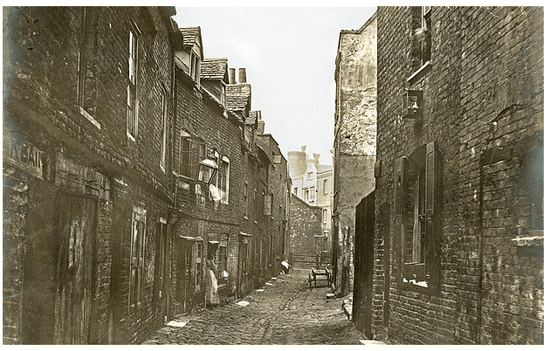
A new book of early photographs was just published. The caption for the above scene:
Lower Fore Street, a narrow cobblestoned street in Lambeth, pictured in 1865. This industrial area became very densely populated over the Victorian period; its inhabitants rose from 28,000 in 1801 to nearly 300,000 by the time this photograph was taken.
Speaking of Dickens, the oldest surviving film based on his work was recently discovered.
 The Dish