Your Feelings Are Smarter Than You Think

Jonah Lehrer emphasizes the wisdom of feelings. He recaps a study that asked undergraduates to make various predictions about everything from forecasting the Dow Jones to the finalists of American Idol:

Here’s the strange part: although these predictions concerned a vast range of events, the results were consistent across every trial: people who were more likely to trust their feelings were also more likely to accurately predict the outcome. … [A] strong emotion is a reminder that, even when we think we know nothing, our brain knows something. That’s what the feeling is trying to tell us.

One American’s Massacre

141137266

It's hard to absorb the reality of what we are now hearing. A rogue and deranged US sergeant, tasked with a "village stabilization operation," decided to leave his base and launch a cold blooded massacre of innocents:

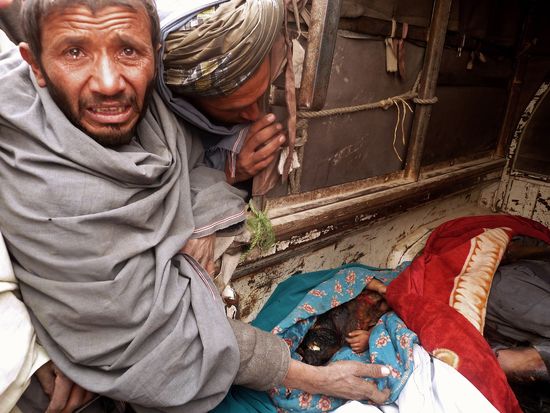
Residents of three villages in the Panjwai district of Kandahar Province described a terrifying string of attacks in which the soldier, who had walked more than a mile from his base, tried door after door, eventually breaking in to kill within three separate houses. At the first, the man gathered 11 bodies, including those of four girls younger than 6, and set fire to them, villagers said.

So first the US forces burn Korans out of incompetence and now one lone sergeant is burning the freshly-murdered corpses of children out of derangement, one can only surmise (and hope). I cannot, frankly, see how the occupation can recover from this series of events. Children have long been collateral casualties of the successful drone war, but this is the first time they have been directly murdered by a US soldier in cold blood and then burned. If this happened in America by a soldier of an army that had been in occupation for over a decade, how do you think public opinion would respond here?

As for US opinion, the latest polling shows that the public wants out:

Sixty percent of Americans say the war in Afghanistan has not been not worth fighting and just 30 percent believe the Afghan public supports the U.S. mission there — marking the sour state of attitudes on the war even before the shooting rampage allegedly by a U.S. soldier this weekend.

Indeed a majority in a new ABC News/Washington Post poll, 54 percent, say the United States should withdraw its forces from Afghanistan without completing its current effort to train Afghan forces to become self-sufficient.

Mercifully, this atrocity, unlike much of what occurred at Abu Ghraib and elsewhere in the Bush-Cheney years, is not policy – far from it. But this act is so barbarous, so counter to American values, and so destructive of the mission that we surely must see some accountability – even if it is merely formal – for this atrocity. We entered Afghanistan to remove the murderer of innocents. A decade later, the roles are, in one case, reversed. These are the risks of warfare. We should recall them before we launch into another even more dangerous one.

(Photo: A mourner cries over the bodies of Afghan civilians, allegedly shot by a rogue US soldier, seen loaded into the back of a truck in Alkozai village of Panjwayi district, Kandahar province on March 11, 2012. An AFP reporter counted 16 bodies — including women and children — in three Afghan houses after a rogue US soldier walked out of his base and began shooting civilians early Sunday. NATO's International Security Assistance Force said it had arrested a soldier 'in connection to an incident that resulted in Afghan casualties in Kandahar province', without giving a figure for the dead or wounded. By Jangir/AFP/Getty Images.)

Fundamentalism And Public Policy

It is now driving the war against Iran and policy on the West Bank among the GOP candidates. But its influence goes deeper. Senator Inhofe explains why the overwhelming data backing climate change is refuted by the Bible:

"Well actually the Genesis 8:22 that I use in there is that 'as long as the earth remains there will be seed time and harvest, cold and heat, winter and summer, day and night,' my point is, God's still up there. The arrogance of people to think that we, human beings, would be able to change what He is doing in the climate is to me outrageous."

 If that is what passes for religion, I really can't criticize atheists.

The Scale Of The Universe

Sloanbutterfly

Ethan Siegel contemplates our smallness: 

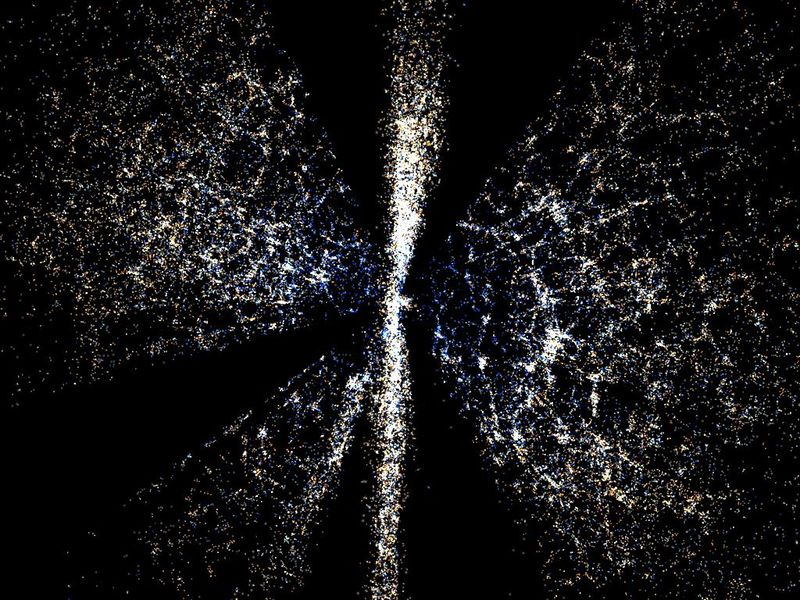
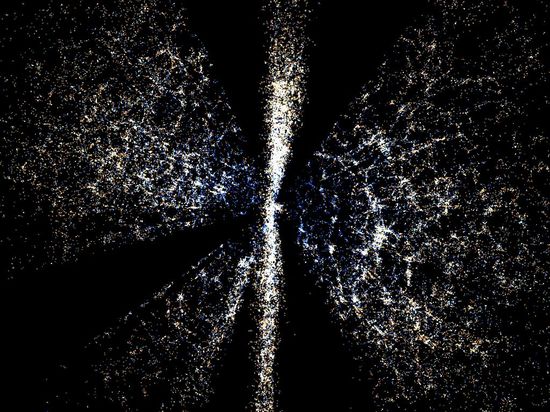
Although “only” about 250,000 galaxies are shown in the above image, the entire Universe is estimated to have at least hundreds of billions of galaxies, spread out over a spherical region about a million times larger in diameter than our galaxy is. In other words, you and everything you know resides on a tiny, wet rock nearly a million times less massive than the star that powers it, in a solar system one ten-millionth the diameter of our galaxy, which contains at least hundreds of billions of stars not so different from ours, in a Universe filled with hundreds of billions of galaxies, and maybe perhaps more.

Image of the visible universe by the Sloan Digital Sky Survey.

The Anatomy Of Autism

Carl Zimmer reports on neuroscientist Eric Courchesne's findings:

When autistic children are born, Courchesne’s research suggests, they have an abundance of neurons jammed into an average-size brain. Over the first few years, the neurons get bigger and sprout thousands of branches to join other neurons. The extra neurons in the autistic brain probably send out a vast number of extra connections to other neurons. This overwiring may interfere with normal development of language and social behavior in young children.

A Heart Without Heartbeats

Heart

Dan Baum reports on the latest artificial heart, which whirs instead of thumping:

Nature is not always the best designer, at least when it comes to things that humans must build and maintain. So the newest artificial heart doesn’t imitate the cardiac muscle at all. Instead, it whirs like a little propeller, pushing blood through the body at a steady rate. After 500 million years of evolution accustoming the human body to blood moving through us in spurts, a pulse may not be necessary. That, in any case, is the point of view of the 50-odd calves, and no fewer than three human beings, who have gotten along just fine with their blood coursing through them as evenly as Freon through an air conditioner.

“His giant heartbeat,” Rainer Maria Rilke wrote of God early in the past century, “is diverted in us into little pulses.” Nowadays, maybe not.

(Artificial Heart by Jack Thompson)

Is Philosophy A Science?

Colin McGinn makes the case:

[M]ost of the marks of science as commonly understood are shared by academic philosophy: the subject is systematic, rigorous, replete with technical vocabulary, often in conflict with common sense, capable of refutation, produces hypotheses, uses symbolic notation, is about the natural world, is institutionalized, peer-reviewed, tenure-granting, etc. We may as well recognize that we are a science, even if not one that makes empirical observations or uses much mathematics.

Jean Kazez counters:

Can it really be true that 10 people are being "systematic and rigorous", if they arrive at 10 different conclusions on the same subject?  Not really, and that's why we're stuck with the word "philosophy."  McGinn says it's "faintly shameful" but so is the whole business of selling views as if they were rationally supported, when the guy or gal at the next stall is selling something else.  

Mental Health Break

Director Gavin Heffernan finds timelapsing refreshing: 

Because most of my Los Angeles work is the slow grinding stress of writing screenplays or producing/directing longer narrative projects, it's pretty easy to get creatively stifled after a while. I've found that timelapsing and other experimental projects sometimes provide a breath of fresh air from the bureaucracy — as well as (in this case) a great excuse to get out of the city and be in nature.

When Cannibalism Threatened Christianity

In a review of Cătălin Avramescu’s Intellectual History of Cannibalism, Steven Shapin recounts how the problem began with the promise of resurrection:

A starving man eats the flesh of another, whereupon the flesh of the eaten is transformed into that of the eater. At the Resurrection, how will the bodies of each be made whole and rise up entire? If this problem could not be satisfactorily addressed, one Church Father wrote, critics could rightly “draw the conclusion that the resurrection cannot take place, because it is not possible for two men to be resurrected with the same flesh at the same time.”