Colin Marshall watches the above commercial by Wes Anderson and wonders:
The word "integrity," I realize, tends to be reserved specifically for artists who don’t do commercials. But if Anderson’s unwavering respect for his own fascinations and aesthetic impulses in every project he works on doesn’t count as integrity, what does?
Richard Brody argues that selling products is "neither more nor less problematic than considering something made to sell tickets as art":
What matters isn’t the forum in which the work is made. So many great paintings were made for popes and kings and patrons, and great buildings sponsored by tycoons and corporations. What matters is the sense that a person is morally invested and engaged in the object at hand to the fullest extent of his or her ability, his or her being.
Cristóbal Vila created the above video as an homage to M.C. Escher. Eugene Buchko gives the back story to the opening scene:
When the creator of the game of chess showed his invention to the ruler of the country, the ruler was so pleased that he gave the inventor the right to name his prize for the invention. The wise man asked the king: for the first square of the chess board, he would receive one grain of wheat (in some tellings, rice), two for the second one, four on the third one, and so forth, doubling the amount each time. The ruler, arithmetically unaware, quickly accepted the inventor’s offer, even getting offended by his perceived notion that the inventor was asking for such a low price. But when the treasurer started doing the calculations, it quickly surfaced that this was an impossible offer to fulfill. Given the request, the final tally would have been 18,446,744,073,709,551,616 grains!
Christina Cooke profiles Wayne Pernu, master of a dying profession:
On the job, Pernu keeps a few principles in mind—first and foremost, the importance of condition. For example, with its original dust jacket, the value of a first-edition “The Great Gatsby” can multiply from two thousand five hundred dollars to more than two hundred thousand. “That little piece of paper on the book is often worth thousands and thousands of dollars, much more than the book itself,” Pernu says. “Specificity is really crucial as well. A book called ‘World History’ isn’t going to do well, but a book called ‘Peruvian Shovel Makers in the Seventeenth Century,’ that’s going to be worth a lot of money to someone. You always get excited when you see something that specific, no matter what it is.”
Twitter is unspeakably irritating. Twitter stands for everything I oppose…it's hard to cite facts or create an argument in 140 characters…it's like if Kafka had decided to make a video semaphoring The Metamorphosis. Or it's like writing a novel without the letter 'P'…It's the ultimate irresponsible medium. People I care about are readers…particularly serious readers and writers, these are my people. And we do not like to yak about ourselves.
Jami Attenberg, the author who transcribed Franzen's comments at Tulane, offers the obvious retort:
He doesn’t have to do anything! He has a publicist who probably has dreams about him every night, whether he has a book coming or not. He is free to write and just be himself, while the rest of us are struggling to be heard and recognized.
Franzen approaches social networking with far too much gravitas. If he had been on Twitter during, say, The Grammys, he would better understand what it is all about. He doesn’t want to be on Twitter, though. The desire is not there and it’s not a matter of necessity for him. In that regard, Franzen is modeling the right attitude toward social networking—do what you like.
Is this more than just crumudgeony griping, though? Does Franzen have a point — that Twitter is "irresponsible" as a medium, because the constantly curated life is half-unlived? #Maybe.
David Haglund notes the irony of #JonathanFranzenHates, the hashtag Franzen most recently inspired:
While he had attempted to make an argument—albeit an off-the-cuff and ham-fisted one—about the negative aspects of Twitter, the partisans of the micro-blogging platform reduced that argument to a meaningless punchline.
Will Wilkinson reflects on country music as ideology:
The emotional highlights of the low-openness life are going to be the type celebrated in "One Boy, One Girl" [above]: the moment of falling in love with "the one," the wedding day, the birth of one's children (though I guess the song is about a surprising ultrasound). More generally, country music comes again and again to the marvel of advancing through life's stations, and finds delight in experiencing traditional familial and social relationships from both sides. Once I was a girl with a mother, now I'm a mother with a girl. My parents took care of me, and now I take care of them. …
Country music is a bulwark against cultural change, a reminder that "what you see is what you get," a means of keeping the charge of enchantment in "the little things" that make up the texture of the every day, and a way of literally broadcasting the emotional and cultural centrality of the conventional big-ticket experiences that make a life a life.
If Wilkinson’s conjecture is correct, the fact that I was raised here and moved away and built a successful life, rather than doing the expected thing and marrying and building a house and raising a family in the community where we grew up might have been experienced to [my sister] Ruthie as a profound threat in ways she couldn’t articulate, though felt deeply. The idea is if I can be raised in the same house as she, yet have very different tastes and feelings about openness to experiences, the nature of our difference was destabilizing of the worldview she embraced. My leaving wasn’t just me going off to find my way through life; it was false consciousness, or perhaps a flat-out rejection of the things she valued. And it would make our children’s generation strangers to each other.
Finally, our inability to coalesce on questions of ultimate meaning must have worried her. She had such a Confucian view of life — the idea that everybody had his place and his duty in the hierarchical order. I had refused my place at home, thereby violating the order of things. My problem is that I probably have a liberal psychology, re: openness, but conservative convictions.
Meanwhile, E.D. Kain laments the hollowness of contemporary country music:
The conservative movement has been cannibalizing conservative art for years now, to the point where I’d say country music is far from a victory of conservative cultural or artistic success and is instead a mirror image of what conservative politics have become: easy and unthinking. No depth, all surface. Superficial and insular. Maybe I’m wrong, but building an entire genre on the back of the idea that regurgitating the same sound on top of the same basic premise over and over again hardly strikes me as a triumph of cultural conservatism. Admittedly, country music pulls off a not-overtly-political conservatism in ways that most conservative films have been unable to achieve. When it comes to a distinctly modern-American quasi-nationalistic conservatism, country is hard to beat.
Buying pre-wrapped bread, consumers were forced to evaluate a product under sensory deprivation—it’s next to impossible to effectively see, touch and smell bread through a wrapper. "Softness," [Aaron Bobrow-Strain, author of White Bread: A Social History of the Store-Bought Loaf] writes, "had become customers’ proxy for freshness, and savvy bakery scientists turned their minds to engineering even more squeezable loaves. As a result of the drive toward softer bread, industry observers noted that modern loaves had become almost impossible to slice neatly at home." The solution had to be mechanical slicing.
Elsewhere, Bobrow-Strain assesses the role of enriched white bread during World War II:
The secret of Germany's "husky soldiers" was its "excellent dark loaf"; the great resilience of Russia was its stubborn rye bread. France, on the other hand, a nation of puffy-white-bread eaters, had folded. What would become of the United States, where people simply would not eat whole wheat? Despite hopeful slogans like "America's Bread Front Has Never Failed," war planners were worried. Something had to be done, but what?
By 1943, this question had been decisively answered. The country would repair its broken staff with synthetic enrichment, the universally mandated addition of thiamin, niacin, iron, and, later, riboflavin to flour and bread. For war planners, synthetic enrichment was the only "realistic" way to improve the nation's health in a hurry.
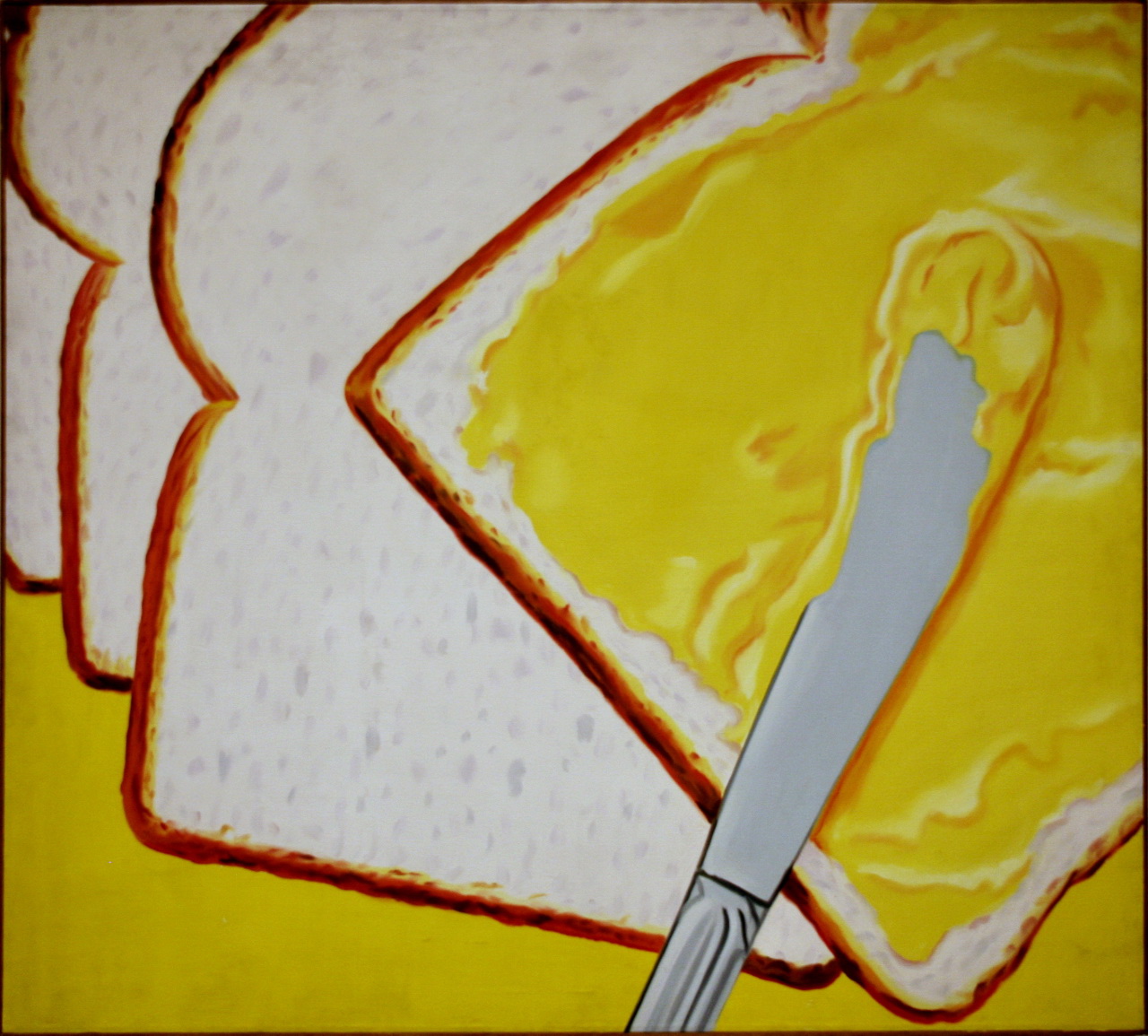
("White Bread," 1964, oil on canvas by James Rosenquist)
My basic take now that we have a sparse set of polls: if Romney wins either, there really is no reason to believe he won't be the nominee. Ditto if Gingrich wins either. Only a two-state win by Santorum keeps this race alive (and then only just).
 The Dish