“Like The Duke Lacrosse Scandal But Worse”

Screen shot 2012-03-29 at 12.27.42 PM

A reader writes:

You mention that the right is sliming Trayvon. Let me preface what I am about to say by stating that I think that the killing was tragic and unnecessary, and I don’t want to minimize that fact. However, there is a narrative that is being pushed by (I hate to use this term because it makes me sound like a wingnut) the mainstream media, where a predatory white man killed an innocent black man. There’s a host of problems with that theme, including but not limited to:

– We really don’t know the facts yet

– The pictures that are circulating of Trayvon show him as an early teen (several years ago), and his assailant in what looks like a booking photo wearing prison orange. These pictures paint a picture that is inconsistent with the concept of “innocent until proven guilty”

– Spike Lee (admittedly a brilliant filmmaker), Jesse Jackson and Al Sharpton are heavily pushing the victimization card, which is the main thing that gives them any relevance at this point in time.

So yeah, this affair rubs a lot of people on the right the wrong way. It also chaffes me (like you, a social liberal-economic conservative). This is like the Duke lacrosse scandal but worse.

Earlier coverage here and here. Details on the above tweet, which we have redacted, here:

An elderly Florida couple has been caught in the cross hairs of the Trayvon Martin shooting case due to an incorrect tweet by Spike Lee and others. The director retweeted an address said to belong to George Zimmerman, the man who shot Trayvon Martin dead on Feb. 26, to his 250,000 followers, according to website thesmokinggun.com.  But the address was incorrect and has caused the couple to go into hiding.

Constitutionality Isn’t Black And White

Aaron Carroll asks for some perspective:

I really wish people would stop acting so darn sure about whether the mandate is constitutional or no. You know what? I’m not sure. I think it seems reasonable, but I don’t profess to know it as truth. But you know what’s crazy? The Supreme Court justices can’t agree! That means the people who are actually in charge don’t even “know” if it’s constutitional. We have to wait until we can poll them and get a consensus before we “know”. And you know what will happen right after that? Half the country will start crowing about how they were “right” and treat the other half as if they were crazy.

Am I the only one who thinks that’s insane? If it’s 5-4 then even though 44% of the Supreme Court justices felt the opposite, they are “wrong”. And so is everyone who agreed.

Can we all develop a little humility here?

The Profound Weakness Of Romney, Ctd

Obamavromneyfav

Romney is only slightly more popular than war in Afghanistan. Steve Benen notes that, unsurprisingly, disliked candidates usually lose: 

It's tempting to think every major-party frontrunner emerges from a primary process with weakened favorability numbers — intra-party contests are often bruising — but that's just not the case. Four years ago, Obama became better liked as voters got to know him, but this year, Romney isn't just disliked, he's also more disliked at this point in the process than any candidate in nearly three decades.

The Terror Of Catcalling, Ctd

A reader continues the popular thread:

I'm a straight guy who doesn't catcall, but I can understand the impulse that drives it. Or at least I'm better equipped to understand it than feminists who claim the authority to say that every catcall is an effort by the man to sexually humiliate and dis-empower a woman. That may be the effect of the catcall, but that doesn't mean it's the motive. We men have a deep-seated urge to get the attention of a prospective mate, and those efforts are not always informed by a coherent calculation of the most tactical course. To paraphrase Jerry Seinfeld, "Wherever there is a woman, we have a man working on it. Now, he may not be our best man, but our organization is very thorough." On other occasions, I imagine it's just a reflex, like saying "Wow."

Mostly, a catcall is a failure of empathy. The man is ignorant to or uninterested in the effect of his catcalling on the woman. And shame on him for that. But for women to apply such a far-reaching and cynical motive to the practice is also a failure empathy.

Another writes:

Alright, I don't want to sound like I'm victim-blaming here, but the reader who complained about dressing skimpy whilst on a bus and being eyed … how was she not expecting it?

Teenage girls pull crap like that all the time because they want attention. I don't buy that they are often that bothered by it. Yeah, maybe as they get older, it gets weird. But every time I'm walking home late on a Friday night (invariably, from the library, such is the life of a graduate student) and see half-naked girls drunkenly giggling, I don't really feel sorry for them being checked out, because why else are they dressing like that?

This isn't to say I'm a complete prude. I'll go out and have a night of fun and drunkenly hook up with boys too, if I can. But I can tell you exactly one time in my life I've been cat-called, and I didn't mind it. I was 17, it was a construction worker outside of a grocery store in Boston, and I had some witty thing to say in return that made him laugh.

Like many women of below-average looks, maybe I just assume that it's pretty girls getting called out and they deserve it for being pretty. I'm the girl who's always carrying piles of books, wears glasses, doesn't run in a bra but a tshirt, is perfectly average-size and absolutely nothing remarkable in her looks, who has been called one of the "bros" or "lads" more times than I care to count. But I'll say this, I'd give almost anything to have men of any sort look at me. I seriously doubt the women who have written to you would be willing to go without the attention like I do. It gets lonely after a while.

Update from another:

Your two latest missives on catcalling are instructive, I think, but not in the way that their authors intended. They both bring up elements of the usual answer for why catcalling is so pervasive: the idea that men's attraction to women is so innate and powerful that anything they do under its thrall is understandable, if not always excusable. That's just resentment masquerading as an argument. Sexual attraction is a powerful force, no doubt, but let's not deny that it can drive people to violent or threatening behavior. That's the central problem with catcalling. It's not anything that women do or don't do.

The times I've been catcalled have made me furious, and in situations where I've felt safe enough to do so I've yelled back in order to shame the guy. I don't know if it always works, but often enough the catcaller in question is taken aback, and it makes me feel less like a victim. Men on the street have also given me sweet compliments, or told me friendly jokes, and boy do those guys get a big grin from me. It ends up being a pleasant interaction for both of us. If guys happen to want attention from a woman, why can't they try charm? Since that's always an option, it seems most likely that catcalls that hurt are intended to sexually humiliate someone else.

Marco Rubio Ends The Race?

Chris Cillizza calls it: 

In just the last 9 days — since Romney won the Illinois primary — he has been endorsed by former Florida governor Jeb Bush and former President George H.W. Bush while leading tea party Senator Jim DeMint has said kind things about him and Freedomworks, a tea-party aligned group, has dropped its opposition to him as the nominee. Add Rubio’s support into that mix and it’s clear that the slew of endorsements for Romney in recent days have done something for the Massachusetts governor that winning primaries had not: Make clear he is the Republican presidential nominee.

Matt Lewis finds the Florida senator's endorsement premature: 

In my estimation, this, perhaps ironically, makes Rubio a less appealing [VP] pick (should Romney be the nominee). Selecting a running mate can be a cathartic experience. But how can Romney now unite the GOP’s disparate factions by picking someone who’s already on his team?

Mataconis doubts that Rubio is secretly interested in the VP slot: 

Indeed, considering that a losing Vice-Presidential candidate has only become President once in American history, one wonders why Rubio would take the offer at this point in his career. In any case, the party establishment is starting to rally behind Romney for real now. Next week, he has a chance to shut the lid on this race completely.

Does Romney Really Want A Foreign Policy Election?

Larison notes that Romney has lost even McCain, Lieberman and Butters due to "excessive hawkishness" on Russia. The candidate is now doubling down in Foreign Policy. Adam Sorensen sees Romney's "no apology" foreign policy returning to the forefront of the campaign: 

[U]ntil very recently the most important issue in Romney’s campaign narrative was the economy. Whether it’s a slightly sunnier domestic outlook or a confluence of events thrusting foreign policy back into the conversation–Obama’s hot mic and creeping war fatigue among them–Romney appears to be revising his narrative back to something closer to his original vision.

Of course, Romney is distinctively out of touch on the issue: 

[I]t is becoming increasingly clear that the American people are very weary of war—indeed, far more weary of it than one would think based on the Republican rhetoric thus far in this campaign. … [A]ny imprudent Romney adventurism probably wouldn’t be attributable to the sentiment of the voters. Indeed, it would probably emerge because a President Romney hadn’t sufficiently taken into account the political sanctions that would be imposed by unsentimental voters if his adventurism went awry.

Earlier Dish on the subject here

Is Big Football The Next Big Tobacco? Ctd

We are still sorting through the nearly 100 responses from readers on the question, but the following one offers a good primer of recent coverage in the blogosphere:

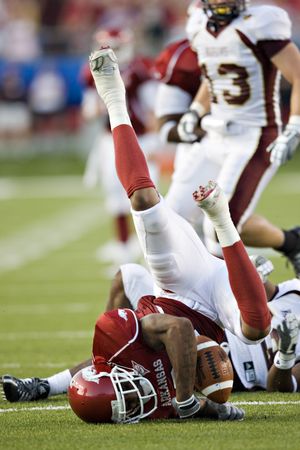
As a lifelong sports fan and football watcher, I have to admit I've lost much interest in football since the issue of brain injury and concussions went mainstream last year. GT_FOOTBALL-HEAD_120329And as the father of young children, I have seriously reconsidered whether I would allow them to play football at any level.

Is it conceivable that football could disappear? Tyler Cowen and Kevin Grier recently laid out the case. They make a persuasive one, as hard as it is to fathom. However, counter to that argument, football is very different than tobacco or seatbelts – unlike football, those two harms lack one major feature: a massively involved fan base. There has never been a huge TV audience or stadiums full of rabid fans cheering on smokers or drivers putting on seatbelts. I don't think you can discount this factor – the thirst for sanctioned violence in sport runs deep in our culture and, perhaps, human nature itself. I can imagine football diminishing in popularity rather than it disappearing altogether.

Regarding your question of whether brain injury is worse now than before, the answer is yes and no. Brain fractures and resulting death were more frequent before advances in helmet technology, but ironically this has led to more brain injury. Jonah Lehrer wrote an interesting piece about this.

(Photo: London Crawford #2 of the Arkansas Razorbacks lands on his head after catching a pass against the Louisiana-Monroe Warhawks at War Memorial Stadium on September 6, 2008 in Little Rock, Arkansas. The Razorbacks defeated the Warhawks 28-27. By Wesley Hitt/Getty Images)

Why The Fiscal Sanity Failed

Because Congress has no backbone. Yesterday, the House voted 382-38 against Simpson-Bowles:

Wednesday's vote  — which considered a version of Simpson-Bowles with somewhat less in tax increases — is at least suggestive evidence that the White House was right and the proposal would never have passed because, in the end, the problem with Simpson-Bowles wasn't that the president didn't say enough nice things about it, but that members of Congress didn't want to vote for it.