How Will History Judge Obama?

Paul Glastris claims most of Obama's accomplishments are underappreciated because – by design – they take full effect down the road:

Obama’s biggest accomplishments function, like FDR’s, with a built-in delay. Some are structured to have modest effects now but major ones later. Others emerged in a crimped and compromised form that, if history is a guide, may well be filled out and strengthened down the road. Still others are quite impressive now but create potential for even greater change in the future. At this point, it’s hard to get a sense of these possibilities without lifting the hood and looking deeply into the actual policies and programs. Hence, there’s no reason to think that today’s voters would be aware of them, but every reason to think historians will.

Greg Sargent situates Glastris' argument in the context of the Great Recession:

Obama is one of the best public communicators of our generation, but getting the American people to take the long view of his presidency amid continued economic suffering is going to be a formidable political challenge. His entire legacy may rest on whether he can pull it off.
Jobs Report Reax: “Start Breathing Easier”

Employment_Recession

Felix Salmon begins to relax:

At this point, if we have a weak month between now and the election, it’s going to be the bad figure which looks like an aberration: only a sequence of two or three consecutive weak payrolls reports will really convince economists and the market that the recovery is going off the rails. It’s taken far too long to get here, but we’re finally moving in exactly the right direction, at an eminently healthy clip. Or, to put it another way: you can start breathing easier again, come the first Friday of the month. All those good job numbers were real, after all. 

Jared Bernstein is more cautious:

So has the GDP expansion that began in mid-2009 finally reached the job market?  Have we achieved lift-off, escape velocity–is a self-sustaining virtuous cycle underway? Unfortunately, those are questions that are tough to reliably answer in real time.  I will assert that while existing threats–Europe, oil/gas, fading stimulus–could all knock some growth out of the economy in coming months, they’re unlikely to do more than that.  The economic bicycle has enough momentum not to keel over, even if it hits a bump.  But it’s still plodding more than speeding and it will still take many months–years even–to make up lost ground.

Yglesias focuses on the revisions:

Today's new jobs news is not as good as I'd hoped, but the addition of 227,000 new jobs is still a sign of an economy that's on track for growth. An interesting tidbit is that there was very good news in the revisions which added 20,000 December jobs and 37,000 January jobs. I note that this means that the total level of employment is basically where it would have been had we done no revisions but my 285,000 jobs forecast for February had come true.

Peter Boockvar takes a longer view:

Bottom line, the job gains were good not great with the 12 month average now at 168k.

Brad Plumer explains why good isn't good enough:

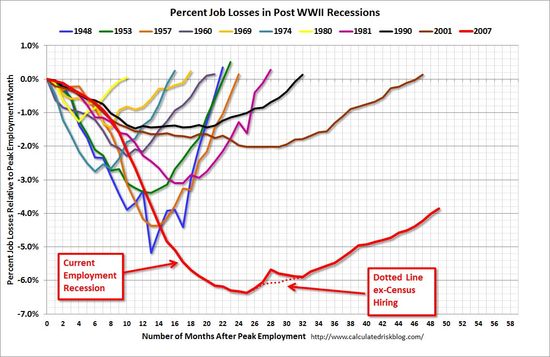
The U.S. economy still has a ways to go. Right now, we’re adding around 250,000 jobs per month. If that trend keep up, it’s enough to get us to 8 percent unemployment by election day. That would bode well for President Obama’s reelection chances. But 8 percent unemployment is still unnervingly high. As the Hamilton Project has found, at the current pace we won’t bring back all the jobs lost from the recent recession until sometime around 2020 or so. A separate analysis from the Economic Policy Institute, which used different assumptions about labor force growth, argued that it would be closer to 2018. Either way, a long time.

Chait considers the political implications:

This remains a divided country, and the floor beneath both parties is high enough that a Johnson 1964 type blowout remains almost inconceivable. The divided nature of the electorate means that the race is always going to be within the range that a major event could flip the standings. And there’s enough time until the election that any number of events could come along to change it. But as boring as it can be to defend conventional wisdom, the conventional wisdom has changed because the facts have changed. Obama was positioned to lose his reelection last summer fall. At the moment, he isn’t.

(Chart from Calculated Risk)

Do Republicans Even Like Ike?

Geoffrey Kabaservice is puzzled that GOP officials are keeping quiet over a controversial plan to memorialize Eisenhower as a barefoot boy on the National Mall:

[A]t a moment when Republicans are posing as stalwart defenders of a balanced federal budget, they dismiss the example of the most fiscally conservative president of the past eighty years. Eisenhower balanced the budget three times in his eight years in office, a feat that neither Ronald Reagan nor George W. Bush came close to achieving. Ike cut federal civilian employment by 274,000 and reduced the ratio of the national debt to GNP, though not the absolute level of debt. The economy bloomed under his watch, with high growth, low inflation, and low unemployment.

Update from a reader, who thinks Kabaservice misrepresents the memorial:

Even as a liberal without a strong affinity, but much respect, for President Eisenhower, I read Kabaservice's claim that the memorial's "only representation of its subject would be a statue showing him as a barefoot boy" with dismay.  Surely that is not sufficient.  So I checked the design out for myself.  Quite different than described.  Two huge wall sculptures, showing Eisenhower respectively as General and President, flank the statue of him as a boy along with excerpts from memorable speeches.  I presume the message intended is that even someone of such humble beginnings can become a great leader.  While I don't have strong opinion either way on the design, it would have been nice if the author had provided an accurate description of it.

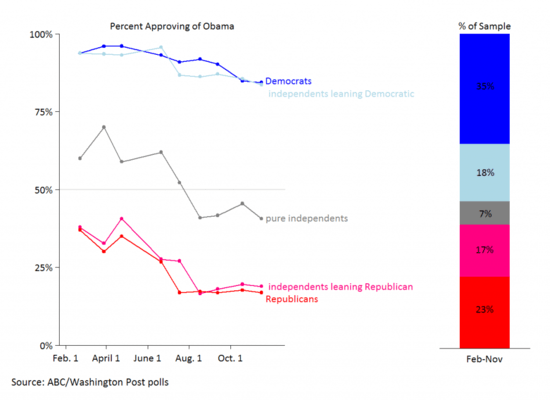
Independents In Name Only

Obamaapprovalandpid-1024x744

Ruy Teixeira, in a harsh review of Linda Killian's new book, notes that most "independents" are partisan voters:

As numerous studies have shown, the overwhelming majority of Americans who say there are “independent” lean toward one party or the other. Call them IINOs, or Independents In Name Only. IINOs who say they lean toward the Republicans think and vote just like regular Republicans. IINOs who say they lean toward the Democrats think and vote just like regular Democrats.

… [T]he “independent” group does include one sub-group whose members look and act more like swing voters. This is the so-called pure independents subgroup, those who say they do not lean toward either party. In 2008, they split their vote much more evenly between the parties—51-41 for Obama—and they have policy views that are not closely aligned with either party. But this is a small group, and because it tends to show low information, low involvement, and relatively low turnout, it is even smaller in the context of an actual election. In 2008, according to the NES, they were just 7 percent of all voters and only 20 percent of nominally independent voters.

(Chart by John Sides)

Parental Authoritah

New research clarifies its limits:

Using data on nearly 600 kids from an ongoing study of middle school and high school students in New Hampshire, researchers from the University of New Hampshire were able to link "my way or the highway" parenting with more delinquency in kids — measured in behaviors like shop-lifting, substance abuse and attacking someone else with the intention of hurting or killing. 

Firm but loving parenting, on the other hand, led to fewer transgressions. Permissive parenting, surprisingly, didn't seem to make much of a difference either way. To explain the link between parenting style and behavior in kids, the researchers suggest that what matters most is how "legitimate" kids think their parents' authority is. This sense of legitimacy comes when kids trust that their parents are making the best decisions for them and believe that they need to do what their parents say even if they don’t always like how their parents are treating them. 

CPAP For The Masses?

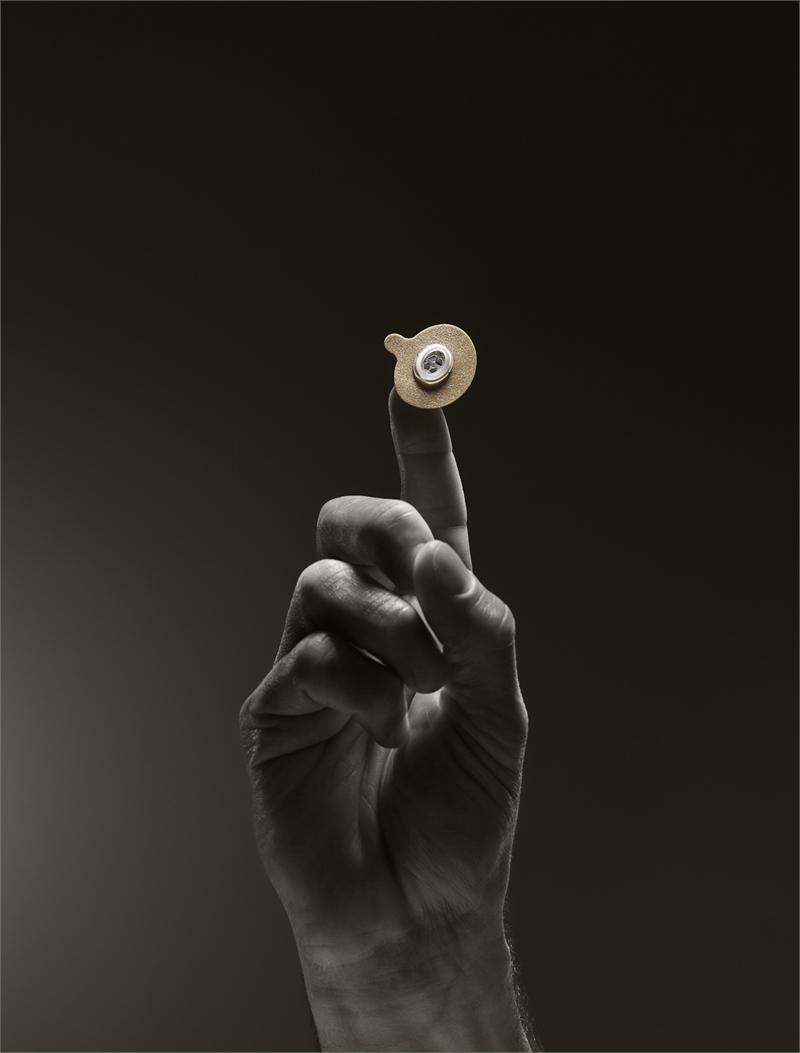
Rajiv Doshi says he has invented a cheaper, much more portable alternative to the sleep apnea machine:

Once taped to each nostril, [Provent's] proprietary valve mechanism kicks in.  Breathing in is almost unobstructed, but the valve blocks most of the air as it is exhaled. This air ricochets back Provent_090420_413_V2warmerinto the respiratory tract and creates just about enough pressure to keep the upper airway (the area between the back of the tongue and the top palette) open. This allows for more air to be inhaled in the next breathing cycle. "It works like a CPAP, but you use your own breathing to create that pressure,” says Dr Doshi. …

The product retails at $120 for a pack of 30 units in America. Dr Doshi reckons that it is a cheaper alternative to the CPAP machine which cost about $1,700 apiece and is difficult to lug around. The World Health Organisation estimates that over 100m patients suffer from sleep apnea. Little wonder investors spy an opportunity. They have already stumped up $93m.

The Prohibition Lobby

Is living high on the hog:

While fighting against [California's failed Proposition 19 last year], lobbyist John Lovell accepted nearly $400,000 from a wide array of police unions, some of which he also represented in attempting to steer millions of federal dollars toward California's marijuana suppression programs. The revelation, reported yesterday by the Republic Report's Lee Fang, illustrates how Proposition 19 threatened the paychecks of some of its biggest foes. Police departments stood to lose lucrative federal grants like a $550,000 payment in 2010 to police departments in three Northern California counties that covered 666 hours of police overtime spent eradicating marijuana.

Lee Fang adds:

Of course, police unions aren’t the only interest group with a stake in maintaining broken drug laws. The beer industry, alcohol corporations, and prison guard unions also contributed money to help Lovell stop Prop 19. Howard Wooldridge, a retired police officer who now helps push for legalization as a citizen advocate, told Republic Report that drug company lobbyists also fight to keep marijuana illegal because they view pot as a low-cost form of competition.

Dollars For Votes

Michael Scherer compares each candidates' spending to their vote totals:

So how much has the entire Romney campaign spent per vote received? $17.14, which is a lot more than the $2.54 that Santorum spent, or the $9.05 that Gingrich has spent, and only topped by the $31.55 that Paul spent. What do these numbers tell us? Both a lot and a little. We can say convincingly that Santorum has been overperforming, compared to the field, while Romney has been underperforming.

The Daily Wrap

6a00d83451c45669e20163029bcc09970d-550wi

Today on the Dish, Andrew read the above cartoon as harbinger of a nasty campaign to come (fouler follow-up here), mocked Bachmann's lunatic attack on health care, picked out the insurance mandate as an issue Santorum could get traction on, advised Newt to get out to get back at Romney given the former's polling, and flagged Obama's rising numbers versus Mitt. We rolled our eyes at Mitt's faux-policies, explained why his "Southern Problem" was really a national problem, listened to an argument for Rick's front-runner status…in 2016, and assessed the Breitbart "bombshell" about Obama's past met principally with derision. Moderates were overrated, heath care may have cost the Dems the House, and SuperPACs couldn't really make up for campaign fundraising deficits. Ad War Update here.

Andrew also rubbished an Iran war on just war theory grounds, caught an egregious instance of theo-Catholicism producing a made-uptheological argument to attack health care reform, noticed another problem with traditional male circumcision (follow-up here), and wondered if Tony Woodlief was the face of a Koch-run Cato. We wondered if Obama lost by winning on Iran, cautioned against a Syria intervention to spite Iran, and surveyed the discussion on and backlash to the #Kony2012 campaign. Readers responded to the Urtak poll on the Cannabis Closet in droves and pushed back against Andrew on Limbaugh. Libertarians were challenged on the consistency of their opposition to the Kochs, homophobia wasn't natural, hate crime laws were ineffective, and sodomy laws were about criminalizing gayness. TSA scanners failed, journalists experimented with 99 cent pricing, apologies seemed like status symbols to some, wine conoisseurs had crazy-sensitive taste buds, and freezing cold beer tricked you into thinking squirrel piss – er, PBR – tasted similar to quality brews. Yglesias Nominee here, VFYW here, MHB here, and FOTD here.

Z.B.

Ad War Update: The Obama Narrative

The Obama campaign previews Davis Guggenheim's 17-minute "long-form" ad, which asks voters to "remember what we as a country have been through" and highlights the achievements of the president's first term: 

David Graham has more

It's an advertisement, even if it takes the form of a narrative about Obama's accomplishments during his first term: the familiar litany of saving carmakers, killing Bin Laden, inheriting a catastrophically broken economy, and more. (I'm old enough to remember when trailers were advertisements, rather that advertisements for advertisements.) Still The Road We've Traveled has many of the hallmarks of Guggenheim's award-winning documentary films, which include An Inconvenient Truth and Waiting for Superman: a sweeping social aim at the center, a star-studded cast (this one features Joe Biden, Elizabeth Warren, David Axelrod, and Rahm Emanuel, with narration by Tom Hanks), dramatic music. The full film is being released at campaign events next week.

Greg Sargent claims that this framing will define the general election:

If Americans cast their vote as a referendum on the conditions of the economy on Election Day 2012 — on "the day’s headlines" — Obama could be denied a second term. But if the Obama team can persuade them to take a longer view — to relive the horrific economic carnage that reigned in the wake of the meltdown, to understand how difficult and dangerous an operation it was to pull the country out of its nose dive, and to appreciate that his policies have put us on track to better days ahead — then he is likely to be reelected.

Previous Ad War Updates: Mar 7Mar 6Mar 5Mar 2Mar 1Feb 29Feb 28Feb 27Feb 23Feb 22Feb 21, Feb 17, Feb 16, Feb 15, Feb 14, Feb 13, Feb 9, Feb 8, Feb 7, Feb 6, Feb 3, Feb 2, Feb 1, Jan 30, Jan 29, Jan 27, Jan 26, Jan 25, Jan 24, Jan 22, Jan 20, Jan 19, Jan 18, Jan 17, Jan 16 and Jan 12.