Cheyenne, Wyoming, 11.46 am
Cheyenne, Wyoming, 11.46 am
Quite a few, according to a new war game exercise reported by Haaretz:
According to a war simulation conducted by the U.S. Central Command, the Iranians could kill 200 Americans with a single missile response to an Israeli attack. An investigative committee would not spare any admiral or general, minister or president. The meaning of this U.S. scenario is that the blood of these 200 would be on Israel's hands.
Amir Oren's conclusion?
At 8:58 P.M. on Tuesday, Israel's 2012 war against Iran came to a quiet end.
But in a world of bluffs, double-bluffs and counter-bluffs, who knows? Other reports suggest more sinister possibilities.
Did Romney actually mock John Kerry for having a big house, when Romney's new proposed one in San Diego has elevators for the cars?
Republican outlets are straining their eyes to see evidence of assault in the new Zimmerman tape. Why on earth should this be a partisan issue, one wonders? And how damning is it of our absurdly polarized culture that it is? Julian Sanchez proposes a possible empirical resolution:
When I was jumped about a year ago, the police who came to the scene took close-up photos of every visible injury—all, mercifully, quite minor—presumably so they could prove battery if they ended up catching the kids. This seems to be pretty standard procedure, and it’s unfathomable that they wouldn’t do the same in a case where those injuries are the main physical evidence backing a claim of self defense in the shooting of an unarmed teenager. I am not intimately familiar with Florida’s records laws, but it would also be pretty standard to have privacy exemptions barring the release of potentially sensitive photographs, such as those showing bodily injuries of identifiable crime victims. But in this case it would seem to be in Zimmerman’s interest to waive that protection if the photographs actually show serious injury.
"[W]hy do Republicans have to get involved in this mess? Wouldn't it be better to utter a few words of regret and move on to something more political? But no, good old Newt can't miss the chance to alienate three-quarters of the American population. What sets him off is President Obama's comment, "If I had a son, he would look just like Trayvon Martin." What's wrong with that? … Like a big, lazy trout [Newt] jumps for the bait. Obama's comment is "disgraceful" and "appalling," "trying to turn this into a racial issue." Good old Rick Santorum isn't far behind, accusing Obama of "introducing divisive rhetoric." So all of a sudden, it's Obama versus the Republicans with three-quarters of the population on Obama's side," – William Tucker, The American Spectator.
At the Dish, we've been leery of wading into an important controversy because, well, the sides were taken before all the facts were in, one of two people in the incident is dead, and the details matter. Which is a relief now, I have to say. How the police video can square with what were previously deemed facts by many journalistic sources I do not know.
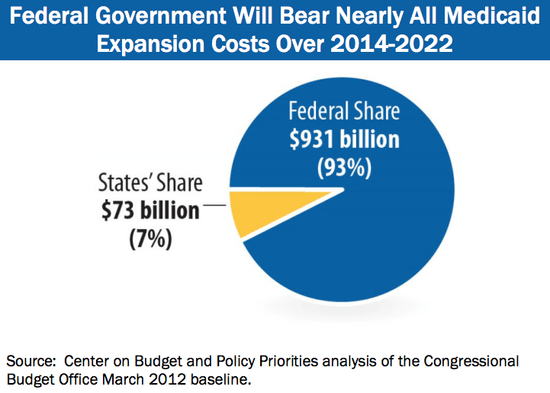
Yesterday, Justice Kagan pointed out that money for Obamacare's Medicaid expansion comes overwhelmingly from the federal government:
"It's just a boatload of federal money to take and spend on poor people's healthcare," Kagan said. "It doesn't sound very coercive to me."
Justice Kennedy sounded skeptical of this point and suggested that giving states massive amounts of money to pay on Medicaid is "coercive." Marty Lederman can hardly believe his ears. He explains the debate:
At issue here is an offer by Congress to give the states hundreds of billions of dollars–Justice Kagan wasn't exaggerating when she referred to a "boatload" of money (indeed, it's a shipload)–on the condition that the states spend the money, as they have since Medicaid's inception, on the categories of needy persons identified by Congress, for the medical services the legislature prescribes. This is a much larger boatload of money than Congress has offered in the past–approximately $443 billion dollars more. And Congress determined that those additional hundreds of billions are to be spent on a new category of beneficiaries, not previously covered by Medicaid–namely, individuals under age 65, not receiving Medicare, with incomes up to 133% of the poverty level. The objecting States don't think federal dollars should be spent on this new population of Medicaid recipients.
The Economist notes that the lower courts dismissed the coercion argument:
States charge that the Medicaid expansion is unduly coercive. Technically states could refuse to expand Medicaid and refuse Washington’s money, they say. But the federal government is so generous as to make this impractical. Every lower court that heard this argument found it to be absurd. Many were surprised that the Supreme Court even agreed to consider it. Yet the court not only tolerated the states’ argument, but seemed amenable to it. … If the court throws out the Medicaid expansion, states will be emboldened to challenge other big programmes.
(Chart from CPBB)
Could it be Azerbaijan – which would avoid overflights through Syrian and Iraqi airspace? There's mounting evidence it might be.
A former White House spokesman on healthcare speaks out:
It would have been easy for Verrilli—or any of us—to explain single-payer health care. "Look," we could have said, "the government is paying for everyone to have coverage." End of story. But single-payer is not what our brilliant, world-leading political system gave us. What it gave us is essentially a halfsy—an extraordinarily confusing patchwork in which some novel legislative mechanisms are used to induce individuals, businesses, insurance companies, and states into doing things that add up to concrete good.
Which is why one possible end-result of all this would be a stronger argument for a simple, constitutional single-payer system.
 The Dish