Marriage Equality Update

Marriage_Maine

Good news:

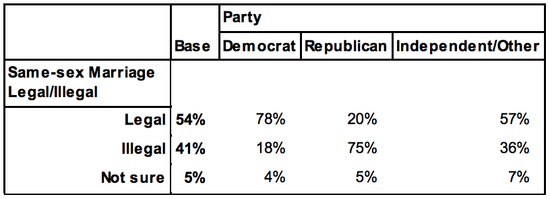
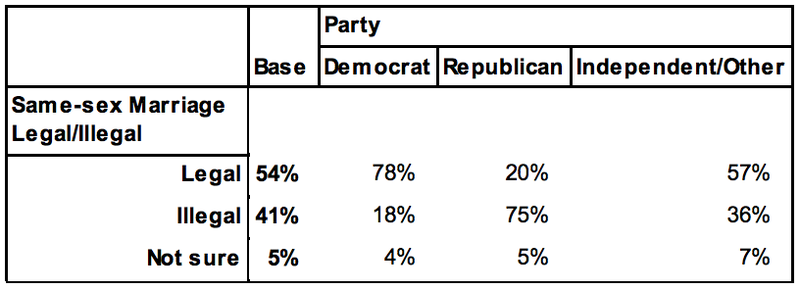
It looks like Maine voters will reverse their 2009 decision and legalize gay marriage in the state this fall. 54% think that gay marriage should be legal to only 41% who think it should be illegal. And when we asked about the issue using the exact language voters will see on the ballot this fall, they say they're inclined to support the referendum by a 47-32 margin.

I’m Barack Obama And I Approve This Text Message

Text messages are roughly 10 times more likely to be read than e-mail, which makes them powerful campaign tools. But, as Sasha Issenberg reports, it's difficult for campaigns to fully harness the power of texts:

[T]he strict regulations around mobile phones have ensured that they exist in a privileged space among forms of campaign communication—the only platform where one needs prior permission to approach a voter.

"The law was written at a time when there was a small number of mobile phones owned generally by really well-off people, including politicians, and they were very expensive with no all-you-can-eat plans. The people who had them wanted to protect them," says Shaun Dakin, a marketing consultant and privacy advocate who launched the National Political Do Not Contact Registry. "Now there are more and more people who are cell-phone only." The cost of having a cell phone has come down in the interim, but most plans still charge users to receive text messages. 

As a result, the durable competitive advantage in mobile communication isn’t technology but social capital: having a strong enough relationship with supporters that they will agree to accept intrusive messages for which they may have to pay.

Iran Is Not The Only Threat

137786478

Michael Crowley questions the GOP's heavy emphasis on Iran to the "near-exclusion of the many other nuclear threats America faces." He warns against being "fooled into thinking that Iran is the only, or even the likeliest, source of a possible nuclear bomb that might be used against America or Israel":

President Obama has devoted serious attention to the complex problem of loose nuclear material, and has tried to start a global conversation about nuclear disarmament. His administration keeps a close watch on Pakistan’s nukes (though with frustrating limits) and has reportedly developed plans for military action should the country’s nuclear arsenal come under imminent threat. But Republicans just haven’t seemed very interested in these dangers.

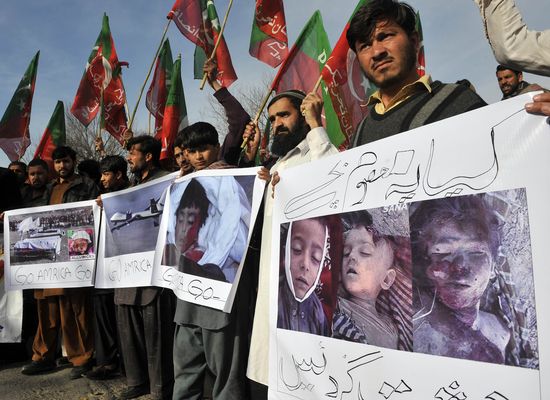
(Photo: Supporters of Pakistani cricketer turned politician Imran Khan of Pakistan Tehreek-i-Insaaf (PTI – Movement for Justice) hold placards during a protest in Islamabad on January 27, 2012, against US drone attacks in the Pakistani tribal region. A US drone on January 23 fired missiles into a vehicle, killing four militants in Pakistan's Taliban and Al-Qaeda hub of North Waziristan that hugs the Afghan border, security officials said. It was only the third such US attack reported in the nuclear-armed state so far this year, following a moratorium after US firepower inadvertently killed 24 Pakistani soldiers in November, plunging relations to an all-time low. By Aamir Qureshi/AFP/Getty Images)

The Unfriending Phenomenon

Quentin Fottrell notes that Facebook users are becoming more discerning: 

The percentage of people who "unfriend" other Facebook members rose from 56% in 2009 to 63% in 2011, according to a new Pew Research study. Women seem to be second-guessing their online relationships the most: some 67% say they deleted people versus 58% of men. Likewise, young adults are more active "unfrienders" when compared with older users: 71% of those between 18 and 29 deleted people versus 63% of those aged 30 to 49.

Strange Things At The CATO Institute, Ctd

Tony Woodlief defends himself – and indeed provides context to the quotes cited by me and others that exonerate him from much of the criticism. Along the same lines, Will Wilkinson, a former Cato employee, argues that "this isn't a battle between good and evil, and the stakes are probably lower than you think."

Santorum And Opus Dei

127244568

He is not a member, he tells us, but his chosen parish church has deep ties to the organization:

St. Catherine is one of only about 10 sites in Virginia that offers “evenings of recollection.” These are monthly, hour-and-a-half long talks by lay people and priests belonging to Opus Dei. They are segregated by sex—St. Catherine men who attend these do so at the Reston Study Center, one town over, while women attend them at St. Catherine.

Sex-segregation for adults is commonplace for Opus Dei. Santorum is not just a weekly-mass Catholic; but a daily-mass Catholic. This too:

In 2002, Santorum travelled to Rome with high-profile American members for the 100th birthday of Opus Dei’s founder, Josemaría Escrivá de Balaguer. (The five-day event is where Santorum first criticized John F. Kennedy’s “separation of church and state” speech, speaking to a reporter.) He has also sent two of his sons to the Heights School, a Washington, D.C. school with ties to Opus Dei.

I was recruited by Opus Dei at Harvard. Why not? I was a very bright young Catholic, very motivated by and interested in the church. I even went on an Opus Dei retreat. I have no issue whatever with groups that are reviving older, Catholic liturgical traditions – like the Veneration of the Eucharist. In fact, I think they are doing the church a favor by recovering some of the rituals, mystery and rigor that were sometimes carelessly lost in the wake of Vatican II. But it was not for me. The sex segregation was creepy; the cult of the Founder was creepier; the practices of self-mortification – the cilice, self-whipping – I found psychologically troubling.

It is within the broad spectrum of Catholic tradition; but the all-male sexual repression seemed all too close to pathology for my part, especially given what we were discovering about sex abuse from the heirarchy on down. So I resisted. There was something dark in there; and I preferred the light.

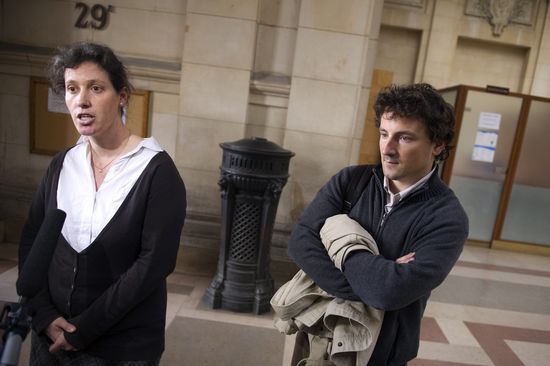
(Photo: Witnesses in the secretive Roman Catholic society Opus Dei 's trial Marie Berangere Juin and Bruno Devos answer journalists' questions upon arrival at Paris court on September 21, 2011, for the first ever trial in Europe coming after a nine-year probe and centers on Catherine Tessier who said that as a teenager she was forced to work 14-hour days and brainwashed, triggering in charges of 'undignified punishment' and illegal employment . Two Opus Dei members are defendants at the trial, along with the University and Technical Culture Association (ACUT), which runs the Dosnon Hotel School in Aisne in northern France and is accused of links to Opus Dei. By Lionel Bonaventure/AFP/Getty Images.)

Is Posthumous Baptism Offensive? Ctd

Readers respond to the controversy:

Looking at this as a lifelong atheist, I can’t see anything in Mormon baptismal practice that’s any more troubling than having my Christian relatives constantly praying for my conversion (which they do constantly).  Yes, it’s creepy, even annoying. Maybe even disrespectful. But in a country where I am routinely demonized by Bible-thumping preachers, it’s a pretty low-grade form of disrespect. I’m far more bothered by Mormon missionaries ringing at my door twice a year.

Another:

You wrote: “I’m with Kohen. In fact, I’d go further. It’s deeply disrespectful to and invasive of other faiths to be posthumously coopted in this fashion.” You’re wrong, Sully. Why is this different than Catholics praying for the dead?  My dad was a deacon and I went to daily Mass growing up (not by choice) and I know they prayed for all dead and suffering souls regardless of religious affiliation.  They prayed for “reconciliation” with their “separated” Protestant brethren, by which they meant that Protestants would wisen up and embrace the pope and all things Roman Catholic.  They prayed for the conversion of nonbelievers or believers of other religions (whether we are perfectly content in our unbelief or not).

Along those lines, another asks, “How is the practice of saying a deceased person’s name during a religious ceremony any more “disrespectful” or “invasive” than baptizing infants who have no choice in the matter?” Another clears up such confusion regarding posthumous baptisms:

I am a practicing Mormon and regularly attend the temple. I can completely understand how this practice can be seen as disrespectful and insensitive to members of other faiths. My only frustration in the debate comes from the thought that Mormons believe that once the posthumous baptism is performed, that person is now a Mormon. That is not the case.

We believe that even after this baptism by proxy is performed that person has the ability to accept or decline the ordinance. They are not listed on any records of the church as members, nor do we claim them to be. The only record kept is if the baptism was performed or not, mostly in an effort to prevent duplication of baptisms.

Any situation dealing with loved ones is clearly sensitive, especially when religion and spirituality is concerned. I cannot, and do not speak on behalf of the church, but I believe that these baptisms are done out of genuine charity for others, not out of an attempt to make everyone a member of our church, or to offend those not of our faith. I admit that some of our beliefs can seem absolutely insane, but none of them come from a malicious or evil intent.

(As a side note, this is an interesting article published by the Maxwell Institute at BYU on posthumous baptisms in early Christianity.)

Another Mormon writes:

I have personally participated in these baptisms for the dead. Let me first say that I have had some of my most soul-swelling and thought-provoking moments while doing so. I understand the feeling that is conveyed by others that baptisms of their dead might be viewed as offensive, but it helps to remember Mormon doctrine on this issue: those who are baptized by proxy have a choice to accept or reject that baptism. We also believe that personal traits, personalities and characteristics carry forward to the afterlife from this life. Thus, those who wouldn’t have accepted Mormonism on earth (had they had the chance) probably won’t accept Mormonism in heaven.

It’s clear from the Bible that Christ commands us to be baptized. What then happens if people go throughout their lives without the opportunity to be baptized? This has most likely happened billions upon billions of times. Are these people just screwed out of heavenly blessings? No, billions aren’t screwed out of heaven – all have the opportunity to come unto Christ, and to memorialize their devotion to him through baptism.

More reader commentary on our Facebook page.