Netanyahu’s Eternal Religious War

Bob Wright has a must-read on the double standards of covering religious fundamentalists. I'm struck by how Netanyahu seems to believe that Persian hatred of Jews is somehow an eternal fact. I'm also struck by Bob's conclusion:

Why is it routine to talk about Iranian religious fanatics who are leading us toward war and so rare to acknowledge the role that religious tribalism in America–among both conservative Jews and conservative Christians–is playing in leading us to war? And why is it that when Muslim radicals use religious scripture in a way that foments belligerence we consider it primitive and vile, whereas when Bibi Netanyahu does the same thing (more subtly, I grant you) we nod politely and smile?

Santorum’s Culture War Edge

GT_SANTORUM-BUTTON_120307

Many in Washington remain befuddled by Rick Santorum's embrace of radical social reactionaryism in an electorate primarily concerned with the economy. What they miss is that was only through bringing such issues to the front and center that Santorum could break through the frothy oblivion to which Dan Savage had tried to send him. He realized that this was what positively motivates those who were not yet sold on Romney.

But this only reinforces my point about the politics of sex. It's a wedge issue now for the left. Since contraception emerged as an issue, thanks to the posturing of Benedict XVI's amen-chorus, Obama has seen his ratings slowly climb, while the GOP candidates' unfavorable numbers keep growing. And Santorum's canny use of the issues has helped him sustain a primary campaign that will now only serve to weaken, demoralize and drain money from Romney.

So this election could prolong the Republican agony for another electoral cycle at least. It could lead to a general election candidate dubbed both rich and out of touch and only lip-syncing the theological truths that evangelicals hold dear. If he loses, it could well mean another spasm of even more Christianist extremism the next time round, since Christianists will argue that running another faux-culture-warrior was the reason they lost.

I say: nominate Santorum and get this over with. Then find a Romney in 2016 who actually is more moderate and doesn't feel the need to apologize for it. But this won't happen. The one outlier that might just happen? A brokered convention where a Palin-like figure emerges. Or a mess, where Romney feels obliged to lie even more, smear even more, and war-monger even more to force himself into a stronger position in the fall.

I fear a weak GOP candidate held afloat by a tsunami of smear ads against Obama, using the race card, the Israel card, the religion card, the Birther card, and what have you – thrown in by billionaires who hate the guy or who are obsessed with Greater Israel. It could be one of the ugliest smear campaigns Romney has ever run – and that's saying something.

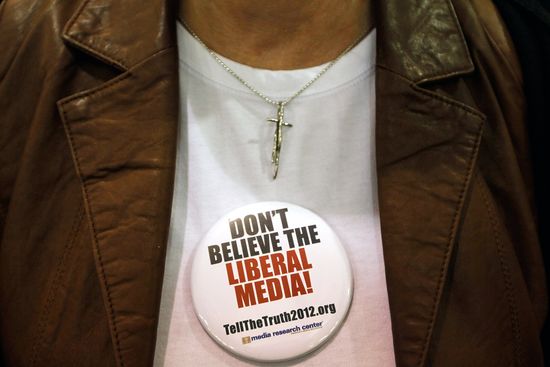
(Photo: A supporter of former U.S. Senator Rick Santorum wears a button that reads, 'Don't Believe the Liberal Media!' as he speaks during a campaign stop at Chillicothe High School in Chillicothe, Ohio on March 2, 2012. By Joe Raedle/Getty Images)

Yglesias Award Nominee

"What does it say about a candidate, though, who wrote an op-ed in 2009 saying that, please apply what we did in Massachusetts nationally on an individual mandate, and then goes on the campaign trail yesterday and just lies? He lied yesterday. It’s on videotape. What does that — what are conservatives to think about that?" – Joe Scarborough.

My answer: that Romney is one of the hollowest, shallowest candidates for national office I've witnessed, and brazen lying in a smooth, authoritative advertizing voice, is his first resort.

Social Media And Rush Limbaugh’s Donnybrook, Ctd

Many readers are bristling over my statement, “It’s a free country, but I get queasy with boycotts to target disgusting but free speech.” One writes:

For your information, Mr. Sullivan, the only recourse we have against the revolting Rush Limbaugh is to boycott his advertisers.  He’s got big, big money behind him and absolutely no sense of shame. I can think of no reason why the people of this country should be involuntarily exposed to the increasingly vicious and mendacious rants of this individual, when there is a way to dial him back. Nobody from the government is trying to stop him.  His fellow citizens are simply exercising THEIR rights.

No one is involuntarily exposed to his poison; and he earned the big bucks by peddling this crap. That’s the American way. Yes, I’m relieved that the government is not intervening, but the First Amendment ensures that. The right way to counter his speech, in my view, is with speech, not threats to his livelihood. Another writes:

Free speech is my unabashed favorite of our constitutional protections. And as much as I loathe Limbaugh’s politics, public persona, and recent remarks, I’d side with you against anyone arguing that he shouldn’t be allowed to say those things, or that people shouldn’t be allowed to listen to him. But I fail to see how that’s happening here. Like anyone’s free speech, Limbaugh’s has consequences.

People are choosing not to listen to him, and they’re choosing to pull their financial support from the people who, by funding him, give tacit approval to his opinions and expressions. They’re voting with their feet and their dollars, and protesting what he said, not his right to say it. If Limbaugh’s loyal fans and listeners agree with his remarks, they can similarly pledge their patronage to other companies that might now step in to sponsor his show. So how is this particular form of protest anything but the free market in action?

Even if his radio show goes off the air – and I doubt it will – Rush will still be able to broadcast his views freely to the entire world over the Internet. His actual ability to speak and be heard might be more limited than it is now, but it won’t be stifled. The people behind this boycott are simply exercising their right not to financially support (directly or otherwise) the content of his discourse.

This is right, of course. And I am not saying that boycotts are somehow illegal or always disturbing. It simply remains a guiding principle of mine that you argue your case, you counter and expose arguments that don’t work, or lies that can be debunked, or smears that are disgusting. But I don’t like the desire to silence someone through economic pressure. It comes from an illiberal place.

We can be better than the Greater Israel lobby and its assorted backers.

The Big Lies Of Mitt Romney, Ctd

Paul Waldman asks when the press will start calling them out:

There are lots of things Romney says about Obama that are distortions, just plain ridiculous, or unfalsifiable but obviously false, as when he often climbs into Obama's head to tell you what Obama really desires, like turning America into a militarily weak, economically crippled shadow of Europe (not the actual Europe, but Europe as conservatives imagine it to be, which is something like Poland circa 1978). But there are other occasions, like this one, where Romney simply lies, plainly and obviously. In this case, there are only two possibilities for Romney's statement: Either he knew what Obama has said on this topic and decided he'd just lie about it, or he didn't know what Obama has said, but decided he'd just make up something about what Obama said regardless of whether it was true. In either case, he was lying.

Super Tuesday Reax: “So Inevitable And So Weak”

GOP_Map

David Frum looks on the bright side:

[Romney] gained more on Super Tuesday than anybody else. Yeah, he didn't win what he should've. Yeah, he looks weak in a lot of ways. But he's making progress by the only decisive metric. And as any good consultant will tell you: if only one metric matters, the guy leading on that measure is the winner—or is on his way to being the winner sooner or later.

Jonathan Bernstein claims the nomination fight is all but over:

It’s not just that no one has ever lost a nomination after building this kind of lead; it’s that no one, since the modern system was fully in place in the 1980s, has ever come close to losing after building this kind of lead. So it goes on, but for all the fun of close vote counts in the occasional state, there’s really not very much suspense here.

How Ed Kilgore frames Romney's victories:

Romney won Super Tuesday but seems to be losing the spin wars over its meaning. And for a candidate whose elite opinion-leader backing remains perhaps his most important asset other than cash, that matters.

Nate Silver measures Romney's vote margins:

Were his vote total just 3 percent lower in every state, distributed among the other candidates in some reasonable fashion, he would have lost Ohio and Alaska on Tuesday, and Michigan and Maine in February — and would have clearly lost Iowa rather than having “tied” there. But it wasn’t, and he didn’t. Mr. Romney has skirted a thin line throughout the Republican primaries — and has almost always ended up on just the right side of it.

Dave Weigel draws lessons from Super Tuesday:

Caucuses reveal that the base is cold on Romney. Here are four numbers: 37%, 45%, 60%, 41%. Here are four more: 24%, 32%, 35%, 17%. Those are the numbers for Rommey, respectively, from the 2008 caucuses in North Dakota, Alaska, Colorado, and Minnesota, and from the 2012 caucuses in the same states.

Rich Lowry sighs:

Rarely has a candidate seemed so inevitable and so weak at the same time.

Ezra Klein is betting that Romney will be stronger in the general election:

[I]t's possible that the GOP primary plays to Romney's weaknesses, while the general will play more to his strengths. He's got a big, top-heavy campaign that has been forced into asymmetrical warfare with smaller, lighter opponents. The dynamics of the primary are forcing Romney to unconvincingly adopt unpopular opinions that contradict what he's done and said in the past in order to persuade an electorate that's unusually concerned with purity. But in the general election, he'll be facing another big, top-heavy campaign, and he'll be able to run towards the center. Perhaps he'll perform better under those conditions.

Jonathan Cohn differs:

The longer this race goes on, the more desperate Romney becomes to protect his right flank, the more he will position himself outside the mainstream. And you can make the case– indeed, I have made the case – that Romney has already committed himself to radically conservative positions on taxes and spending that will alienate swing voters in the general election.

Sabato's Crystal Ball expects a long slog:

We can make one prediction: No one is going to drop out of this contest any time soon. The race moves to Kansas on Saturday (March 10) and Mississippi and Alabama next Tuesday (March 13). Santorum starts out with an edge in the Sunflower State while he and Gingrich will battle it out in the Magnolia State and Yellowhammer State. 

John Ellis says campaigning is Santorum's drug of choice:

Running for president is exhilarating, especially when you're Rick Santorum and been left for dead after losing in a landslide in Pennsylvania in 2006. It's vindication; I was right and they were wrong. It’s proof that you “have what it takes.”

Garrett Quinn thought Paul had a rough night: 

Paul’s strategy has been focused on caucuses and at this point only a handful of them remain: Guam, Kansas, Virgin Islands, Hawaii, Nebraska, and Montana. Yes, Paul will have delegates at the GOP convention in Tampa—but if these so-so results continue he will not march in there with the army he has been hoping for.

Bill Kristol won't give up on Santorum:

Mitt Romney of course remains the clear favorite. But the schedule over the next few weeks does him few favors. There are 14 primaries and caucuses in the next month, including Kansas on March 10, Alabama, Hawaii, and Mississippi on March 13, Missouri on March 17, Illinois on March 20, Louisiana on March 24, and Maryland and Wisconsin on April 3. Rick Santorum will probably hold his own—maybe more than hold his own—against Romney in these contests. 

Jennifer Rubin, meanwhile, spins for Romney:

The night is emblematic of the race as a whole. Romney, with superior organization and a focused message, is striding toward the nomination. Santorum is hanging on, but not doing much more than that. Santorum would like to think the difference between the two is simply money. But in fact, Santorum’s message has become ragged and his wins in two relatively rural states do not bode well for his ability to build a winning coalition.

Douthat thinks Santorum's brand of politics may be the Republican future:

Ours is increasingly a country where sky-high economic expectations coexist with middle class wage stagnation, and where the idealization of married life coexists with steadily rising out-of-wedlock births. In this atmosphere, the fusion of a (moderate) social conservatism and a right-leaning economic populism could end up having a broader appeal than many alternative right-of-center visions.

John Avlon and Ben Jacobs wonder if anyone will get to 1,144:

If Mitt wins every remaining all-or-nothing state but one, and half of the remaining proportional delegates, he would likely still fall short of the magic nomination number of 1,144—which would force him to rely on unpledged delegates, the Republican version of the infamous Democratic superdelegates in 2008, to claim his party’s mantle.

And Dan Amira declares winners:

Ultimately, Super Tuesday benefited the political media (which needs something to write about) and President Obama (who avoids a unified GOP attack for a while longer) more than any of the Republicans running for president. 

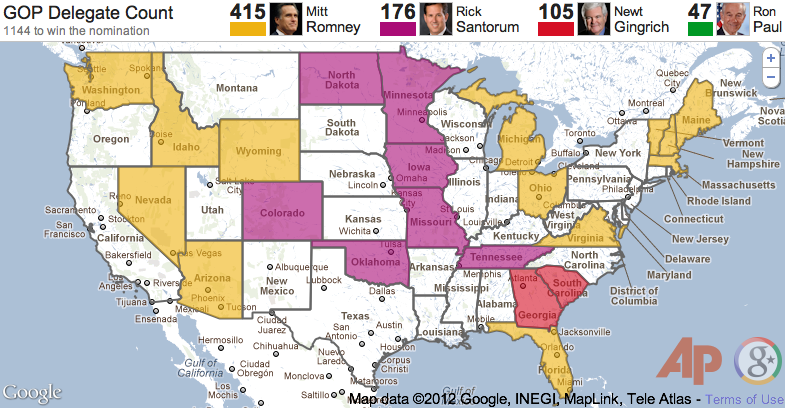
(Chart from Google. Interactive version here.)