
Ad War Update: Romney’s Super Splurge

Santorumclinton

First Read breaks it down:

… Romney and his Super PAC allies have more than a 4-to-1 ad-spending advantage over Santorum and his allies in the pivotal state of Ohio. And overall, it’s nearly a 5-to-1 advantage.

Here are the most up-to-date numbers for ad spending in the Super Tuesday states: Ohio: pro-Romney $4 million, pro-Gingrich $739,000, pro-Santorum $950,000. Georgia: pro-Romney $1.5 million, pro-Gingrich $950,000, pro-Santorum $214,000. Tennessee: pro-Romney $1.3 million, pro-Gingrich $664,000, pro-Santorum $247,000. Oklahoma: pro-Romney $576,000, pro-Gingrich $422,000, pro-Santorum $182,000. Idaho: pro-Romney $126,000, pro-Santorum $3,000, pro-Paul $47,000. Vermont: pro-Romney $61,000, pro-Paul $55,000.

Alex Burns provides a post-Super Tuesday look at climbing Super PAC spending levels. He also captions the above mailer from Restore Our Future:

It's an all-negative piece; unlike the other Restore Our Future hits in Alabama, there's no positive sell for Romney in this one. It's just about taking down Santorum. The Clinton/felons voting theme is one that ROF has used in its TV ads as well. My Dem source quips: "To try and use Hillary Clinton as a villain is almost laughable. On the plus side, between Romney mailers and the L.L Bean catalog, the Postal Services future is looking bright."

Previous Ad War Updates: Mar 5Mar 2Mar 1Feb 29Feb 28Feb 27Feb 23Feb 22Feb 21, Feb 17, Feb 16, Feb 15, Feb 14, Feb 13, Feb 9, Feb 8, Feb 7, Feb 6, Feb 3, Feb 2, Feb 1, Jan 30, Jan 29, Jan 27, Jan 26, Jan 25, Jan 24, Jan 22, Jan 20, Jan 19, Jan 18, Jan 17, Jan 16 and Jan 12.
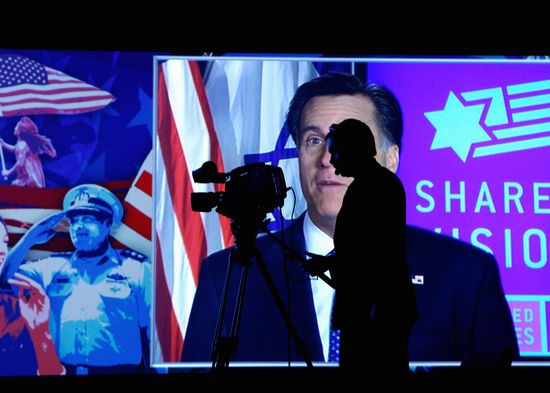
Face Of The Day

GT_FACE-ROMNEY-AIPAC_120306

Former Massachusetts governor Mitt Romney addresses the American Israel Policy Affairs Committee's annual policy conference via satellite at the Washington Convention Center on March 6, 2012 in Washington, DC. Romney took time out of campaigning on Super Tuesday to address AIPAC, on of the most prominent organizations lobbying the United States government on behalf of Israel. Former senator Rick Santorum today addressed the conference in person. By Chip Somodevilla/Getty Images.

Will Evangelicals Vote For A Mormon?

Ryan Lizza will be watching the evangelical vote tonight:

The source of Romney’s problems is very clear from exit- and entrance-poll data collected in seven states that have voted so far (Iowa, New Hampshire, South Carolina, Florida, Nevada, Arizona, Michigan): evangelical Christians have refused to back his candidacy. Romney has lost evangelicals in every contest—and by an average of fifteen points. His best showing came in New Hampshire, where he lost the evangelical vote by nine points, and his worst came in Iowa, where he lost it by twenty-four points.

Obama On Iran: “This Is Not A Game”

Chait cheers the president's Iran comments today:

His news conference offered the most crystallized version of what is likely to be his foreign-policy argument through the election. Obama repeatedly dismissed Republican attacks as bellicose political rhetoric. He argued that the demands he do more to stop Iran from obtaining a nuclear weapon generally dissolve, upon inspection, into endorsements of policies he is implementing, like sanctions and using the threat of an attack as leverage.

The View From China

Evan Osnos relays Chinese attitudes toward Super Tuesday and the GOP primary in general: 

Some things have become clear: Santorum has a powerfully repellent effect on the Chinese non-electorate. Commentator Li Yi, like others, has tried to make sense of the faith-based campaign: “Are you sure that he’s going for the presidency, not for organizing a cult?” Perhaps the biggest surprise is that Ron Paul has his fans in China, where he’s better known by the genuinely honorific nickname Grandpa Paul. “Compared with Romney’s sugar-sweet talk, this grandfather is a lot more direct and candid,” a commentator wrote Tuesday.

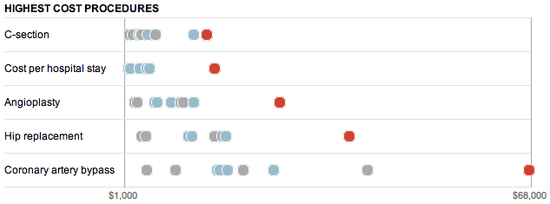
Why Does Healthcare Cost More In America?

The US is the red dot in this healthcare price comparison chart:

Healthcare_Costs

Ezra Klein studies why American procedures are much more expensive. One theory:

“In my view, health is a business in the United States in quite a different way than it is elsewhere,” says Tom Sackville, who served in Margaret Thatcher’s government and now directs the IFHP. “It’s very much something people make money out of. There isn’t too much embarrassment about that compared to Europe and elsewhere.” The result is that, unlike in other countries, sellers of health-care services in America have considerable power to set prices, and so they set them quite high.

Follow-up here. In other health spending news, a new study finds that electronic medical records are associated with more testing and, therefore, more healthcare spending. Drum defends them regardless:

I never bought the notion that electronic records would really restrain costs much anyway. I just think they're a good idea because they'll reduce medical errors and make life more convenient. I've been with Kaiser Permanente for the past few years, and their extensive computerization of everything really does streamline the whole process of dealing with the healthcare system. I'm totally sold, regardless of whether they're saving any money by doing it.

Yglesias bets the healthcare spending will increase no matter what:

Once you're talking about a middle class family in a developed country—a family that's not worried about starving to death or freezing on the streets or being unable to afford shoes—you're talking about a family that's going to plow what resources it has into attempting to address the potentially limitless health care needs of its members.

Relatedly, Aaron Carroll argues that HSAs won't fix runaway spending.  

What The Pill Means For Women

Annie Lowrey appraises the economic impact of oral contraceptives: 

[Y]oung women who won access to the pill in the 1960s ended up earning an 8 percent premium on their hourly wages by age 50. Such trends have helped narrow the earnings gap between men and women. Indeed, the paper suggests that the pill accounted for 30 percent – 30 percent! – of the convergence of men’s and women’s earnings from 1990 to 2000.

Kill The Caucuses?

Jonathan Bernstein claims that the "anti-caucus animus has gone way too far":

The distinction between those who can just drop in at their polling place and vote and those who have to spend a couple of hours at a caucus looks a lot less significant if the real key to having an important voice in the nomination is spending hours building up strong ties within the party—or, for that matter, spending lots of money to do the same. 

It’s those party actors, from elected officials down to long-time activists, who should, and do, have influence within the nomination process. And if they believe they can do it best through the current system, then there’s no reason for us on the outside to intervene. Indeed, our outrage at the injustices of the primary process—including caucuses—should be tempered by the fact that it’s never entirely been about fairness to begin with.