Will Tonight Decide The Nomination?

Blumenthal's Super Tuesday primer:

He expects a close race in Tennessee:

The most surprising finish may be underway in Tennessee, where two automated, recorded voice polls conducted over the weekend both show support for Newt Gingrich climbing rapidly. … The WeAskAmerica poll showed all three frontrunners separated by a single percentage point, 30 percent for Romney and 29 percent each for Santorum and Gingrich. The PPP poll gave Santorum a slightly larger share of the vote (34 percent), followed by Romney (29 percent) and Gingrich (27 percent). Other Tennessee surveys conducted late last week had Gingrich significantly lower.

John Cassidy wonders if Romney will effectively end the nomination fight tonight:

A week ago, a Santorum loss in either Tennessee or Oklahoma seemed unthinkable. That such possibilities are even being discussed shows how far things have moved in Romney’s favor. It’s not just the polls, and it’s not that social conservatives have suddenly shed their suspicions of Romney. But there seems to be general feeling in the G.O.P., certainly in its upper reaches, that it’s time to call a halt to the circular firing squad.

Ezra Klein watches Republican lawmakers:

Party leaders have come to the conclusion that this primary is hurting them — here are some graphs on that — and they don't seem interested in letting it go on in a serious way for much longer. If Romney wins tonight, expect a lot of endorsements, and a lot of establishment pressure on Rick Santorum and Newt Gingrich, in the coming days.

Nate Silver outlines various scenarios and says "Romney is likely to remain the favorite to win the nomination almost no matter what happens." Josh Putnam calculates that neither Santorum nor Gingrich can get 1,144, the number of delegates needed to win the nomination:

The bottom line here is that Romney has enough of a delegate advantage right now and especially coming out of today's contests that it is very unlikely that anyone will catch him, much less catch him and get to 1144. … And that is a problem in this race. Well, a problem for Gingrich and Santorum anyway. If all either of them can take to voters is an argument that all they can do is prevent Romney from getting to 1144, then neither has a winning strategy. 

They have, instead, a losing strategy, in a way that would make the eventual winner look more and more like a loser. The pressure on Gingrich and Santorum will be brutal after tonight, if they don't win more than one state apiece.

I repeat what I'll be looking out for: Romney's share of the blue-collar vote in Ohio and his evangelical support. My daring prediction is that Romney won't win those core constituencies handily enough, and that his weak position as the nominee will be buttressed by one of the harshest, nastiest propaganda campaigns against an incumbent president in memory.

We know what Romney is capable of, with brutally negative advertizing. We also know his own substantive positions – more tax cuts for all, more defense spending, and yet somehow a balanced budget – are too weak to bear much scrutiny or mathematical analysis. So we'll have a Super-PAC dominated endless loop of anti-Obama slime and untruth.

The Dish will, of course, be live-blogging tonight. Good times.
Social Media And Rush Limbaugh’s Donnybrook

I was struck by this quote from a Limbaugh advertizer who pulled his sponsorship:

When reached by telephone, Michael Rozbruch, the chief executive of Tax Resolution Services, said that his company had been a sponsor of Mr. Limbaugh for “just over a year.” He said he had been “inundated” by messages from online protesters that wanted him to drop the sponsorship.

“What put me on the map 14 years ago was ‘The Howard Stern Show,’” Mr. Rozbruch said. Mr. Stern is a famously controversial radio host, and Mr. Rozbruch said he once had a “similar experience” with opponents of that show. “But social media was nowhere where it is today,” he said.

The power of Limbaugh's vocal connection with millions was overwhelmed in the end by the collective chorus of disdain – and its speed and immediacy. That seems to have made the difference here – as well as the cut-and-dried offense of deploying the words "slut" and "prostitute" and demanding that a law student provide a sex tape.

It's a free country, but I get queasy with boycotts to target disgusting but free speech. Think Progress has whittled down its list of targeted advertizers to … just two left. Nine have quit. No one knows the full list.

Strange Things At The CATO Institute, Ctd

Pareene sticks up for Cato:

[Y]ou should wish for an independent Cato Institute even if — maybe especially if — you’re a socialist statist tool (like me). Cato is mostly antiwar, decidedly anti-drug war, and sponsors a lot of good work on civil liberties. That … is basically what the Kochs don’t like about them, because white papers on decriminalization don’t help Republicans get elected. As Jonah Goldberg complains in a post that otherwise resolutely refuses to come to a conclusion or have a point, Cato has an annoying habit of not always seeing itself as a natural member of the glorious Republican coalition. (Current Cato headline: “It’s Not Obama’s Fault That Crude Oil Prices Have Increased.” Oh, man, don’t tell Americans for Prosperity that!)

Julian Sanchez, a Cato employee, will resign should the Kochs take control. Jane Mayer sees the takeover as part of a trend:

As Bruce Bartlett, a conservative economist who was drummed out of the National Center for Policy Analysis for criticizing President Bush, told me yesterday, “This is not all together surprising. It happened at the American Enterprise Institute to David Frum. Staying on the good side of the Republican Party was more important than maintaining its integrity. The conservative right-wing Republicans who fund all these places now see they can serve their own agenda of paying no taxes, and screwing the hell out of the poor. They’ve drunk their own Kool-Aid on Obama. They see the guillotine around the corner, and they want to do anything they can to stop it.”

Weigel has useful background on the legal battle over the think tank. Earlier thoughts here.

2002 All Over Again

“All U.S. intelligence officials are confident the Israeli leadership has already decided to attack Iran, unless a significant change happens in the coming weeks or months with the Iranian nuclear program,” – a "senior American official" to Channel 2 in Israel. The channel adds:

In response to the American official’s statement to Channel 2, “sources close to Netanyahu” said the U.S. is doing what it can to “handcuff”  the Israelis and to “frighten the Israeli public”.

I have no way of knowing if this is true, but it does not bode well for the world if Netanyahu has drawn the conclusion that the main goal of this visit was to establish that the US won't actively stop an Israeli attack. He remains, in my view, the man with the greatest potential to create a crisis to scramble the US presidential race. And he is an adjunct to the neocon right of the GOP, which includes all three leading candidates.

Can Diplomacy Prevent An Iran War?

Suzanne Maloney thinks it's the best bet:

Negotiations in the absence of mutual trust present a difficult dilemma but not a hopeless one. The depth of the estrangement that exists today between Washington and Tehran is hardly less fierce than it was during the hostage crisis, yet ultimately a mechanism for dialogue and a resolution to the standoff was found largely because both sides could ascertain no better alternative to achieve their interests. Even then, it took repeated forays and failures in diplomatic outreach by both sides, the persistent efforts of a well-situated objective intermediary, and a considerable investment in staff work to ensure preparation, mediation, and implementation of the complex financial, legal, security, and other dimensions of a bargain.

 Paul Pillar factors in the effect of sanctions:

Western negotiators need to persuade the Iranians that concessions on their part will lead to the lifting of sanctions. This may be hard to do, partly because the legislation that imposes U.S. sanctions on Iran mentions human rights and other issues besides the nuclear program, and partly because many U.S. hawks openly regard sanctions only as a tool to promote regime change or as a necessary step toward being able to say that “diplomacy and sanctions have failed,” and thus launching a war is the only option left. The challenge for the Obama administration is to persuade Tehran that this attitude does not reflect official policy.

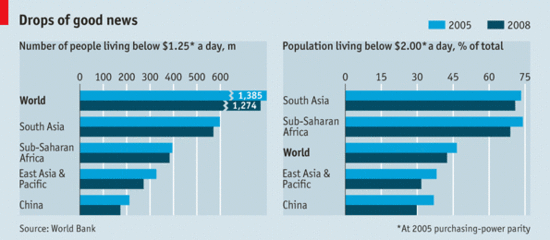
Chart Of The Day

20120303_FNC667

By The Economist, which notes:

The past four years have seen the worst economic crisis since the 1930s and the biggest food-price increases since the 1970s. That must surely have swollen the ranks of the poor. Wrong…The new estimates show that in 2008, the first year of the finance-and-food crisis, both the number and share of the population living on less than $1.25 a day (at 2005 prices, the most commonly accepted poverty line) was falling in every part of the world.