Obama’s Organization Advantage

Erin McPike spotlights the Obama campaign's early efforts in swing states like Ohio: 

Since the president launched his re-election bid last April, his Ohio team has conducted 5,000 volunteer-led events, including house parties, phone-banking efforts and neighborhood canvassing. These events have now reached more than 650,000 Ohio voters, whether via phone, the front door or even one-on-one meetings, according to the campaign. The team is opening its 10th office — in Youngstown — on Thursday and plans to open several dozen more over the next few months. 

Earlier coverage of the campaign's impressive data operation here.

Bounties On The Gridiron

Alyssa Rosenberg breaks down the latest NFL scandal, where New Orleans Saints players were incentivized to injure players on other teams:

[T]he bounties themselves were offered—and paid—not by the team but by Saints players to Saints players. And they worked as incentives because special teams players who are in a position to inflict those injuries make less than the teammates who offered them the bounties. … [I]t’s a worrisome illustration of how the league’s compensation patterns could make bounties seem worth reaching for, and could lead to them violating their own collective bargaining agreement.

Buzz Bissinger, by contrast, has no problem with the payments:

Is it barbaric? Yes. Is it terrifying? Yes. Is it sick? Yes. So what?  I’ve said it before and I will say it again: That is why we watch football. Because it is barbaric and terrifying and sick. Because we love good hits and kamikaze safety blitzes and a quarterback sitting on the field after a sack with visions of Tweety Bird dancing in his brain.

Update from a reader:

Your post is not entirely accurate, particularly the quote "[T]he bounties themselves were offered—and paid—not by the team but by Saints players to Saints players."  One of the distinctions between the Saints situation and many other stories that have come out about other teams is the source of the funds.  In addition to player contributions, the pool was allegedly funded by coaches as well.  This is an issue in both the enticing of players to aim to injure, as well as a circumvention of the league's salary cap.  Even more disturbing is the money said to come from outside the team.   Mike Ornstein, a felon (twice), who has defrauded the NFL of $350,000 also allegedly funded these bounties.  Convicted felons exerting influence on it's games is the absolute last thing the NFL wants to see.  So more then the "barbaric" nature of this, the league is more concerned about its integrity.

These details have been covered in many of the news article about the investigation.  One is here.

Does It Matter That Ron Paul Hasn’t Won A State?

While the campaign can "boast only second-place finishes in New Hampshire, Maine, and Minnesota," Paul is still quietly racking up delegates. John Avlon revisits the long game: 

Super Tuesday totals could begin a shift from the Paul campaign’s caucus strategy to a delegate strategy. It’s the day when Paul could start to adjust the narrative just a bit by creeping ahead of Newt Gingrich in total delegates. Right now, Gingrich is one delegate ahead of Paul in the totals—39 to 38. Mitt Romney’s organization, by comparison, has earned 182 delegates to date. While Rick Santorum and Gingrich have some overlapping support from conservative populists looking for a red-meat alternative to Romney, Paul has the libertarian side of the conservative coalition all to himself. 

Robert O'Brien guesses that Paul could win North Dakota and Alaska. 

Anglosphere, Fuck Yeah!

Anglosphere

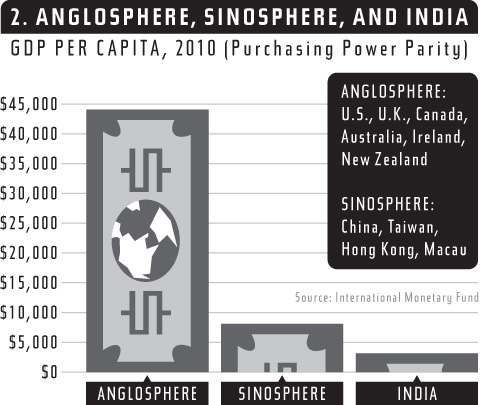
Joel Kotkin and Shashi Parulekar think warnings of the West's decline are greatly exaggerated:

Start with economics. Like Germany in the 1930s or Japan in the 1970s, China has found that centrally directed economic systems can achieve rapid, short-term economic growth—and China’s has indeed been impressive. But over time, the growth record and economic power achieved by the free-market-oriented English-speaking nations remain peerless. A little-noted fact these days is that the Anglosphere is still far and away the world’s largest economic bloc. Overall, it accounts for more than one-quarter of the world’s GDP—more than $18 trillion.

Does Money Corrupt?

A new series of seven studies point to yes:

According to [psychologist Paul Piff], unethical behavior in the study was driven both by greed, which makes people less empathic, and the nature of wealth in a highly stratified society. It insulates people from the consequences of their actions, reduces their need for social connections and fuels feelings of entitlement, all of which become self-reinforcing cultural norms.

Tyler Cowen complicates the study. How Robin Hanson sees the research:

[E]lites excel at hypocrisy. Elites can better distinguish ideals which are mainly given give lip service, from ideals that really matter personally. Elites can better see which laws and social norms are actually enforced with strong penalties, and those that can be violated with impunity. This ability comes in part from implicit cultural learning, and also from just raw IQ. Homo hypocritus is alive and well – having big enough brains to manage hypocrisy well is still a core human capacity, crucial for success in the modern world.

Previous Dish on money's corrupting elements here

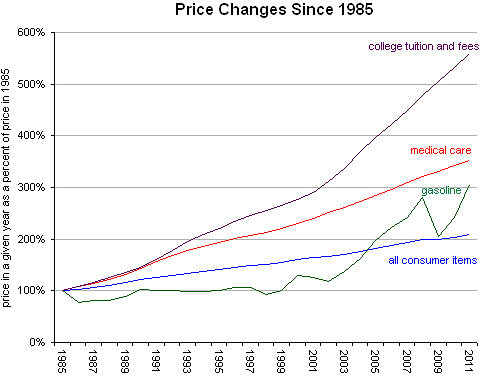
Why Has The Price Of College Nearly Sextupled Since 1985?

College_Prices

Catherine Rampell mostly blames funding cuts, at least when it comes to public schools:

Every recession, states face a budget squeeze as their tax revenue falls and demand for their services rises. They have to cut something, and higher education is often a prime target. Why? Struggling states have to prioritize other mandatory spending, like Medicaid. Higher education usually falls under the "discretionary spending" part of the budget — and in fact is often one of the biggest programs, if not the biggest, in the discretionary category. State legislators also know colleges have other sources of funds to turn to.

Academia Needs More Google, Ctd

A reader writes:

RE: your post about Alan Jacobs' misadventures in searching scholarly databases, Google does in fact support a scholarly journal database: Google Scholar. I have had similar issues with engineering and science databases and have abandoned them for Google Scholar. If Alan had put all that information into Scholar he would have gotten the result he was looking for in the top ten hits. He could have downloaded a citation for major bibliographic software (EndNote, BibTeX, etc.) and at most universities, linked directly to his university's library database and downloaded the PDF. While I'm sure Google and other search engines have a ways to go towards perfecting their search algorithms for scholarly works, I have found using Google Scholar is an easy transition from regular Google searching and a lot less frustrating than your average academic database.

In the comments section, Jacobs recommends a "smart blog post by Margaret Heller on simplifying library database interfaces." Another reader:

I am the Library Director at a small private academic library in Ohio. I also wish that library research databases were simpler to use for our students and faculty. However, I don't think Dr. Jacobs's suggestion to put "greater emphasis…to improve the search tools" is the ultimate or best solution to the current research problem. I know this will sound like being a "bad UI" apologist, but I don't think the solution is as simple as saying "Academia Needs More Google".

1. If you want the Google experience applied to research, then go use Google Scholar. Make sure you set the Library Links option (if you attend or work at an Ohio college or university use OhioLINK) in Scholar Preference settings to be able to access subscription based full-text journal articles paid for by your library.

2. The native JSTOR search interface isn't that bad. Granted, JSTOR's advanced search syntax isn't always intuitive. However, taking five minutes or less to figure it out will save a lot of time and provide better results than using Google.

3. Librarians can encourage EBSCO, Gale, ProQuest, et al to dramatically improve their search interfaces, expose their metadata to Google, or even license Google's search algorithm. However, these research database providers have invested to much of their money in developing their underlying database structure and search interfaces to have much incentive to change and be more like Google. 

4. Those "terrible research database" user interfaces allow you to do a much more precise search. Google gives us good enough results. The clunky research database interface allows the student or faculty member to have greater control over the results returned. 

5. I have a hard time believing that Dr. Jacobs could not access the article knowing the citation. He doesn't provide enough information in the article to fully understand why trying to find the article was such a challenge that an ISSN had to be used.

6. Searching the scholarly literature is only part of the research process. Students and faculty still need to apply human intellect before even going to a search box and relying/expecting an algorithm to do the heavy lifting for them.

Ad War Update: Republican Leaders Are Un-American?

That seems to be the message of a new mailer by Restore Our Future, Romney's Super PAC:
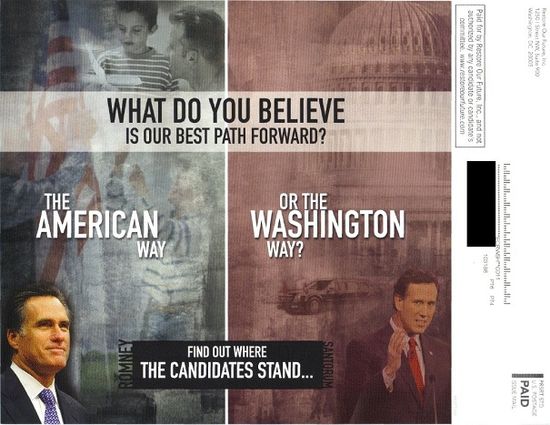
Theamericanway

The ad is being stuffed in mailboxes throughout the South. Alex Burns sees the strategy extending beyond Super Tuesday:

In addition to the multiple mail pieces, ROF has reserved over half a million dollars in airtime for the last week of the Alabama and Mississippi primaries [on March 13]. Those are real resources for Romney’s allies to commit to elections where the former Massachusetts governor isn’t expected to win – and where victory would send a strong signal to the GOP about Romney’s strength in the nomination fight. The Democratic strategist who passed on the mail piece points out that there may be a certain tension between Romney’s task of delivering an anti-DC message and the challenge of consolidating the national party behind his campaign. Asked the source: "I wonder how Jim Talent, Eric Cantor, Tom Coburn, Mike Turner et al feel about Romney allies saying the ‘Washington way’ is un-American?"

Another mailer from Restore Our Future: 
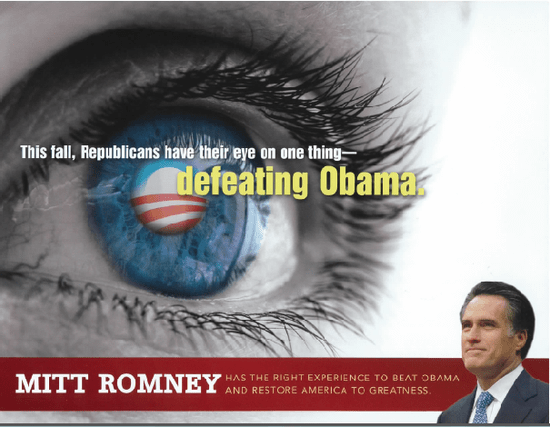
Eyeonobama2

Maggie Haberman is puzzled by Romney's strategy: 

For all the money ROF has spent on the TV air wars, the group has also been prolific in its literature drops, dispatching mail against Newt Gingrich back in the Iowa caucuses days that featured little blue Christmas present bags reminiscent of the Tiffany blue bags that purchases from the high-end store come in. Yet as one Democratic strategist put it, the fact that the group and the Romney campaign are still spending so heavily to best Santorum is "mindboggling," especially when you consider how organization-and-message-hobbled the former Senator has been in his own run.

The Romney campaign is running this GOTV ad in Alaska:

Previous Ad War Updates: Mar 2Mar 1Feb 29Feb 28Feb 27Feb 23Feb 22Feb 21, Feb 17, Feb 16, Feb 15, Feb 14, Feb 13, Feb 9, Feb 8, Feb 7, Feb 6, Feb 3, Feb 2, Feb 1, Jan 30, Jan 29, Jan 27, Jan 26, Jan 25, Jan 24, Jan 22, Jan 20, Jan 19, Jan 18, Jan 17, Jan 16 and Jan 12.
The Daily Wrap

6a00d83451c45669e20163027b09eb970d-550wi

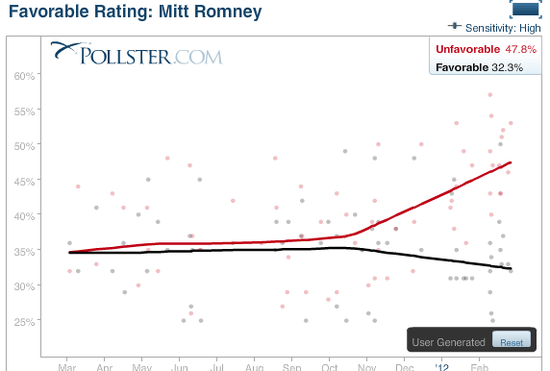
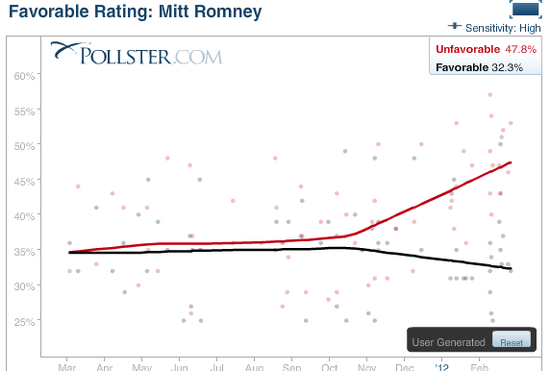
Today on the Dish, Andrew started a "Big Lies of Mitt Romney" feature, pointed out Joe Scarborough's delayed acknowledgement that Andrew was right about the birth control debate, (unfavorably) compared Romney's polling to John Kerry's, and connected Romney's polling slump to the contraception contretemps. We saw the establishment line up behind Mitt, heard Santorum's bankruptcy plea, examined the GOP's viability with independents, and discovered that Republican support among both female and single voters was in jeopardy. We geared up for Super Tuesday (delegate count explained here), Romney seemed poised to win big enough, and Mitt met Mr. Burns.

Andrew also weighed in on the Koch hostile takeover at Cato and kept an eye on the AIPAC conference and prospects for war with Iran – here, here, here, here, and here. Putin blatantly stole Russia's election and Saudi women were banned from Olympic competition. We broke down Dittohead demographics as GOP leaders became suddenly mealy-mouthed, continued the food stamps and soda debate, wondered if abortion could be merciful, and aired a dissent on posthumous baptism. TV joined the Internet age, big corporations loomed, people of the future looked likely to lie to their iPhones, food sensors told you if your dish had gone bad, jeans were amazing technology, and a reporter exposed the sordid reality of online shopping. People remembered faces well but not so much names, Faulkner eulogized Camus, whaling economics were a hot topic, and mixing up routines generated creative results. Marriage depended on monogamy, the art trade was rigged, jury duty was often worthwhile, and the Chevy Volt failed to meet high expectations. Cool Ad Watch here, Malkin Nominee here, AAA here, Quote for the Day here, Hewitt Nominee here, VFYW here, MHB here, and FOTD here

– Z.B.

Can Romney Unite The Party Tomorrow?

Romney_12_Shirt

Maybe, says Weigel:

A Romney source in Tennessee tells me that the campaign's internals have showed the race down to 3 points, with Santorum's lead collapsing. This was what the Romney campaign always wanted and expected. Santorum's wins in the February caucuses were unwelcome surprises. He was able to win voters there by bailing on Nevada and Florida, where Romney was running up his scores. It was Super Tuesday that was supposed to kill the Santorum grassroots campaign, with the live-off-the-land candidate unable to campaign in every state, unable to match Romney's ad spending.

Pete Spiliakos doubts Romney can consolidate the vote:

[W]e might see a third Gingrich surge or a third Santorum surge.  And then another Romney surge.  All of this is going to be accompanied with discontent.  It is like the Republicans have three cartons of rotten milk.  They’ve already taken a taste out of each carton and, on some level, know the milk is bad in all of them.  So they take out a carton, pour a drink, gag, put the carton back in the refrigerator, and take out one of the other two cartons that they’ve already gagged on.  And they keep doing it over and over again.

Caroline Bankoff notes that "the Republican Establishment is indicating a desire to see an end to the current war of attrition." Ryan Lizza questions whether this is best for the party:

Having a presumptive nominee heading into the Convention would allow Republicans to begin their campaign against Obama. But maybe the conventional wisdom is wrong. If Romney is the nominee, many conservatives could feel marginalized, with no recourse other than pleading for a more conservative running mate. The invisible primary failed to produce a consensus choice, and it may actually be to the Party’s advantage to have the actual primaries fail in the same way. If that happens, then a deliberative Convention, where all factions of the G.O.P. have a voice, could be what puts the Republican Party back together.

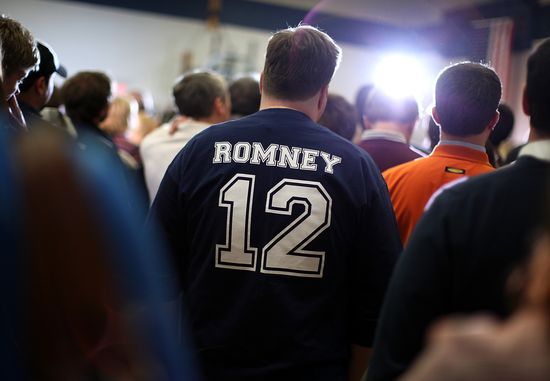
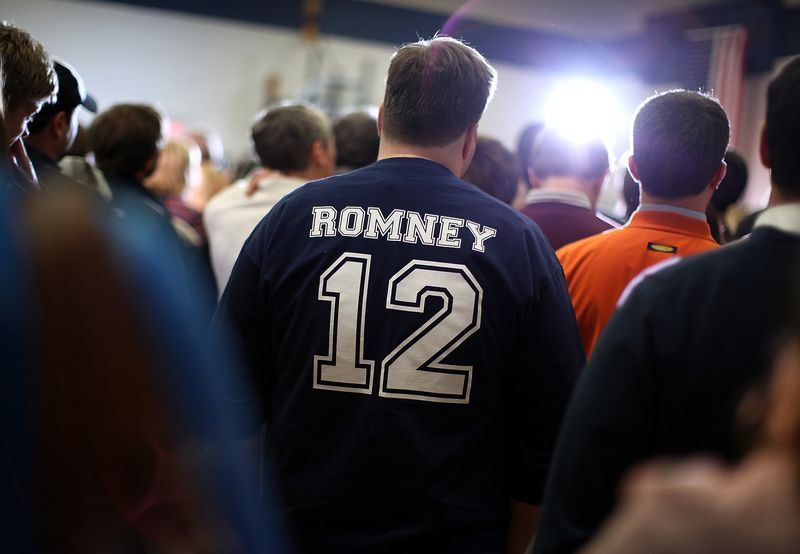
(Photo: A supporter of Republican presidential candidate, former Massachusetts Gov. Mitt Romney wears a campaign shirt during a campaign rally at West Hills Elementary School March 4, 2012 in Knoxville, Tennessee. Mitt Romney is campaigning in Georgia and Tennessee ahead of Super Tuesday. By Justin Sullivan/Getty Images)