"Just because we support legalized prostitution doesn't mean we want to live it," – Cato staffer Jonathan Blanks, on the Koch takeover bid.
Month: March 2012
Malkin Award Nominee
"A 30-year-old poses as a 23-year-old, chooses a Catholic University to attend at $65,000 per year and can not afford ALL the birth control pills she needs… so she wants the US taxpayers to pay for her rampant sexual activity. By all accounts she is banging it five times a day. She sounds more like a prostitute to me. She must have an gyno bill to choke a horse (pun intended). Slut was a softball. Obama calls her and tells Sandra Slut Fluke that her parents should be so proud of her. He’s a pimp," – Pamela Geller.
Should You Be Able To Use Food Stamps On Soda? Ctd
A reader writes:
The whole concept of food stamps is nannyism. The message they send is that the state can’t trust you to even feed yourself if they don’t make you spend the money on food – that if left to your own devices, you’d accidentally spend it all on laundry detergent and then starve the rest of the month, or spend it all on booze or crack or something.
Money is fungible. So if someone gets $300/mo in food stamps, guess what? The money they used to spend on food is now freed up. You haven’t changed their behavior one bit, and possibly even encouraged it since now they have this disposable income that they apparently can’t be trusted to spend wisely.
If you knock junk food off the buy list for food stamps, a lot of people will feel like they’re helping America’s poor. But you know what? They’ll just use the money freed up by the food stamps to buy the food they really want. The only practical effect of rules like this is to make getting in line behind food stamp users a long and painful process as they sort between the food stamp approved items and the cash items. It will have absolutely no effect on people’s eating habits at all, except maybe to free up the cash for even more crap.
I worked at a gas station for a while, and people were allowed to use food stamps on fountain drinks – as long as they hadn’t put a straw in the cup. If they had a straw in their hand or in the pocket, that was fine, but if they put the straw in the drink, we weren’t supposed to let them use food stamps. Ultimately all the rules about how they can spend food stamps are about that pointless.
Another writes:
Food stamp users get on average less than a $1 per meal per month. That’s $3-4 a day. That’s not a lot and not a huge boost in purchasing power. Most food stamp users who buy soda do so not necessarily because they are wasteful or uneducated or looking to work the system, but because soda is all they can really afford to buy on a paltry amount of benefits. If anything, food stamp users are being as EFFICIENT as possible in buying soda.
Until the day when a gallon of milk or fruit juice is cheaper than soda, until the day broccoli is cheaper than Kraft mac n’ cheese, and until the day a pound of meat is cheaper than a can of Chef Boyardee, food stamp users will continue to maximize their benefit by buying the cheapest food products out there. And unfortunately for all of us, non-food stamp users included, the cheapest foods in the market are often times the least healthy for us. There is actually good research out there validating this theory (see work of Adam Drewnowski, Univ of Washington). Restricting benefits to only “healthy foods” will only worsen the food insecurity and poverty so many food stamp users are facing.
Another:
I think it’s helpful to compare food stamps to another government food program: WIC. When I had my first child, my job paid very little and I qualified for the WIC assistance program. The foods that qualify are extremely limited: carrots, cheese, milk, eggs, formula, oatmeal, peanut butter, tuna, and a few other things. All of these foods help ensure the health of the mother and fetus, and later the infant. The cost of the foods is easily made back several times over by preventing health issues and pregnancy complications. Given that people who qualify for food stamps also often qualify for Medicaid, it’s in the government’s interest to ensure those people are eating healthy so they are less likely to develop disease.
Soda and candy eating correlate strongly to increased rates of obesity, diabetes, and many other diseases, and if people choose to eat these things, they should do it on their own dime.
(Photo of a bodega in South Williamsburg, Brooklyn by Clementine Gallot. Explanation of “EBT” here.)
Is Posthumous Baptism Offensive? Ctd
I argued that it's "deeply disrespectful to and invasive of other faiths to be posthumously coopted in this fashion." Dreher differs:
I don’t understand why anybody would care about this. If Mormons were engaged in an act that they believed would bring curses on the souls of my ancestors, or on the living, I would still believe them to be empty rituals, but they would also be overtly hostile acts. However misguided, the Mormons engaged in posthumous baptisms are trying to be kind, according to the dictates of their religion. Everybody chill.
Romney’s Nadir?
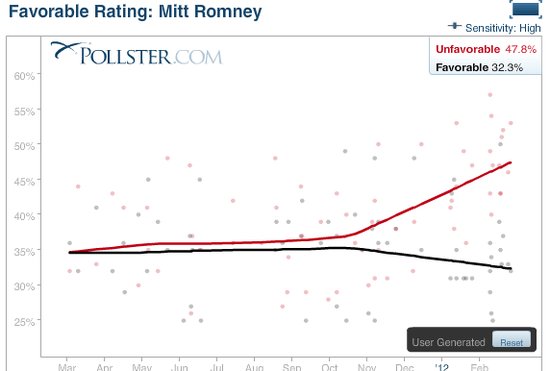
Right now, Obama is winning in all of the swing states against the presumptive GOP nominee, Romney. He's pulled even in Florida, he has a comfy 4 point lead in Virginia (with one recent poll showing him ahead by 17!); his margin in Pennsylvania is growing; it's tied in North Carolina; he's ahead in Ohio. The president's margins over the other GOP nominees is even bigger.
I suspect it's because of the GOP primary campaign exposing the flaws of their candidates and the contraception debate highlighting their reflexive religious fundamentalism. But that could wane if Romney does well tomorrow, stanches the bleeding and somehow manages to unite his party. Working against him is a slowly recovering economy, and high grades for Obama's foreign policy. If Romney had shown any signs of improving as a candidate, as distinguished from getting more endorsements, I'd say he could recover by the summer.
But very few candidates have gone into the general election with the kind of unfavorable numbers Romney now has. Unless there's another Romney under the plastic, they will be hard to shift. I mean: how do you win when half the country doesn't, you know, like you?
Obama At AIPAC, Ctd
My take here. Joe Klein calls Obama's AIPAC speech both "strong" and "flawed":
[Obama] warned against the warmongering toward Iran that has overtaken some of the noisier precincts of the Jewish and evangelical communities. But then he bowed to the AIPAC crowd by saying that “containment” was not his policy with regard to the Iranian nuclear program. This directly contradicted his previous policy–which was that all options were on the table. Containment happens to be the option favored by most non-neocon foreign policy experts; it was a policy that proved a huge success against the Soviet Union, which threatened our national security far more profoundly than Iran does.
M.J. Rosenberg differs:
Both Netanyahu and his lobby wanted Obama to set out "red lines" that, if crossed by Iran, would lead to an American attack on that country. Obama offered no red lines. Yes, he said that the war option was on the table but, contrary to Israel's demands, made clear that it would come into play if, and only if, Iran develops a weapon, not when it develops a weapons "capability" as Israel (and its Congressional acolytes demand).
Walter Russell Mead believes Obama's tough talk is an attempt to keep the peace:
The dirty secret about President Obama’s generally successful effort to put more pressure on Iran through sanctions and diplomatic methods is that in the last resort its effectiveness depends on exactly the military threats that he would like to downplay. If the European countries weren’t terrified that Israel would act unilaterally, they would not have moved nearly as far or as fast as they have to isolate Iran. Isolating Iran, they hope, will calm Israel down enough so as to postpone or perhaps avoid the danger of war. If that threat disappeared, President Obama would not enjoy the kind of support for sanctions he has so far received.
When Is Abortion Merciful?
Emily Rapp, a mother whose two-year-old son with Tay-Sachs is dying slowly and painfully in front of her eyes, shares her anguish:
I'm so grateful that Ronan is my child. I also wish he'd never been born; no person should suffer in this way—daily seizures, blindness, lack of movement, inability to swallow, a devastated brain—with no hope for a cure. Both of these statements are categorically true; neither one is mutually exclusive.
Bonnie Rochman, who wrote about Rapp last year, draws a distinction:
For sure, there is a huge difference between aborting a child who has no chance of survival and a dreadful quality of life in his shortened months on earth and a child with Down syndrome, who — depending on his abilities — can learn to read, to ride a bike, to live alone. Children with Down syndrome born today live, on average, until the age of 60; children with Tay-Sachs don’t reach kindergarten. Even if they lived that long, they are fundamentally brain-damaged, incapable of practicing their ABCs or coloring in the lines. Is ending one type of pregnancy wrong and another right?
To read more than a dozen stories of expecting parents facing horrific diagnoses and the prospect of late-term abortion, see the Dish's "It's So Personal" series.
From Putin, With Fraud
Julia Ioffe reports on the truly massive voter fraud she observed in the presidential vote that overwhelmingly swept Putin back to power:
Moscow was flooded with news of violations in the city. In part, they were the result of more eyes. In many cases, the violations were so blatant that no pair of eyes could miss them. Instead of limiting themselves to the quiet tricks they've used before — stuffing ballot boxes before the voting begins, pressuring people at work to vote for Putin, fudging the numbers on the election protocols after the election monitors have gone home — whoever was in charge of the operation almost seemed to have made a conscious decision to go flagrant.
Mark Adomanis compiles competing dispatches on the scale of the fraud. David Dayen looks forward:
This has pierced the aura of invincibility around Putin. But in many ways, the election was a prelude. Now comes the question of how Putin, ensconced in power for the next six years, will react to protests. The Kremlin gave permission for demonstrations on Monday and Tuesday. Beyond that, the future is uncertain. Moscow saw an extra 6,500 police officers on the streets over the weekend. And at some point, Putin may order a crackdown. He basically ran the election against shadowy outside forces, unnamed, who sought to determine the course of Russia. You can easily see how Putin could connect those outside forces to the protesters in the mind of the public.
Walter Russell Mead and Jackson Diehl both see a severly, if not fatally, compromised Putin post-"election." Owen Matthews and Anna Nemtsova make related points:
The inherent problem of authoritarian systems is that loyalty to the great leader is absolute—until suddenly a new great leader rises, at which point there’s a stampede for the exits. Putin isn’t at that point yet—he has been challenged by society, but not yet by an individual pretender to the throne. But his immediate task is to reassure his supporters that he is still top dog. The problem is how, and with what money. For much of his first two terms in power Putin presided over a massive rise in global commodities prices that flooded Kremlin coffers with a tsunami of free money. But suddenly, just when Putin needs it most, that tide of money is receding. In 2007 Russia’s federal budget balanced with oil prices at $29 a barrel; in 2012 oil needs to stay at $130 to avoid a deficit and fund Putin’s $160 billion in election spending promises.
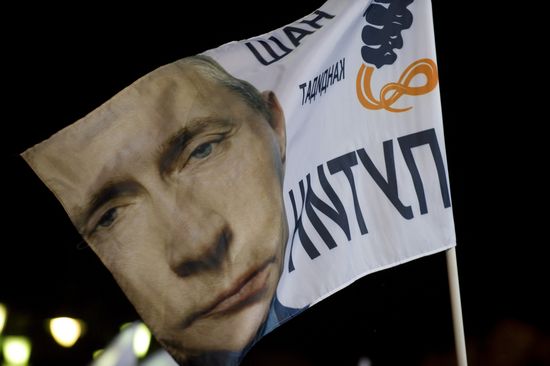
(Photo: A supporter of Russian Prime Minister Vladimir Putin waves a flag featuring a portrait of Putin during a victory rally in Moscow March 4, 2012. Allegations of multiple voting and ballot stuffing took the shine off Vladimir Putin's victory in presidential elections, with some in the opposition saying the whole process was illegitimate. By John Macdougall/AFP/Getty Images)
Who Listens To Limbaugh?
Nathan Pippenger breaks down Rush's 15 million devotees:
80 percent of Limbaugh’s listeners identified themselves as "conservative," compared to 35 percent of the total U.S. population. About three-quarters of his listeners are NRA supporters, compared to 40 percent of all Americans. The same proportion identify themselves as Tea Partiers and Christian Conservatives. Why do they listen to Limbaugh? In one survey, 37 percent said they tune in for opinion, but another 28 percent say they enjoy the blend of news, opinion, and entertainment. Among Republicans, 13 percent say they tune in to Limbaugh "regularly." There’s one more interesting number to keep in mind, and after the events of [last] week, it will hardly come as a surprise: According to a 2009 survey, only 28 percent of Limbaugh’s audience is female—a smaller proportion than any other news source included in the questionnaire.
AIPAC Backs Israel’s Netanyahu Over US President Obama
Unsurprising. But it's rare that the leader of an American lobby actively supports a foreign prime minister against its own president on a critical foreign policy dispute.
 The Dish