Der Spiegel just ran a fascinating profile of Moritz Pfeiffer, a German historian who, in 2005, interviewed his grandmother and Wehrmacht-veteran grandfather about their war experiences. He then spent the next 7 years matching their testimonies against the historical record. Describing his grandmother as both "loving [and] kind" and a "committed, almost fanatical Nazi," he judges his grandparents to have been gripped by
A state of emotional coldness, a lack of self-criticism and absolute egotism combined with a strong deficit of moral judgment as well as the support, acceptance and justification of cruelty when the enemy was affected by it…It was a necessary human reaction.
The history Pfeiffer is grappling with only took place 70 years ago, a blink measured by reference to the long run of human history. Many suggest this means we're only another blink away from something similar; that people like Pfeiffer's grandparents are principally shaped by the events and institutions that surround them, and, hence, liberalism and the cessation of Holocaust-like violence against civilians that travels with it can only survive until the next great historical upheaval.
I think they're wrong. Liberal democracy, by virtue of its peculiar emphasis on individual freedom, is perhaps the only political system in history to be directly responsive to changes in the people it governs. Because liberalism is so capable of adapting to shifting human needs and goals, its global ascendance is far more durable than historical determinists would have you think.
The determinist argument goes something like this: Our currently unprecedented run of peaceful, democratic self-determination is dependent on certain contingent features of our world, like the distribution of political power. While the "ordinary German" today might be a committed liberal, the "ordinary German" in 1937 was willing to accept Nazi rule. Since the only thing history has shown is that no political regime lasts forever, it's more than likely the current distribution of power will change. The era of liberal democracy and coterminous peace will melt away as surely as the Roman or British Empires, likely due to events we can't well predict.
But there's a disconnect in there. The fact that people respond to the circumstances they find themselves in doesn't mean that people must respond principally to political circumstances. Indeed, the basic plasticity of humans is responsible not only for our political choices, but also for shaping our non-political identities. Circumstances also helped determine the fact that some people want nothing more than to open a coffee shop, raise a family, pray to Jesus, or play the oboe. What a person values the most, in terms of their own life goals and ambitions, is the most important determinant of their attitudes and actions toward the broader world.
The basic human commitment to individual own life-projects ought to give us hope for liberalism's durability. The foundational liberal creed is that, in all spheres of life, each person should be able to pursue whatever it is they most value. The function of political rights, be they political, social or economic, is to ensure that citizens are free to pursue their vision of the good life absent coercion. In this sense, the basic system is near-infinitely adaptable: cultural norms or sub-state shifts in attitudes, like the increasing moral convergance in favor of marriage equality, are never a threat to the state so long as they don't demand coercion of other citizens. Liberalism is, in essence, a plastic political system for a plastic species.
This feature of liberalism explains why liberal democracies, so far, tend not to be replaced once consolidated. So long as people are allowed to pursue their own life-plans with a minimal amount of state interference, no one has any reason to mount a serious challenge to the state proper. Anger over specific events, like poor economic performance or wars, is sated by voting out the party deemed responsible. Humanity's stubborn malleability, rather than threatening the political status quo as it has in the past, is well accounted for by liberal political institutions in a way that can't be replicated by, say, Chinese authoritarian capitalism.
It doesn't follow from this that liberalism is inevitably going to spread globally or that it's impossible to overthrow a liberal state once it's consolidated. History hasn't stopped. Rather, I'm suggesting that getting beyond liberal democracy is going to take something over and above what has previously overthrown many political orders: the fact that global institutions have changed in the past doesn't mean that they will in the future. The point is strengthened by multiple features of the modern world. For example, massive wars of conquest, that oh-so-potent source of global transformation in the past, seem peculiarly unlikely in the modern world for reasons that both do and don't relate to democratic governance.
Which brings us back to Pfeiffer. He's chosen to orient his life around uncovering painful truth for many Germans. That his project is not only tolerated, but celebrated, speaks volumes about the ability of liberal polities to react to changing times – and the fact that we're lucky to live when we do.
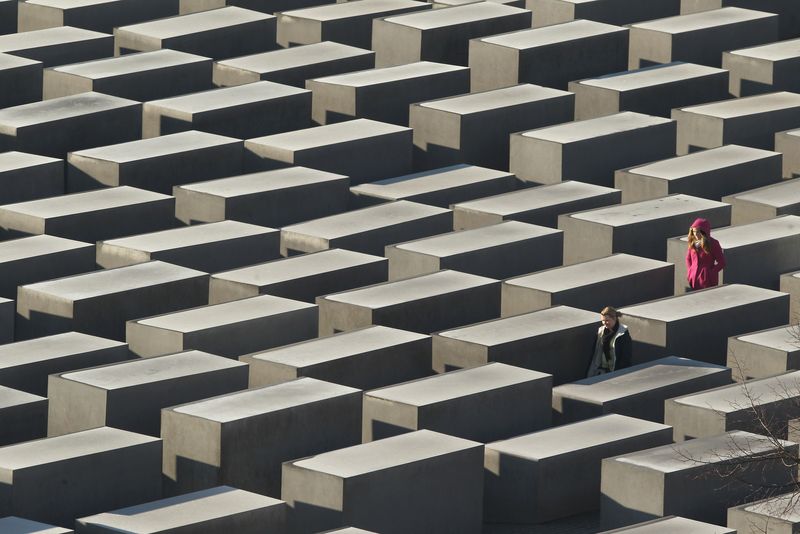
(Photo: Visitors walk among stellae at the Memorial to the Murdered Jews of Europe, also called the Holocaust Memorial, on January 26, 2012 in Berlin, Germany. Germany observed Holocaust Memorial Day on January 27 to commemorate the 6 million Jews and other victims murdered by the Nazis in the Holocaust. By Sean Gallup/Getty Images.)
 The Dish