by Zoë Pollock
Alain de Botton explains why he thinks it's dangerous:
For a start, there is the danger of individualism: of placing the human being at the center stage of everything. Secondly, there is the danger of technological perfectionism; of believing that science and technology can overcome all human problems, that it is just a matter of time before scientists have cured us of the human condition. Thirdly, without God, it is easier to lose perspective: to see our own times as everything, to forget the brevity of the present moment and to cease to appreciate (in a good way) the miniscule nature of our own achievements.
But he believes we can be the masters of our own morality:
An adequate evolution of morality from superstition to reason should mean recognising ourselves as the authors of our own moral commandments. We don’t need a central structure. We are beyond the age of gurus and inspirational leaders. We are in the age of the Wiki structure. This means that it is up to all of us to look at religion and see what bits we can steal and place into the modern world.
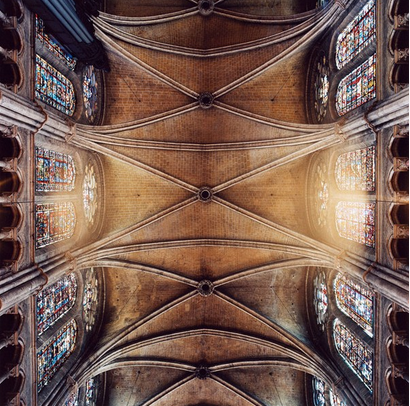
(Photo: "Nave, Chartres Cathedral, Chartres, France, 2006" by David Stephenson, from his series of church vaults. Courtesy of David Stephenson and Julie Saul Gallery, New York.)
 The Dish