Readers keep the thread going:
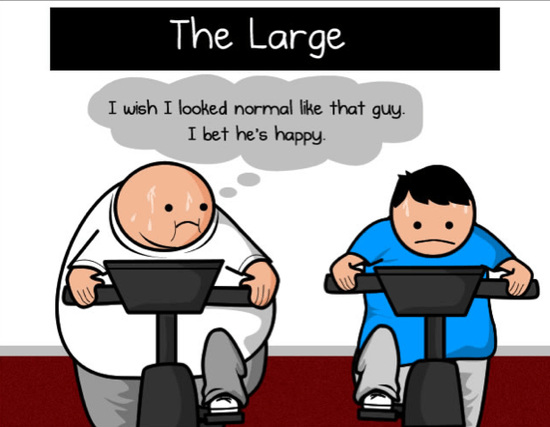
In response to your reader who says obese people can't go to the gym due to body-shaming, she needs to 1) find another gym, 2) find a different personal trainer, and 3) get a better exercise bra. I used to avoid the gym because I assumed I'd be looked down upon or mocked because I'm overweight.
But In my late 20s I realized that was a moronic reason to not get healthier, and hired a personal trainer to help me get better adjusted with the environment. What I found was that absolutely no one cared about me at the gym at all. No one paid attention to me because they were all wrapped up in their own exercise routines or admiring themselves in the mirror, or listening intently to their headphones or the TVs mounted on the wall. No one gives a damn about my big ass. The idea that fat-shaming happens at gyms is 95% in the heads of of those fearing the gym.
And don't use your boobs as an excuse. I am a similar size and my life was changed by finding a sturdy underwire exercise bra. Go to a proper lingerie store that can give you something better than you can find at Target. I can do jumping jacks until the cows come home without an ounce of discomfort.
If your personal trainer didn't suggest such a thing to do, or response to your concerns with some sensitivity, you found a crappy personal trainer. There are better ones out there – plenty that used to be obese, too, and got over their fears to improve their health. Talk to several before committing to a workout, and if it doesn't work out after one or two sessions, find another one. Trainers I've worked out with in the past have been, to a person, excited for me to be taking strides in improving my health and driven to find out what kind of exercise works best for me in terms of results and enjoyment. The ones I've worked with have trained people of all weight levels, age levels, and physical ability – they're not jocks looking to train more jocks.
While I still sometimes find myself uneasy at the gym, I realize it's because I'm body-shaming myself if I've gotten off track – disappointed my stretch pants are tighter than they used to be, or that a workout that was easy a year ago has gotten hard because I got off track and got lazy. It's never been because of other gym-goers or staff.
Another writes:
If it's gym intimidation that is keeping one from getting into shape, may I recommend working out at home? There are plenty of home video exercise programs, many of which are incredibly effective. I don't wish to plug a specific program, but I've been doing the P90X programs at home, and am in the best shape of my life. Granted, my gym trips were pretty aimless – I'd run a little, lift weights at random – and P90X is a highly-regimented training program (which one can combine with a nutrition plan for better effect), so I benefitted immensely from the detailed direction the program offers. But no more gyms for me – P90 is more efficient, and in the long run, less expensive (all I really need is a pull-up bar and a set of dumbbells or resistance bands).
Another:
If watching "The Biggest Loser" has taught me anything, it's that overweight people are (mostly) overweight because of emotional issues like insecurity and depression. I've read that people who succeed in losing weight through exercise are prone to relapse and put the weight back on. It seems to me that if you don't address the underlying emotional issues, diet and exercise are going to be temporary measures at best. I think it's obvious to extrapolate from there that a person with insecurities about their weight is going to have a hard time going to the gym, and might even do more damage to their mental state when they fail to achieve their gym goals.
On a slight tangent, I turned 30 last year and for the first time in my life dropped the puppy fat I'd been carrying around since college. I did it by using medical pot to stabilize my emotional state, which helped me stop shoveling burgers and pizza into my face every night (kind of counterintuitive for those familiar with the munchies, but it worked for me). I went from ~2500 calories per day and binges of 5000+ on weekends to around ~1800 per day, which, with my office worker no exercise lifestyle, is just a bit less than I needed. 12 months later I had lost 6 inches off my waistline and my self confidence skyrocketed to the point that I no longer need the pot to regulate my appetite. It cost about the same as a gym but was (believe me) a great deal more enjoyable and easier than previous failed attempts to run it off on a treadmill.
One more:
Losing weight is 80% watching your caloric intake. If reaching a certain number is your only goal, you don't even need to go the gym. However, losing weight should never be the only goal; losing weight should only be a corollary of the true goal.
Being thin does not in any way equate with being healthy. There's tons of people who look like they are in better shape than me who I would annihilate in a one-mile race, or a pushup contest, or long distance cycling, or whatever. When I applied for life insurance, the nurse took my blood pressure three times because she couldn't believe how low it was. There's plenty of thin people who dropped dead from heart attacks because they think that being thin means they don't have to worry about blood pressure or cholesterol. This is simply not true. Genuine health is something that your body fat level has surprisingly little to do with. Better a chunky mountain biker than a slender couch potato.
The goal should be to achieve genuine health, and concerns about hitting a particular number on the scale should be a secondary goal. It's this mindset that weight is the sole measure of health that makes people think of exercise and diet as unpleasant tools to be discarded at the first opportunity rather than a necessary part of a whole and happy life. The gym is to health what the church is to spirituality; it's a place that is not strictly necessary, but helpful if used properly.
This has to be a lifetime thing. You can never stop. If you are still thinking that exercise and nutrition are things you do until you fit in the bikini, you are doomed. It should be viewed as a permanent lifestyle change, like changing religions or having kids.
(Image: From an eight-panel cartoon from The Oatmeal titled "At the gym: who is looking at whom")
 The Dish