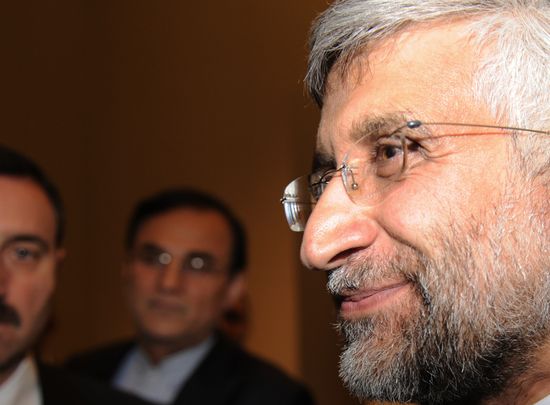
What if the talks with Iran actually reach a serious deal? Ignatius thinks it's possible:
The mechanics of an eventual settlement are clear enough after Saturday’s first session in Istanbul: Iran would agree to stop enriching uranium to the 20 percent level and to halt work at an underground facility near Qom built for higher enrichment. Iran would export its stockpile of highly enriched uranium for final processing to 20 percent, for use in medical isotopes.
In the language of these talks, the Iranians could describe their actions not as concessions to the West but as “confidence-building” measures, aimed at demonstrating the seriousness of Supreme Leader Ali Khamenei’s public pledge in February not to commit the “grave sin” of building a nuclear weapon. And the West would describe its easing of sanctions not as a climb down but as “reciprocity.”
Khamenei's "grave sin" statement was noticed by the Obama administration – and may be used as a way for Tehran to climb down without losing face. Here's the statement:
“The Iranian nation has never pursued and will never pursue nuclear weapons . . . because the Islamic Republic, logically, religiously and theoretically, considers the possession of nuclear weapons a grave sin and believes the proliferation of such weapons is senseless, destructive and dangerous.”
Khamenei could tell his people: we never wanted nuclear weapons, and now I have averted the dreaded "Zionist entity" from attacking our peaceful nuclear program by a deal with the major world powers. The accommodating line from Tehran is still audible:
In an interview Monday with the Iranian student news agency, Foreign Minister Ali Akbar Salehi explained that “making 20 percent fuel is our right,” but that “if they guarantee that they will provide us with the different levels of enriched fuel that we need, then that would be another issue.”
For me, the key test is full IAEA access to all nuclear sites identified as potentially covert military programs. All of this could be done in confidence-building stages. The trouble, of course, is that the Netanyahu-Romney axis could try to derail this, as Fareed worries. Netanyahu is still grotesquely comparing the Iranian nuclear program to Auschwitz. And his disturbed and dangerous psyche could mesh with Romney's goal of running a Cheneyesque GOP campaign on defense: hulk go smash. But this paradoxically could help make a deal possible. Obama is Tehran's best hope for a suspension of threatened European sanctions this summer, and Netanyahu's crazed Holocaust obsession and Romney's foreign policy crudeness would be the alternative. That's the final leverage for the great powers to use to persuade the Iranians that it is now or never.
So we are reaching what is clearly a moment of truth for Obama's Iran policy. So far, I'd argue, it has all the ingredients of success, has been a real diplomatic feather in the cap for the administration and, if it reaches a serious deal, will represent a real coup for Obama abroad. He will have ended torture, finished the war in Iraq, destroyed al Qaeda, killed bin Laden and resolved the Iran question. An Iran deal would also show how exactly Obama's long game can work, if given time.
Know hope.
(Photo: Iran's chief nuclear negotiator Said Jalili leaves after a press conference, on April 14, 2012 as Iran and six world powers open talks on Tehran's disputed nuclear programme in Istanbul. By Bulent Kilic/AFP/Getty Images.)
 The Dish