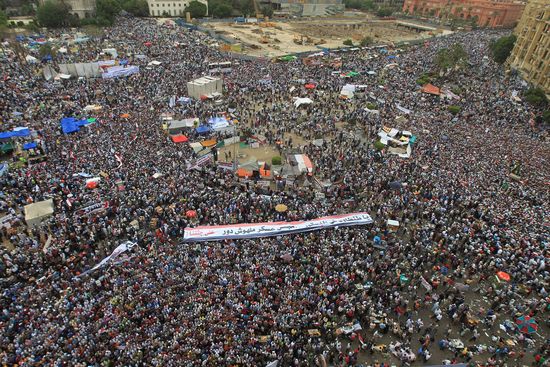
Yesterday brought massive protests against military rule. Thanassis Cambanis worries about another sort of threat:
Who decided to disqualify three presidential front-runners? Who shut down the constitutional process that had been convened, however poorly, by the freely and fairly elected parliament? On what grounds? In both instances, a group of essentially anonymous and unaccountable bureaucrats radically transformed the political landscape, citing reasons at best opaque and at worst nonsensical, deploying jargon and legalese to set the parameters of Egypt’s future state. We have no idea, really, who these officials are, whose interests they serve, whether they are acting in good faith, as independent decision-makers, or at someone else’s behest.
Mahmoud Salem focuses on the weakness of the Egyptian press:
The press became a battlefield of conflicting false accounts and exaggerations, truth was the first casualty, and all credibility went out of the window. We suddenly lived in a Huxley-ian world where there was no truth, only narrative, and the people got flooded with such conflicting information that they either believed what they wanted to believe (whether it was "The revolutionaries are foreign agents" or "Mubarak still rules us"), or tuned out completely from the entire process and stopped paying attention to any of the current events or caring about their outcome.
Walter Russell Mead is glum.
(Photo: Egyptians hold a huge national flag bearing a slogan that read in Arabic 'Hey Tantawi, the army has no role in the constitution' as thousands rally in Cairo's Tahrir Square on April 20, 2012 to protest against the ruling military and hold-overs from the former ruling government ahead of the presidential election to be held at the end of May. By Khaled Desouki/AFP/Getty Images.)
 The Dish